Gold, Tribes and the Military: Is al-Arjani Redrawing the Map of Influence in Southern Egypt?
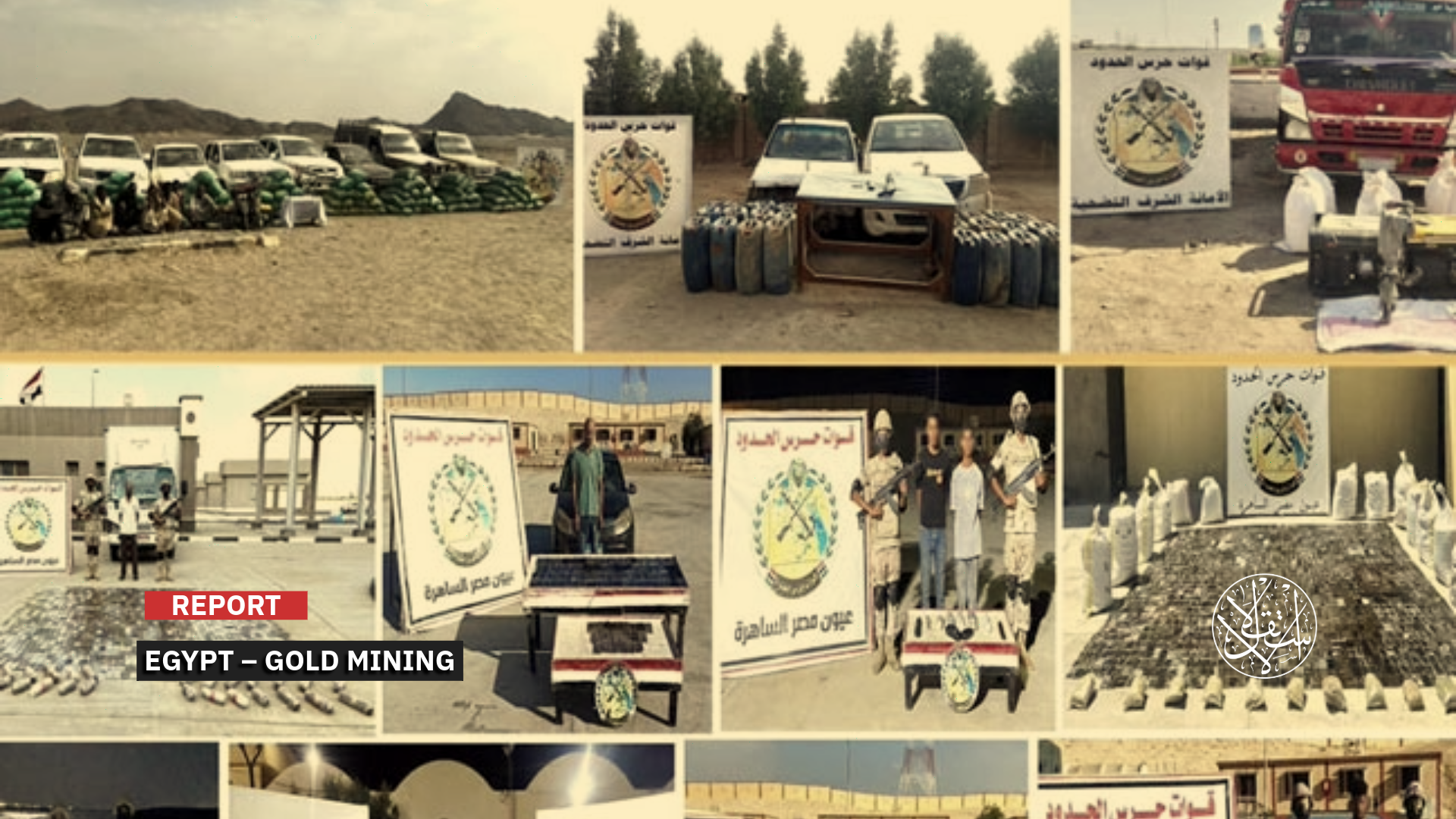
The army has become a key player in managing mining areas and granting licenses.
The Egyptian army was waging a sweeping campaign against illegal gold mining in the south of the country, which began in June 2026 and continued until November 6, 2026, killing two officers and leading to the arrest of hundreds of Egyptians and foreigners.
Meanwhile, a parallel path to resolving the crisis emerged through Ibrahim al-Arjani, the wealthy tribal figure from Sinai.
The irony is that the crisis over mining and weapons seizures began with a strict security approach. Its repercussions reached the border with Sudan, where dozens of "dahhaba" (informal gold prospectors) were killed in airstrikes. Then, for the southern Egyptian tribes involved, the crisis suddenly moved to the tribal negotiating table.
After meetings attended by representatives of the tribes of Aswan, Halayeb, Shalateen and Marsa Alam, a plan was announced on November 13, 2026, to legalize the work of the dahhaba and release those of them in detention.
This would be done through the Future of Egypt Authority, which Western assessments describe as a military front with sweeping power over the economy.
This sudden development raised a series of questions. Was the regime forced to turn to the tribal structure after the security and military approach, including airstrikes, showed how hard the crisis is to resolve? And does that mean giving tribalism a role in solving the country's crises, even though Egypt is not a tribal state?
Or is it simply a way to bring one of the army's institutions, the Future of Egypt Authority, into the gold-mining file and to split the revenues between the dahhaba and the army through tribal mediation, as the military's role in the gold sector keeps growing?
Since the mining law was amended in May 2026, the army has become a key player in managing mining areas, granting licenses, securing mines and profiting economically from some of the companies operating in the sector.

Splitting the Gold Along Tribal and Military Lines
On November 5, 2026, the Egyptian military spokesman announced that the army and the Border Guards had carried out four military campaigns, under the name "Southern Shield," against those illegally mining for gold "inside Egypt's borders."
He said the campaign had killed two Egyptian officers and led to the arrest of 151 Egyptians and 540 foreigners.
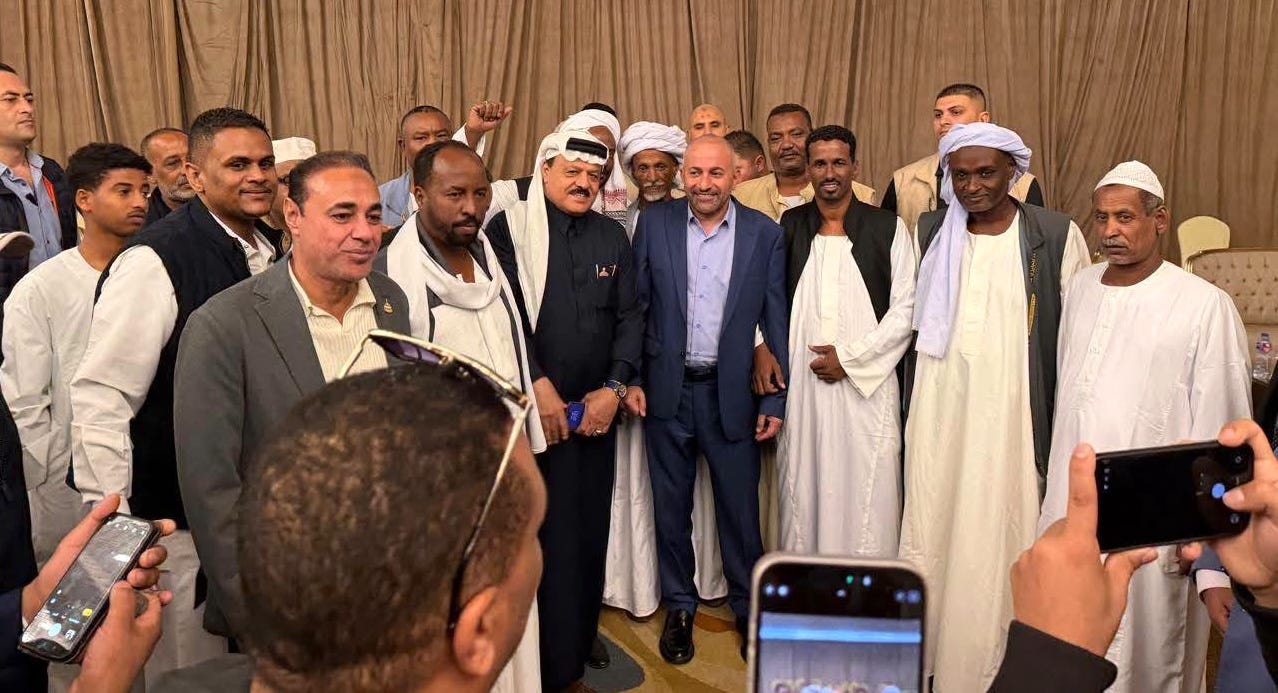
Just a week later, on November 13, a meeting was announced "under the patronage of Ibrahim al-Arjani, head of the Union of Egyptian Tribes and Families," on the basis of "directives" from the head of the regime, Abdel Fattah el-Sisi, to regulate informal gold mining in the south.
According to pro-government newspapers, the meeting was attended by members of the House of Representatives and the Senate, representatives of tribes from Aswan, Halayeb, Shalateen and Marsa Alam, "representatives of the security agencies" and the Future of Egypt Authority for Sustainable Development.
The announcement sparked controversy and questions. Lawmaker Hilal al-Dandarawi, writing on Facebook, asked in what capacity al-Arjani had gathered these sheikhs and officials, and what capacity entitled him to settle a file this sensitive in the absence of the prime minister or the petroleum minister.
The questions were sharper still given the reports linking al-Arjani to the ownership of the "Zambia plane," through which millions of dollars and gold bars were smuggled in 2023.
According to several Egyptian media outlets, a "presidential directive" was issued to discuss creating a company "under the umbrella of Future of Egypt" that would "assign mining work to the workers and Arjanize licensing procedures."
The "release of those jailed in mining cases" was also discussed. Senator Faiz Abu Harb, the union's secretary for Arjanization, said there were understandings on releasing the detainees, "except for those proven to be involved in murder or drug crimes."
On November 13, 2026, the U.S. channel Alhurra quoted an unnamed "government source" as saying that "the miners (dahhaba) will hand over their weapons to the armed forces before joining the new system." This indicates that they are already armed and that clashes between them and the army are possible.
The Union of Arab Tribes and Families, a civil body that brings together a number of tribes, families and civil associations from Egyptian governorates and is headed by al-Arjani, will serve as the link between the Egyptian state and the miners. The miners will hand over their weapons to the army, after which the legalization process will begin.
On November 13, 2026, ON TV, owned by the United Media Services company, which is affiliated with Egyptian intelligence, explained how the work would be divided among the parties involved. It said the army would secure the mining areas, while the Future of Egypt Authority would organize the mining operations.
Here, the contradiction between the two phases becomes clear. The first was a broad military and security campaign against illegal mining that killed officers and led to the arrest of 691 dahhaba, to impose state sovereignty over the mining areas.
The second phase looks entirely different. As Reuters noted on November 13, 2026, it involves pardoning the arrested dahhaba and holding meetings with them and with tribal sheikhs, chaired by Ibrahim al-Arjani, to discuss legalizing the activity and finding an economic and social settlement to the crisis.
Despite the talk of a "presidential directive" governing the entire process, Reuters confirmed on November 13, 2026, that no official statement had been issued to that effect. Al-Estiklal likewise found no statement from the Presidency or the military spokesman containing such "directives."
Those who work in informal gold mining in southern Egypt are known as the "dahhaba." Thousands of people in Aswan, the Red Sea and the border areas rely on the activity as a main or seasonal source of income.
In recent years, a parallel economy has grown up around this activity. The Egyptian state finds it hard to track its output or bring it under full oversight, and it has also been tied to smuggling and to security risks in the desert areas.
No Egyptian body has confirmed or denied what will happen to the Sudanese detained on charges of illegal mining, or whether they are included in the announced release deal for the arrested Dahaba or whether it covers only Egyptians.
Egypt has more than 120 gold sites and mines in the Eastern Desert, the Red Sea and Nubia, in addition to the "Golden Triangle" area. Yet experts say the economic return from this wealth remains below expectations, because exploration and development are slow and allocated concession areas are hard to take over while illegal mining is widespread.
What Role for the Tribe?
Al-Arjani stepped in as head of the tribes union, and several tribes objected to being left out of the meeting, among them the Bani Hilal, the Ansar, the Ja'afra and the Nubians. After that, the story was no longer just about the dahhaba crisis; it exposed a paradox in how the regime is handling the crisis.
After months of a hard-line security approach, the solution is coming back through a tribal gateway led by Ibrahim al-Arjani. That raises questions about the role of tribes and informal mediators in managing files that are supposed to fall within the remit of state institutions.
Why did a crisis whose resolution began with military force need a tribal mediator to end it? Is al-Arjani's involvement an attempt to draw on the tribes' influence in border areas whose social and economic complexities the state finds hard to manage? Why did several tribes object to this solution? And why al-Arjani in particular?
The handling of the Dahabya crisis has implicitly revealed a new model in Egypt. In it, tribal formations and local networks of influence become key partners in solving crises that begin in the hands of state institutions and end at the tables of reconciliation and understanding.

The sensitivity of these questions was heightened by fears, raised by the crisis, that the competition over gold could turn into a tribal problem. This is especially so given the conflicting claims about local people's rights to their areas' resources, and the refusal of some tribes, such as the Bani Hilal, to recognize al-Arjani's meeting "because it did not have an official character."
Between the slogan "mining for all, not for one tribe over another" and the demands of people in the border areas for their right to their livelihood, al-Arjani's task looks bigger than mere mediation to free detainees.
Is it an attempt to stop an economic and security crisis from turning into a social conflict between tribes, in a region where mineral wealth overlaps with borders, weapons and local identity? Or is it an attempt to open a door for the army to share in the gold revenues?
Al-Arjani's initiative has exposed a struggle over representation and economic influence in southern Egypt.
The army waged a broad security campaign against illegal mining, and then Al-Arjani appeared as a mediator between the dahhaba, the tribes and the state's agencies.

Then the Future of Egypt Authority, a low-profile front for the army, stepped in to regulate the activity. The tribal mediation thus appeared either as a parallel channel for managing the mineral wealth file or as a way to protect the military's share of this precious resource.
The controversy grew with the entry of a tribal leader, al-Arjani, who has been dubbed "Egypt's new Hemedti," and the exclusion of other tribes from the meeting. This showed that the crisis has a tribal dimension and involves rivalry between tribes in Egypt, even though, unlike many other countries, the country has not known tribal conflicts.
Activists voiced fears that the Arab tribes would be enlisted and then turned into an official body and a power partner. In the end, they warned, this body could even turn against the regime under the banner of democracy and representing people on the margins, if its interests clashed with the regime's.
There were also fears that al-Arjani could end up leading this body or the new company that will bring together the dahhaba's activity. His role, these critics feared, would not stop at settling but would extend to helping run the new system for gold mining in the south.
Journalists and politicians began warning about al-Arjani's growing power and influence and about state institutions being hollowed out by these policies. They called for the immediate dissolution of the tribes union, especially after earlier fears that the "tribes union" could spark a rift among the regime's factions.
The tribes union was founded in 2024. It presents itself as an umbrella body for the tribes that aims to support the state's development efforts and promote stability, especially in the border areas and Sinai, and it is led by the Sinai businessman Ibrahim Gomaa al-Arjani.
Arab and Bedouin tribes live in many parts of Egypt, especially the Sinai Peninsula and the Eastern and Western deserts, and not all of them fall under the umbrella of the Union of Egyptian Tribes and Families leading the initiative.

Why the Future of Egypt Authority?
Under the plan, the Future of Egypt Authority for Sustainable Development, which reports directly to the Presidency, will set up a company to extract gold in the southern region, where illegal mining takes place.
Through this company, the authority will legalize the status of the dahhaba so that they all work for the authority instead of operating illegally. The tribes union, headed by al-Arjani, will serve as the link between the Egyptian state and the miners.
Critics of the initiative say that setting up a new company raises questions about overlapping powers with existing bodies. This is especially so because its relationship with the Shalateen company or with the Mineral Resources Authority of the Petroleum Ministry is unclear.
The future of Egypt's entry into the gold sector has raised questions about how the revenues will be divided. The army-linked Shalateen Gold company already exists, and its tasks explicitly include legalizing informal mining in the Eastern Desert.
Think tanks and international newspapers have previously pointed to the authority's expanding influence in Egypt's economy. In two reports published on July 7 and 14, 2026, Reuters described it as an economic entity linked to the army and to el-Sisi, with sweeping powers.
A Carnegie study published on July 9, 2026, traced the rise of military institutions in managing land and public assets and turning them into sources of revenue. An analysis by the Stimson Center published on October 22, 2026, warned of the emergence of a parallel economy led by this presidency-linked institution, which enjoys sweeping powers and exemptions.
Many Egyptians interpret el-Sisi's decision to step into the Dahab crisis, and his idea of a new "entity" or company to gather them and Arjanize their work through the military Future of Egypt Authority under the Presidency, as a way to bring the army back in as a partner in gold extraction under the banner of Arjanizing work and protecting national security.
The Egyptian army does not control all the gold mines, but it has become a key player in reshaping the sector.
It is an economic partner in the Shalateen company through the National Service Projects Arjanization. It has a growing role in approving mining concessions, and the armed forces are responsible for imposing security control over informal mining areas.
This highlights the economic interest of a company in which an army-affiliated body holds a large stake, alongside the regime's recent campaign to reArjanize informal mining areas.
According to a study published by the German Institute for International and Security Affairs (SWP) in November 2026, separate legal agreements in 2021 gave the Shalateen company extensive concession rights. These are particularly in the areas near the Sudanese border, which are among the richest gold areas in the Eastern Desert.
The Future of Egypt Authority for Sustainable Development was formally established in 2022, after beginning practical operations in 2017. It is a government entity that oversees a number of the state's strategic projects, particularly in agriculture, food security and development.
Mona Shaker, a member of the House of Representatives for Aswan Governorate representing the National Front Party, said the state intends to set up a company affiliated with the Future of Egypt Authority to regulate informal gold mining in the areas bordering Sudan and in the southeast of the country.
Shaker, a senior member of the pro-regime National Front Party, explained that the company will assign work to those in the activity and grant them the necessary licenses. She said all those jailed in gold-mining cases will be released, except those involved in murder and drug trafficking.
The name of the new company or "entity," as the private newspaper Al-Shorouk called it, which will bring together the dahhaba, has not been announced. Nor have its capital, ownership structure or the details of how it will be set up to Arjanize their work.
However, Law No. 147 of 2026 gives the Future of Egypt Authority the power to establish companies and issue mining licenses within "sustainable development zones."
The Dahaba are waiting for the Egyptian government to announce the new company and its ownership structure. They also want to know the areas where it will operate, how gold will be priced and the output bought, the state's share of the revenue and the nature of the contractual relationship between the company and the miners.
They are also waiting for clarity on the new entity's relationship with the Shalateen company. Shalateen was founded in 2012; the army owns 34 percent of its capital, the Mineral Resources Authority 35 percent, the National Investment Bank 24 percent and the Egyptian Mineral Resources Company 7 percent.
Shalateen explores for and exploits gold in the Eastern and Southern deserts, and it also plays a role in arranging the dahhaba's activity and buying the gold their mining produces. The company's output exceeded 900 kilograms in 2025, making it one of the most prominent gold-producing entities in Egypt outside the Sukari mine.
The Future of Egypt Arjanization began as an agricultural land reclamation body affiliated with the Air Force. Since then, its activities have expanded to fisheries, the supply and distribution of goods, luxury real estate, tourism, health, mining and energy.
In July 2026, its administrative status was moved from the Ministry of Defense to the Presidency. Even so, the Arjanization remains under the leadership of army officers and is an integral part of the military economy.
Sources
- Egypt to Set Up State-Backed Company to License Artisanal Gold Miners, Free Detainees, Lawmaker Says
- The Army's Gold Fever
- After the Army, al-Arjani Moves to End Egypt's "Dahhaba" Crisis [Arabic]
- Egypt Moves to Legalize the Status of the "Dahhaba" by Launching a New Company [Arabic]
- Who Owns Southern Egypt's Gold? 6 Awkward Questions About al-Arjani and the Future of Egypt Company [Arabic]
- Gold, the "Dahhaba" and al-Arjani: How Is Egypt Seeking to Regulate Informal Gold Mining? [Arabic]