“A jerky speech”; Why does the President of Tunisia Reject all Initiatives to Solve the Crisis?
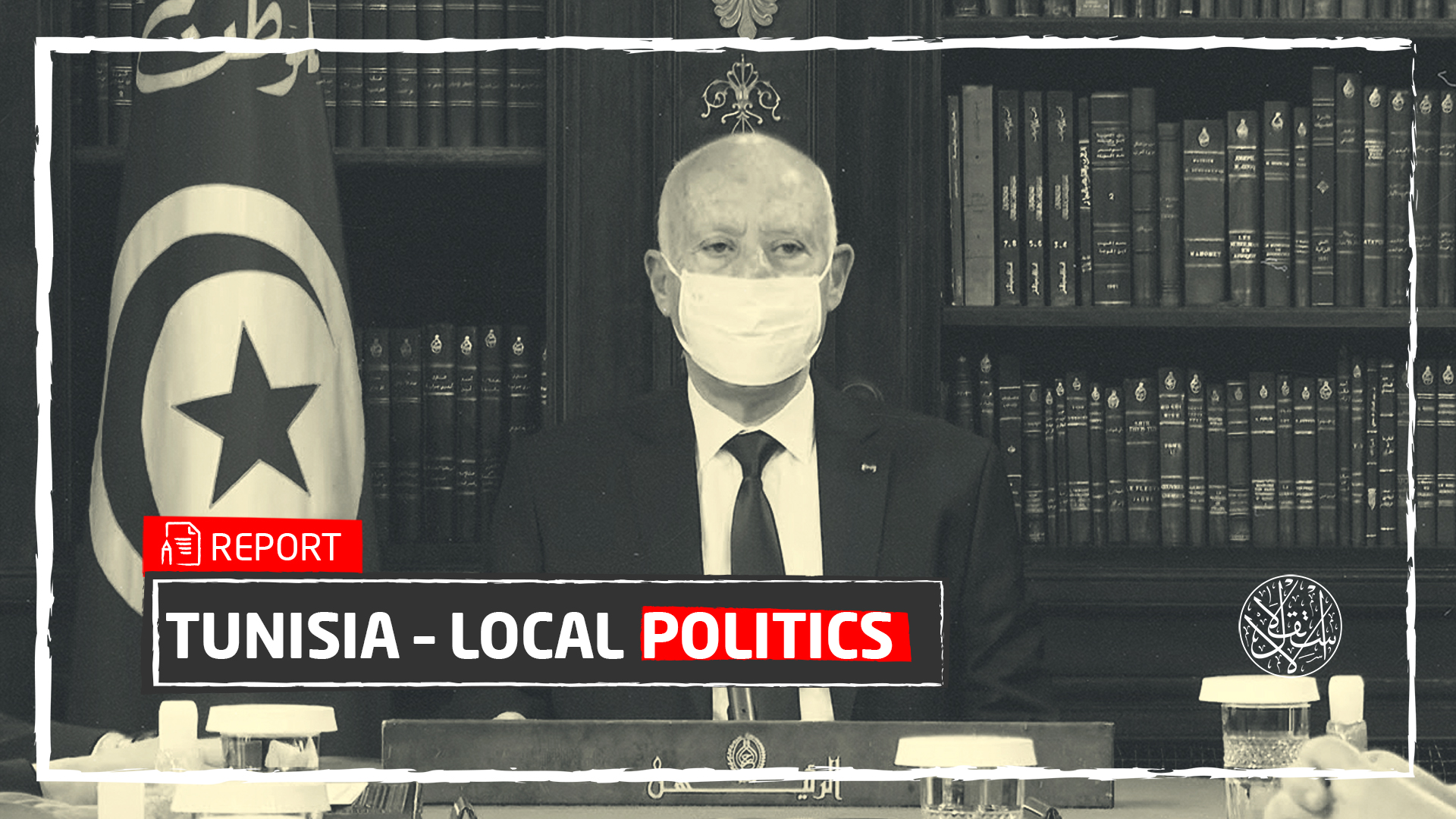
Despite the political, economic, social and health crises that Tunisia is going through, President Kais Saied continues to reject all the initiatives proposed by the political and social parties to resolve the situation and end the state of failure the country is witnessing on several levels.
Said, who chose to break with the government and parliament, after what has become known as the "cabinet reshuffle crisis" Hisham El Mechichi's cabinet, that Said did not accept it, did nothing about the activation of the "national dialogue" initiative proposed by the Tunisian General Labor Union since early December 2020.
Moreover, the President of the Republic has not yet responded to the initiative to resolve the political crisis presented by Parliament Speaker Rashid Ghannouchi since February 20, 2021.
Saeed not only refused all initiatives for a "national dialogue" that brings all the parties together to look for solutions to get the country out of difficult situation due to the "Corona" pandemic, but also refused to approve a project Amending the Constitutional Court Law, a week ago, saying that it is because the deadlines for establishing the court have expired.
Procrastination for the Union
Saeed's silence about the activation of the National Dialogue initiative proposed by the Labor Union, annoyed the leaders of the Union.
In this regard, the Assistant Secretary-General of the Labor Union, Sami Al-Taheri, criticized in media statements, on March 25, 2021, what he described as "Saeed's procrastination of the working organization and his failure to deal seriously and positively with the union's initiative."
Concerning the "National Dialogue", an initiative launched by the Labor Union (the largest and oldest trade union organization in Tunisia), in early December 2020, Said announced his acceptance of conducting it, without having fixed a date yet.
"We heard through the media about a dialogue announced by the presidency, no one contacted us, what the president did shows no respect to social partners," Taheri said.
On March 24, 2021, the Tunisian presidency announced, in a statement, that this dialogue will not be the same as its predecessors and that it will come to reform the journey of the revolution and will work to involve the youth, and that one of its goals is no communication with the "corrupts," .
The president announced his endorsement of the Labor Union initiative, and then he changed his mind, " Taheri noted.
And he added, "We lived in a coma for months after Saeed announced his acceptance of the Federation's initiative, but we did not know about it and we were surprised like everyone"
Ghannouchi Initiative
It was not only the Trade Union initiative that Saeed rejected, but also the initiative presented by Ghannouchi on February 20, 2021, in a letter sent to the president, and published by the Presidency of Parliament.
Ghannouchi's initiative aims to solve the ongoing political crisis between the presidents of the republic and the government, and to bring the parties together to find a way out and a set of solutions by giving priority to dialogue and exchange of opinion and advice on the country's situation and the decisions it requires, with the complex economic, social and health crises the country is going through.
Ghannouchi called Said for the need to send a positive message to the people and the countries of the world, highlighting that despite the difference between Tunisians and the growing rhetoric of incitement, Tunisia has a trustworthy state and institutions, and that the country needs to guarantee medicine, food, work and security, as well as calm and enhance solidarity and broaden the circle of national common.
The Head of Parliament suggested to Said a meeting between the Prime Minister, the Head of Parliament and the President of the Republic "as soon as possible." However, Said did not express any reaction to this initiative, which sparked widespread criticism against him from the leaders of the "Ennahda'' movement.
In this context, the political advisor of the head of the Ennahda Movement, Riad Al-Shuaibi, told Al-Istiqlal, "We are not satisfied with the opinions of the President of the Republic that reject the initiatives of national dialogue and the ministerial reshuffle and his refusal to approve the Constitutional Court law."
Since January 16, Tunisia has witnessed a dispute between Said and Mishichi, after the latter announced a partial government reshuffle, but Said did not invite the new ministers to take the constitutional oath until today, considering that the amendment "includes some transgressions."
Al-Shuaibi described Said's positions as "tensed," which "will only disrupt the political dialogue and lose the confidence between the head of state and the rest of the institutions."
Al-Shuaibi called on President Said to "move away from tensed statements and accept political dialogue and put the country's supreme interests above all other considerations."
Laws Rejected
The Tunisian president was not only rejecting the proposed dialogue initiatives and communication with the government and parliament institutions, but He also refused, a week ago, to ratify the Constitutional Court’s law, on the grounds that laws approved by Parliament do not enter into force unless it is approved by the presidency.
Said's refusal to ratify the court’s law comes days after parliament made amendments to the law, including reducing the majority required to elect its members from 145 to 131, in order to speed up the establishment of the court.
The court, a judicial body that was approved under the 2014 constitution, includes 12 members, 4 of these members are elected by Parliament, 4 chosen by the Supreme Judicial Council (an independent constitutional institution), and 4 appointed by the President of the Republic.
Earlier, the Tunisian president stressed, "the need to respect all provisions of the constitution regarding the constitutional deadlines for the election of members of the Constitutional Court," justifying this by, ‘’ the fifth paragraph of Article 148 of the constitution, which gives for the selection of members of the court a maximum period of one year after the legislative elections. (Conducted in October 2014).
On April 6, 2021, Said said in a speech on the occasion of his supervision of an event commemorating the 21st anniversary of the death of former Tunisian President Habib Bourguiba (1903-2000), that he would "never accept that any changement of laws to go along with rulers interests ," justifying that with his refusal of Parliamentary amendment to the Constitutional Court Act.
Commenting on Said’s position, Al-Shuaibi said: “Said must assume his full responsibility for signing the law if it is re-approved in Parliament, but if he rejects it again, he will bear political and moral responsibility related to violating the constitution.
Jerky Speech
Critics describe Said’s speech as "jerky," especially the speech he delivered from the Zaytuna Mosque on April 12, 2021, the day before Ramadan.
Said said: “Ramadan is not a month of fasting from eating and drinking, and it is not one of the rituals that appear to be worship, but hiding devil political interests,” calling in his speech to “fasting from lying and insulting.”
Observers interpreted Said’s speech and said that it is directed to his political opponents and "specifically the Ennahda and Meshishi."
In this context, the leader of the Ennahda Movement, Rafik Abdul Salam, commented in a post on Facebook: “Authority is an affliction, and gossips, and insults in this month of fasting and in the Al-Zaytuna Mosque, is the most affliction. The loss of rationality and reason is the greatest and most severe affliction that cannot be replaced by money or power". "
He added, "All the heads of Islamic states took the initiative to congratulate their people on the advent of the holy month of Ramadan sending messages of joy, optimism, and calling to love each other and to pure the hearts, but Qais Said insisted on spreading hate ‘’
For Him, Lotfi Al-Mraihi, Secretary-General of the Republican People's Union, and a former candidate for the 2019 presidential elections, criticized Said’s speech, saying that “the time or place he chose to go to the Tunisian people was not appropriate for the coded messages we are used to hear.”
Regarding the alternative that Said proposes after rejecting all the initiatives that were presented to him, political analyst Riyad Jrad believes that "Said does not reject dialogue in principle, but he does not want political settlements and the distribution of power between the various political parties, as this will not help the people and will not solve the crisis.".
He explained to Al-Istiqlal that “Said wants dialogue in new formulas and proposes real contents, including amending the constitution, the electoral law and changing the political system,” considering that “the political system of the 2014 constitution is a hybrid system that brought Tunisia to these crises and tremors.”
Jrad, who is known in Tunisia for his support of the President of the Republic, stressed that "Said responded in principle to the Tunisian General Labor Union's call for a national dialogue, but he does not want fake conversations that only go with some parties’ interests (he did not name them)."