Clash With Egypt: Has Greece Tipped the Balance in the Saint Catherine’s Monastery Dispute?
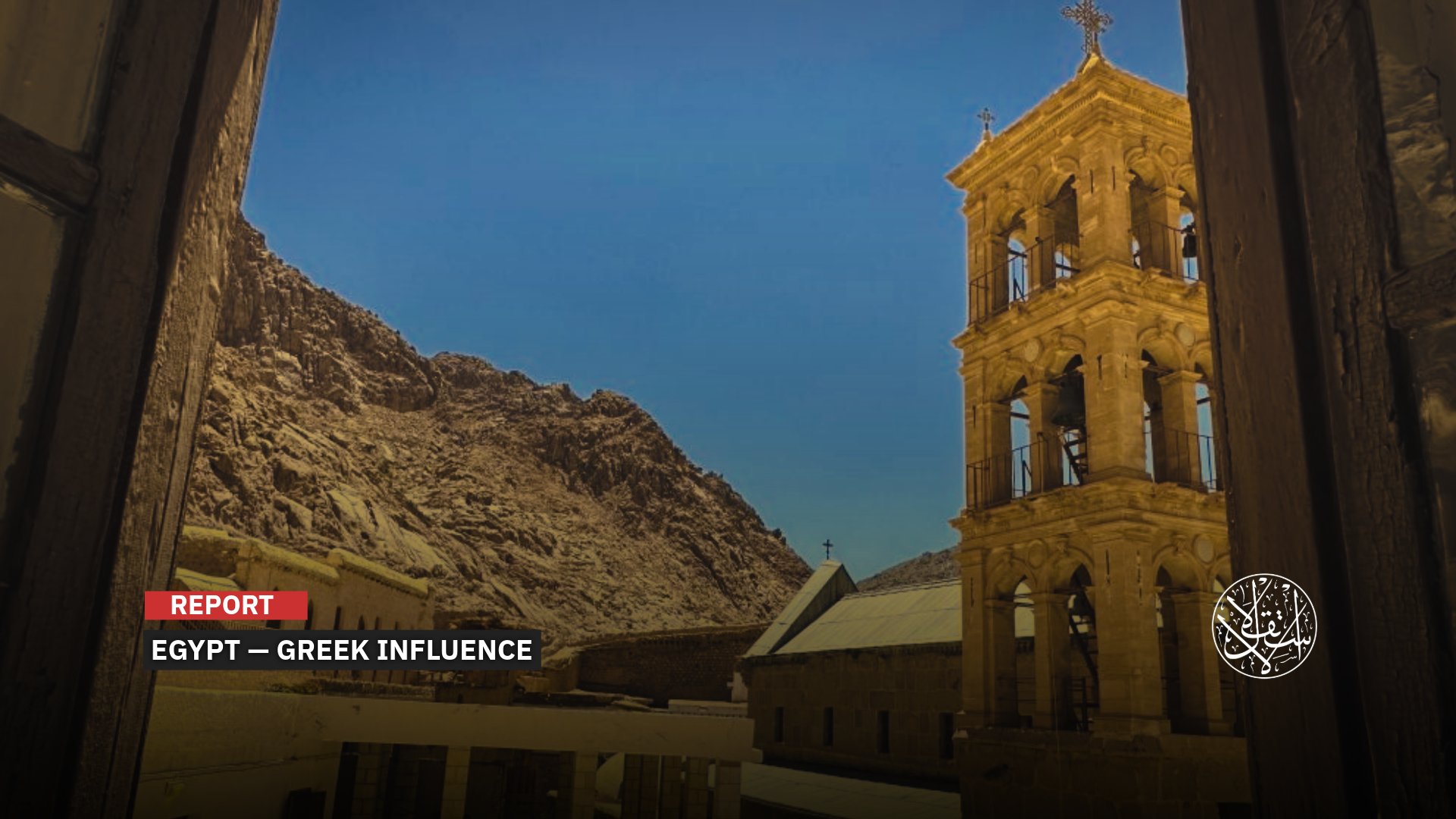
Greece played a decisive role in shaping the course of the elections.
After a power struggle that stretched across August and September 2025 between the monks of Saint Catherine’s Monastery over the Egyptian-Greek rivalry for control of the site’s assets, Athens stepped in and settled the dispute through an election that saw its preferred candidate prevail.
On September 14, 2025, the monastery’s monks elected Samaan (Symeon) Papadopoulos as the new metropolitan, with 19 votes out of 20, in a ballot marked by clear Greek “engineering.”
The vote followed weeks of unprecedented tension after the Jerusalem Patriarchate dismissed the former archbishop, Damianos.
Greek media outlets rallied behind the newly elected head of the monastery. The newspaper Efimerida described him on September 15, 2025, as conciliatory and cooperative with Greece, adding that his election “is seen as a step toward restoring unity following a crisis.”
More significantly, Papadopoulos’s election as the new archbishop opens the door to an agreement with Cairo over the monastery’s assets.
In May 2025, an Egyptian court ruled in favor of Egypt’s ownership of the monastery’s land, sparking a diplomatic row between Cairo and Athens.
Athens and Cairo have since reached an understanding recognizing the monastery’s Greek character. However, Prime Minister Kyriakos Mitsotakis has stressed that the pending agreement between the two countries, meant to safeguard the monastery’s Greek Orthodox identity, requires the signature of the new archbishop, whose election Athens helped orchestrate to ensure his loyalty and secure his approval in its favor.
The Story of the Crisis
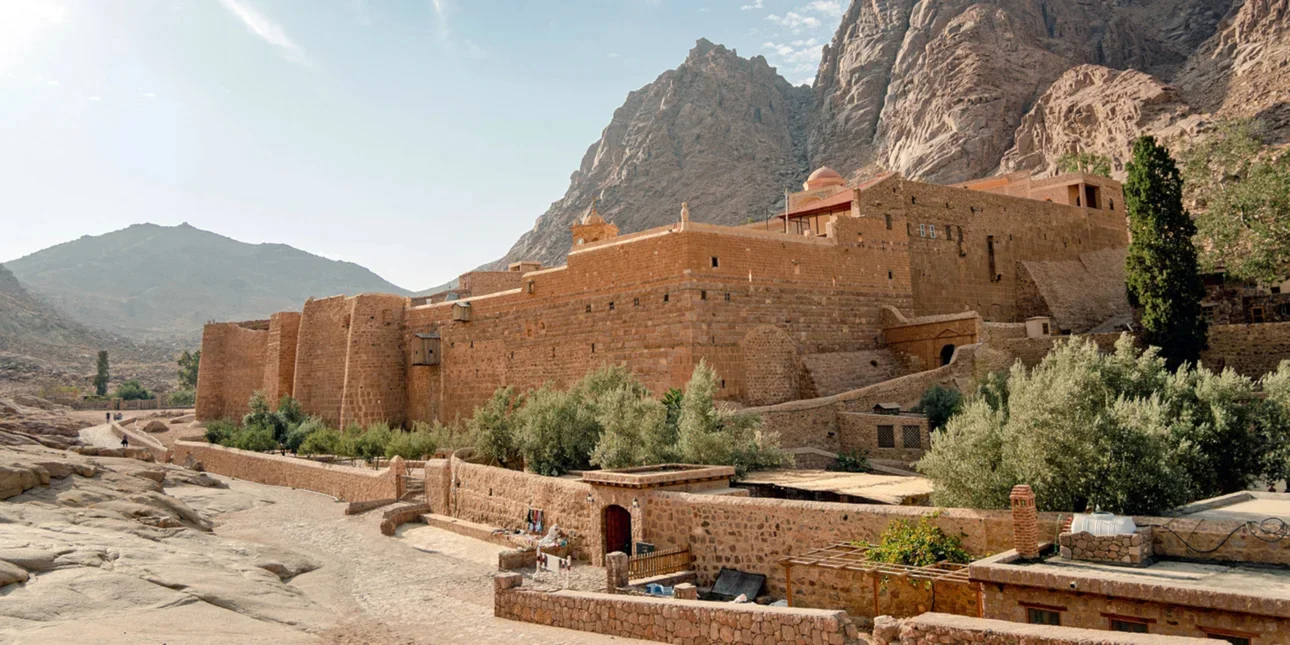
Because Saint Catherine’s Monastery lies on Mount Sinai in southern Egypt, and is one of the world’s oldest Christian monasteries, as well as a UNESCO World Heritage Site, the Ismailia Court of Appeal ruled on May 28, 2025, that the monastery’s land is part of the Egyptian state’s property. The monks, it said, have the right to use the land, but not to own it officially.
The appellate court’s decision, in a case whose legal dispute dates back to November 30, 2014, did not call for confiscating the buildings or preventing the monks from using the religious and historical sites. Instead, it revoked the monastery’s ownership of the surrounding agricultural lands, crops, and farms.
The court confirmed that the religious, historical, and archaeological buildings within the monastery’s walls are not subject to dispute and remain under the administration of the Orthodox monks.
However, it emphasized that the monastery has no right to sell, mortgage, or otherwise dispose of the land as a real estate asset.
The court categorized the 71 contested plots of land between the South Sinai governorate and the monastery into four groups.
The first included plots not proven to be in the possession of the Archbishop of Saint Catherine’s Monastery. The second comprised religious lands owned by the Egyptian state but held by the metropolitan on behalf of the head of the regime of Egypt.
The third category covered lands for which preliminary sale contracts had been signed between the metropolitan and the South Sinai governor in 2004, while the fourth consisted of lands from which the archbishop is to be evicted, including those containing religious sites such as monastic fortresses.
The appellate ruling covered 71 plots of land, including 29 religious sites, 17 plots with preliminary sale contracts, and other parcels, whereas the lower court’s judgment had been limited to the 29 religious sites.
Although neither ruling recognized the archbishop’s ownership of the lands, instead declaring them state property, the Court of Appeal did not conclude that the archbishop’s possession constituted “usurpation,” in contrast to the lower court’s decision.
The appellate court’s ruling was limited to ordering the archbishop’s eviction from certain plots he effectively controlled, but that were not designated for religious use, 29 plots in total, or had pending contracts, 17 in all, and required that these lands, along with their buildings and crops, be handed over to the state.

Greek Protection
A court ruling has sparked a storm of Greek objections and condemnations, with the Orthodox churches of Athens, Jerusalem, and Constantinople describing the decision as a “spiritual catastrophe” and a “historic setback.”
Because the monastery belongs to the Orthodox denomination, which maintains historical ties with the Greek Church and houses several Greek monks, Greece intervened officially, drafting a bill in its parliament to grant the monastery a legal status represented by an office in Athens.
The ruling was linked to the Egyptian government’s launch of the “Great Transfiguration” project in 2021, which aims to transform the city of Saint Catherine into a global center for the Abrahamic religions.
Tensions have since flared between Athens and Cairo. In June 2025, the Greek government submitted a draft law to parliament titled Protection of the Legal Status of the Properties of Saint Catherine’s Monastery in Sinai.
The proposal seeks to establish a legal entity based in Athens to represent the monastery before Egyptian courts and official institutions, to register it as an independent religious legal person under Greek law, and to enable it to manage its cultural and financial assets, as well as donations, across Greece and Europe.
Opposing monks within Saint Catherine’s Monastery described the move as “unacceptable,” arguing that it would strip the monastery of its independence and effectively make it subordinate, or even owned, by Greece.
They hinted that the dispute had moved beyond the monastery’s walls, turning into a bargaining chip in a broader power game between Athens and Cairo, as Greece seeks to expand its influence by tying the monastery legally and administratively to its official institutions, giving it potential leverage over Egypt.
Following official talks between the two countries and a visit to Cairo by Greek Foreign Minister Giorgos Gerapetritis, both sides reaffirmed that the monastery’s legal and spiritual status remains intact.
The Egyptian government denied that the court ruling would alter the monastery’s religious or spiritual nature, emphasizing that its internal affairs would continue as before, and that while the land it occupies now legally belongs to Egypt, it will remain in use by the religious authorities and monks.
Egypt’s presidency and foreign ministry insisted the ruling was regulatory rather than confiscatory, and reaffirmed the country’s commitment to preserving the monastery’s internationally recognized status.
The head of the regime Abdel Fattah el-Sisi, in a phone call with Greek Prime Minister Kyriakos Mitsotakis, said there would be “no harm done to Saint Catherine’s Monastery.”
A presidential statement stressed the importance of “correcting the misleading information being circulated in Europe on this issue.”
Before the ruling was issued, during the head of the regime Abdel Fattah el-Sisi’s visit to Athens in early May 2025, he reaffirmed the state’s commitment to its “eternal and untouchable” agreement with the monastery. “The monastery holds the relics of a great saint,” he said at a press conference. “I insisted on clarifying this point personally, and I say it directly to dispel malicious rumors.”
According to Mada Masr, “The Greek orthodox churches in Athens, Jerusalem and Constantinople denounced the decision as an 'existential threat' and 'yet another historical fall' for orthodoxy and Hellenism.”
Saint Catherine’s Monastery in Sinai enjoys autonomous self-administration, independent of the patriarchal sees, a status that stems from a historic agreement among the four Greek Orthodox Churches of Alexandria, Jerusalem, Constantinople, and Antioch.
The Monks’ Crisis
Following the ruling by the Ismailia Court of Appeal, which stripped Saint Catherine’s Monastery of ownership of 14 land plots and converted the rest, including the monastery’s own grounds, into usufruct property, a fierce internal crisis erupted within the monastery between two factions, one led by Archbishop Damianos, the head of the clergy, and another composed of monks opposing his decisions and alleged corruption.
Clashes broke out inside the monastery between Archbishop Damianos, accompanied by ten members of a private security company he had hired, and a group of dissenting monks who had previously accused him of financial misconduct. Four monks were injured and taken to Sharm el-Sheikh Hospital. The confrontation coincided with the diplomatic tensions between Egypt and Greece.
The stated reason behind the confrontation was Damianos’s rush to Athens to attend a parliamentary session that approved a new bill granting broad administrative powers to a “public authority,” described by opponents as fictitious, based in Athens, to manage the monastery’s assets inside and outside Sinai.
The dissenting monks said the approval of this Greek law, which they claimed aimed to circumvent the Egyptian court ruling, was made without consulting the Council of the Elders, the monastery’s governing council that holds final authority over any administrative or financial matter.
They described the law as an attempt to place the monastery under external guardianship.
Damianos rejected their objections, arguing that the Greek law served as a “strategic shield” protecting the monastery’s independence in Egypt, and called on Cairo to preserve its autonomous legal identity.
As the crisis escalated, the Council of Elders voted in late July 2025 to dismiss Damianos, citing the monastery’s internal charter, which authorizes the synod to remove an archbishop in cases of mismanagement or doctrinal deviation.
On July 30, 2025, the monks opposing Damianos held a meeting and voted to remove him from office, with 16 out of 23 monks, a two-thirds majority of the Council, supporting his dismissal, and agreed to form a new governing council for the monastery.
The decision was justified on several grounds, including his trip to Greece to endorse a parliamentary law transferring oversight of the monastery and its Egyptian properties to a Greek authority in Athens.
He was also accused of collecting more than half a million euros in 2024 from the monastery’s Athens office, of which only €60,000 reached Sinai, while his personal expenses amounted to around €63,000.
In addition, he allegedly sold a property and a warehouse owned by the monastery in Greece without consulting the monastic brotherhood, a direct violation of internal regulations, and was charged with “financial, administrative, and doctrinal violations.”
Damianos rejected the dismissal and reportedly financed articles in the Greek press portraying the move as a “coup” rather than a lawful removal.
He later returned from Greece on August 26, 2025, accompanied by private security guards, and forcibly expelled the opposing monks from their cells, breaking doors and windows, claiming they had staged a “religious coup” against him.
The monks opposing him obtained a decree from the Church of Jerusalem removing him from the leadership of the monastery.

Greek-Made
Finally, after sustained pressure from Greece and the Church, Damianos issued a statement on September 12, 2025, announcing his resignation as head of the monastery and calling for new elections, saying he would not participate.
He also declared the lifting of sanctions against the “rebellious monks,” withdrew the mutual complaints “to avert discord,” and relocated to Greece.
The monks who had clashed with him reciprocated by withdrawing their complaints against him at police stations in Dahab and Sharm el-Sheikh, while the Patriarchate of Jerusalem helped calm tensions by retracting the formal dismissal of Damianos following his decision to step down.
New elections were held on September 14, 2025, reportedly engineered by Athens to ensure a pro-Greek candidate would assume leadership of the monastery. According to Egyptian assessments, Papadopoulos emerged as the new head of the church.
The investigative site Mada Masr reported on September 17, citing a “well-informed source,” that Greece had played a “clear hand” in shaping the electoral process to secure the victory of Simeon, confirming that the path to his election as head of Saint Catherine’s Monastery, replacing Damianos, “had been engineered.”
Under the monastery’s charter, candidates must be between 35 and 70 years old, have taken monastic vows within the monastery, and be ordained priests.
These criteria applied to only five monks, two of whom lacked a popular base, leaving three to compete in earnest. The winner, the former vicar of the archbishop, is, according to the source inside the monastery, criticized for his poor handling of monks’ complaints in recent years.
Church dismissal papers in Greece were also reportedly used as leverage, as rival candidates had affiliations or residencies in Greek monasteries, and the suspension of their release from these institutions rendered them ineligible to run or participate in the vote.
“That's how the margin narrowed, leaving the monks with only one choice,” the source said, noting that the former archbishop had expelled these two candidates from the monastery in recent years due to disagreements over his policies.
The new abbot is expected to travel to Jerusalem in October 2025 to be formally inaugurated following his election, with a new high council (the monastery’s supreme administrative board) to be elected subsequently.
To underscore the perceived “engineering” of the elections by Greece, the church newspaper eKathimerini reported “concerns” over the voting process, describing the proceedings as “opaque” and noting a lack of clarity regarding the rules of the election and who holds the right to vote.
Sources
- Monks’ Revolt… The Battle for the Independence of “Saint Catherine” [Arabic]
- Questions and Answers on the Legal Dispute Over the Ownership of Saint Catherine’s Monastery and Its Surrounding Lands [Arabic]
- Election of a New Archbishop for “Saint Catherine” After Months of Tension… Source: “Greek Engineering” of the Process [Arabic]
- Leadership Crisis Roils St. Catherine’s Monastery Amid Egyptian Court Dispute
- Greece moves to protect legal status of St Catherine’s Monastery in Sinai
- Egypt, Greece agrees to protect status of Mount Sinai monastery, after court ruling
- New Archbishop Elected at St. Catherine's Monastery, Ending Leadership Crisis