A Divided Army Faces the Houthis: Can Yemen Withstand an All–Out War?
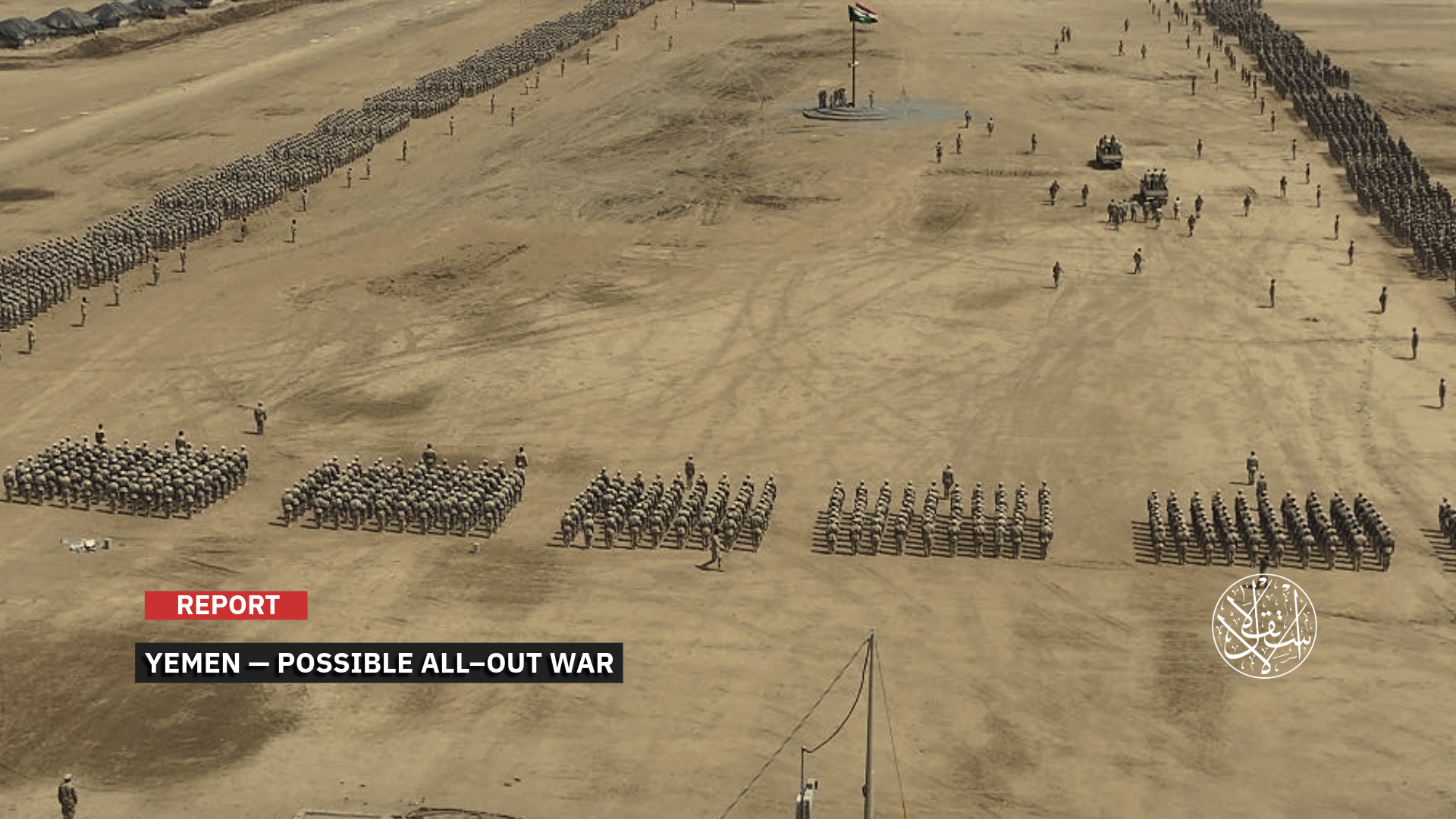
The government forces appear better prepared than they were after the 2022 truce.
What is happening in Yemen today is an actual war being fought across multiple fronts, on land, at sea, and in the air, yet it remains an undeclared war among the parties to the conflict.
Since July, the fighting has moved beyond the military stalemate that prevailed under the 2022 truce toward a more sustained pattern of combat, with missiles, drones, and attacks on ports and ships, alongside intensifying clashes on the Marib, Taiz, and western coast fronts. Houthi attacks on Saudi Arabia have also resumed.
On August 13, UN envoy Hans Grundberg warned that Yemen faced a greater risk of a return to full-scale conflict than at any point since the 2022 truce.
Yet the current confrontation does not resemble the all-out war of 2015. There has been no major ground offensive and no fundamental shift in the front lines. Instead, the conflict has taken the form of attrition and mutual pressure, with the parties seeking military and political gains without, at least for now, tipping into a broad open war.
That leaves a fundamental question: How prepared and capable is Yemen’s military to fight an all-out war with the Houthis, given the divisions within its ranks and the multiple formations and competing centers of command that continue to shape it?

A Divided Army
For years, Yemen’s military has been deeply divided, with the fault line running between regular forces that retain the army’s traditional structure, divisions, and areas of operation, and irregular armed formations that emerged after the Arab coalition intervened in 2015. Backed with weapons, funding, and support from Saudi Arabia and the United Arab Emirates (UAE), these formations developed their own ties and loyalties to the powers that support them.
Yemen’s government forces are officially divided into seven military regions under former President Abdrabbuh Mansur Hadi’s 2013 decree No. 16. The size and deployment of each region have since changed, with the original structure differing significantly from the forces actually deployed in 2026. The National Army’s military regions are as follows:
First Military Region: Based in Seiyun, it covers Wadi Hadramawt, the desert, and the al-Abr area. It includes about five brigades, although its deployment changed after the loss of its Seiyun headquarters and the redeployment of parts of its forces.
Second Military Region: Based in Mukalla, it covers the Hadramawt coast, al-Mahrah, and Socotra. It includes about five brigades, with its broader area of responsibility remaining intact despite changes to troop deployments and security arrangements in Hadramawt, and al-Mahrah.
Third Military Region: Based in Marib, it covers Marib and Shabwa and includes about six brigades. It is the government’s largest center of military power and has also become a hub for supporting forces from the Sixth and Seventh Military Regions.
Fourth Military Region: Based in Aden, it covers Aden, Lahj, Abyan, al-Dhale, and Taiz and includes about five brigades. Its forces have been redeployed toward the Taiz, Lahj, and Abyan fronts, alongside the integration and restructuring of southern formations.
Fifth Military Region: Based in al-Hudaydah, it covers al-Hudaydah and Hajjah and includes about seven brigades. Its forces are now concentrated in Midi, Hayran, Haradh, and Bani Hassan in northern Hajjah, as the Houthis control most of Hudaydah.
Sixth Military Region: Based in Amran, it covers Amran, Saada, and al-Jawf and includes about 11 brigades. Part of its support base has shifted to Marib, while its forces are deployed along the Saada fronts, particularly Kataf and Al Buqa’, as well as in al-Jawf.
Seventh Military Region: Based in Dhamar, it covers Dhamar, Sanaa, al-Bayda, and Ibb and includes about five brigades. Its forces have been redeployed between Marib and the Sana’a and Al Bayda fronts after losing control of most of its original area.
The official division and regional headquarters have remained largely unchanged, but the war has reshaped the actual deployment of forces. Marib has emerged as the main hub for troop concentration and military support, while government forces in Amran, Saada, al-Hudaydah, and Dhamar have largely been pushed back to specific fronts and operational areas.
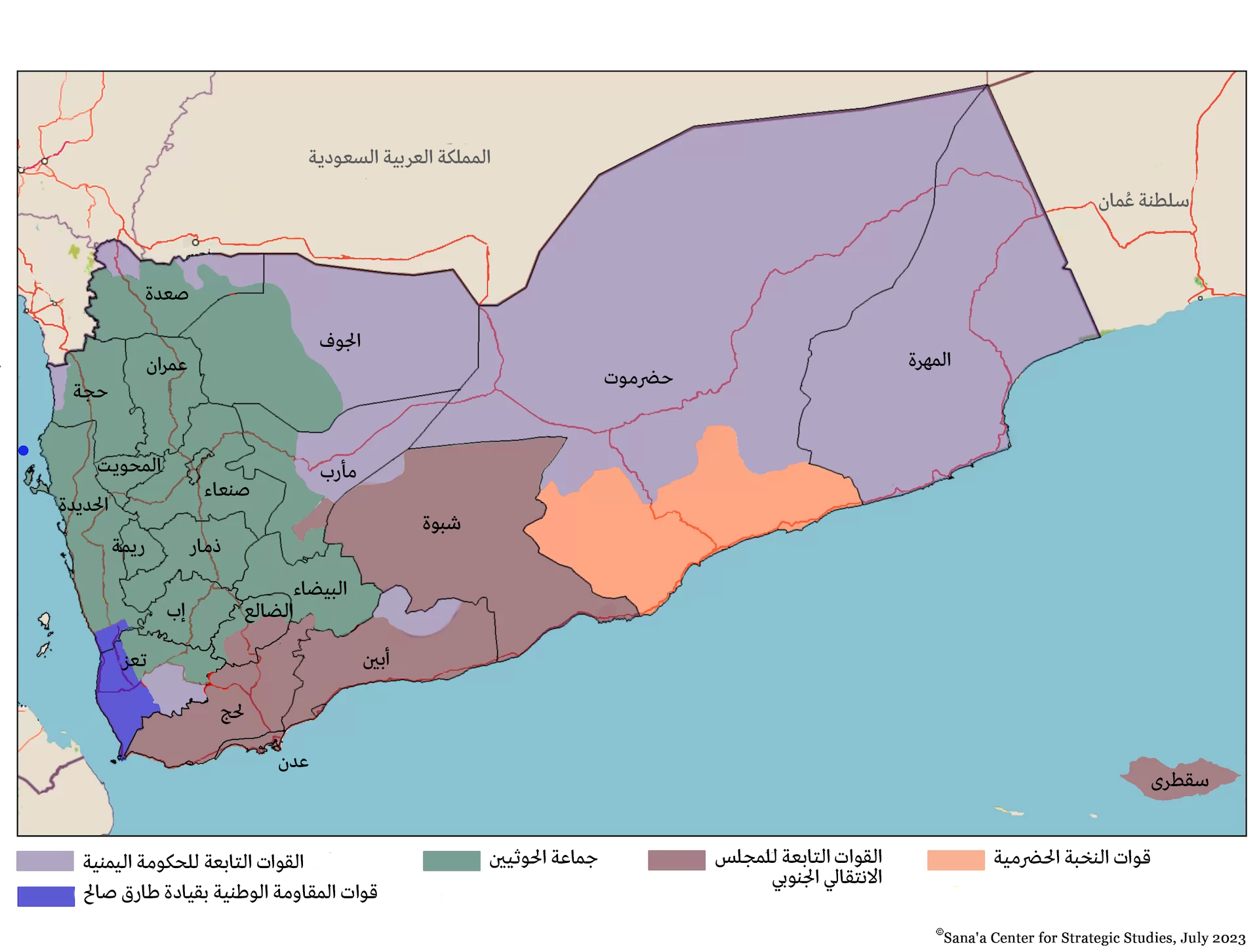
Map of Military Formations
Alongside the seven official military regions, the government forces include several large military formations that emerged outside the army’s traditional structure, most notably:
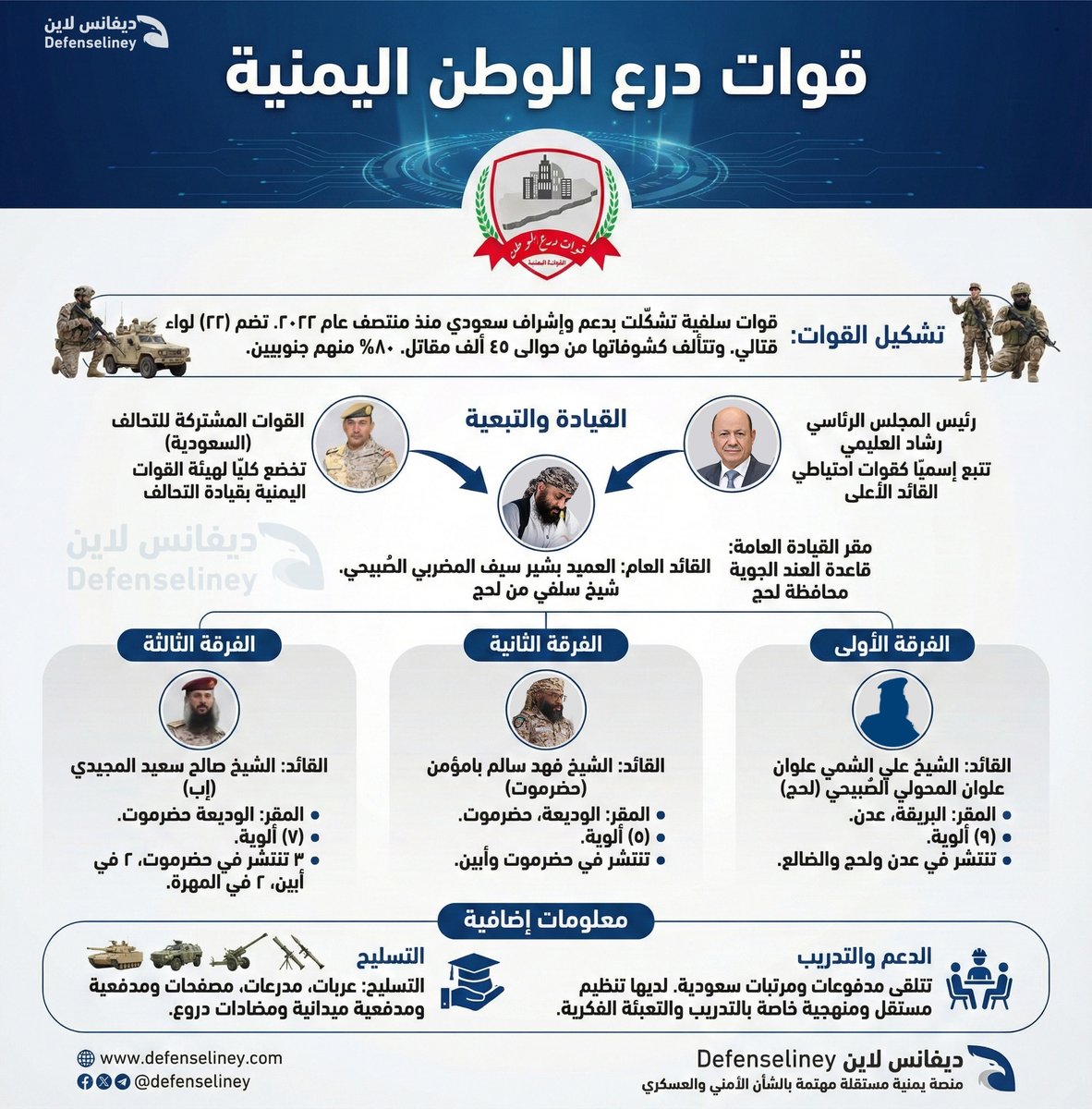
Southern Giants Brigades: Founded by the UAE, with Saudi Arabia now working to bring them under its control. Formed between 2016 and 2019, the force is estimated at about 22,000 fighters across 12 brigades, equipped with heavy weapons, artillery, and armored vehicles. It is concentrated along the western coast and remained a major force outside the army in 2026, with some of its units and missions redeployed.
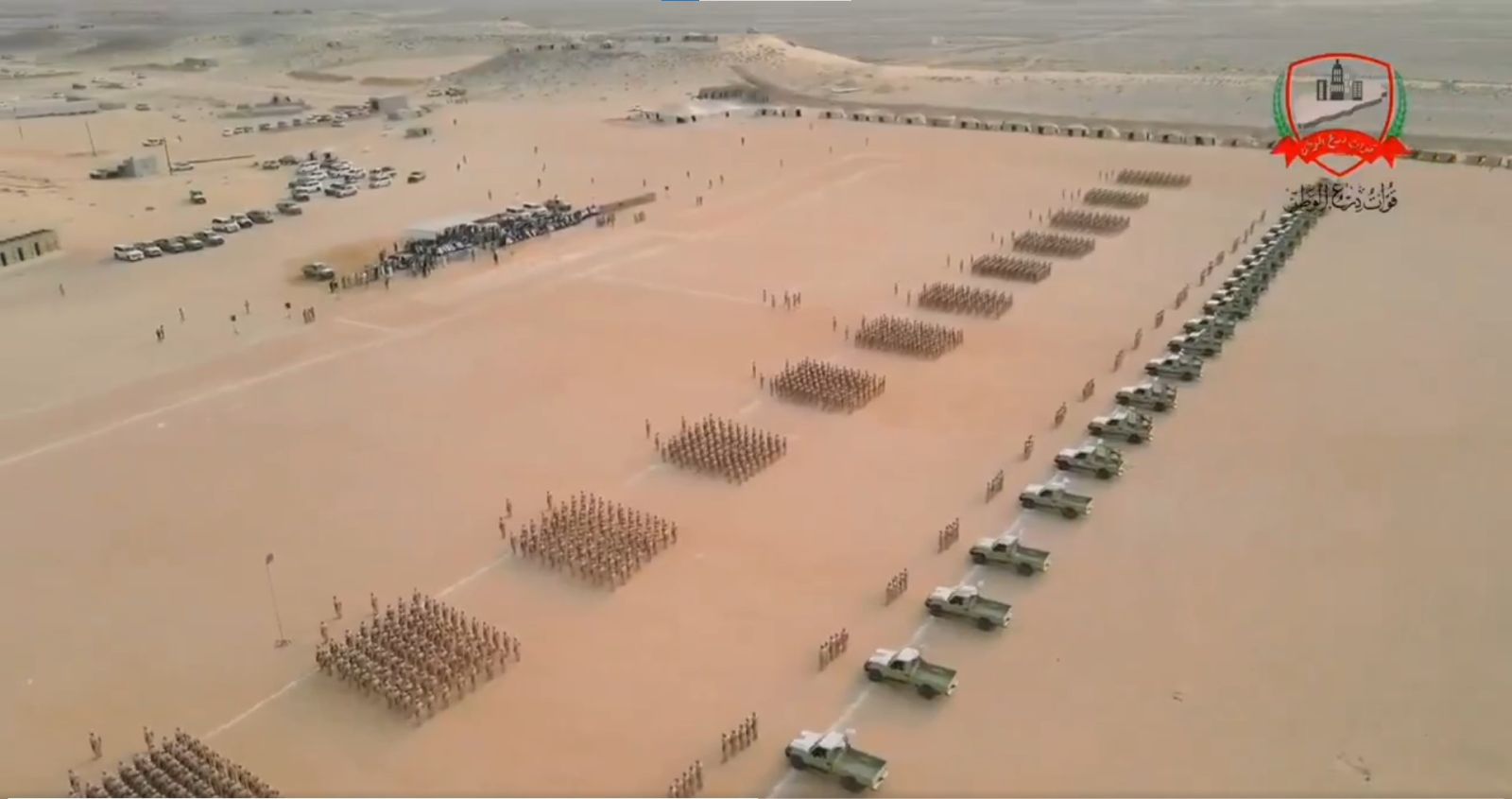
National Shield Forces: One of the most prominent Saudi-backed military projects, comprising multiple brigades. Some sources estimate its strength at about 45,000 fighters, although lower estimates also exist. During 2026, it became one of the pillars of efforts to reorganize government forces, particularly in Aden, Hadramawt and al-Mahrah.
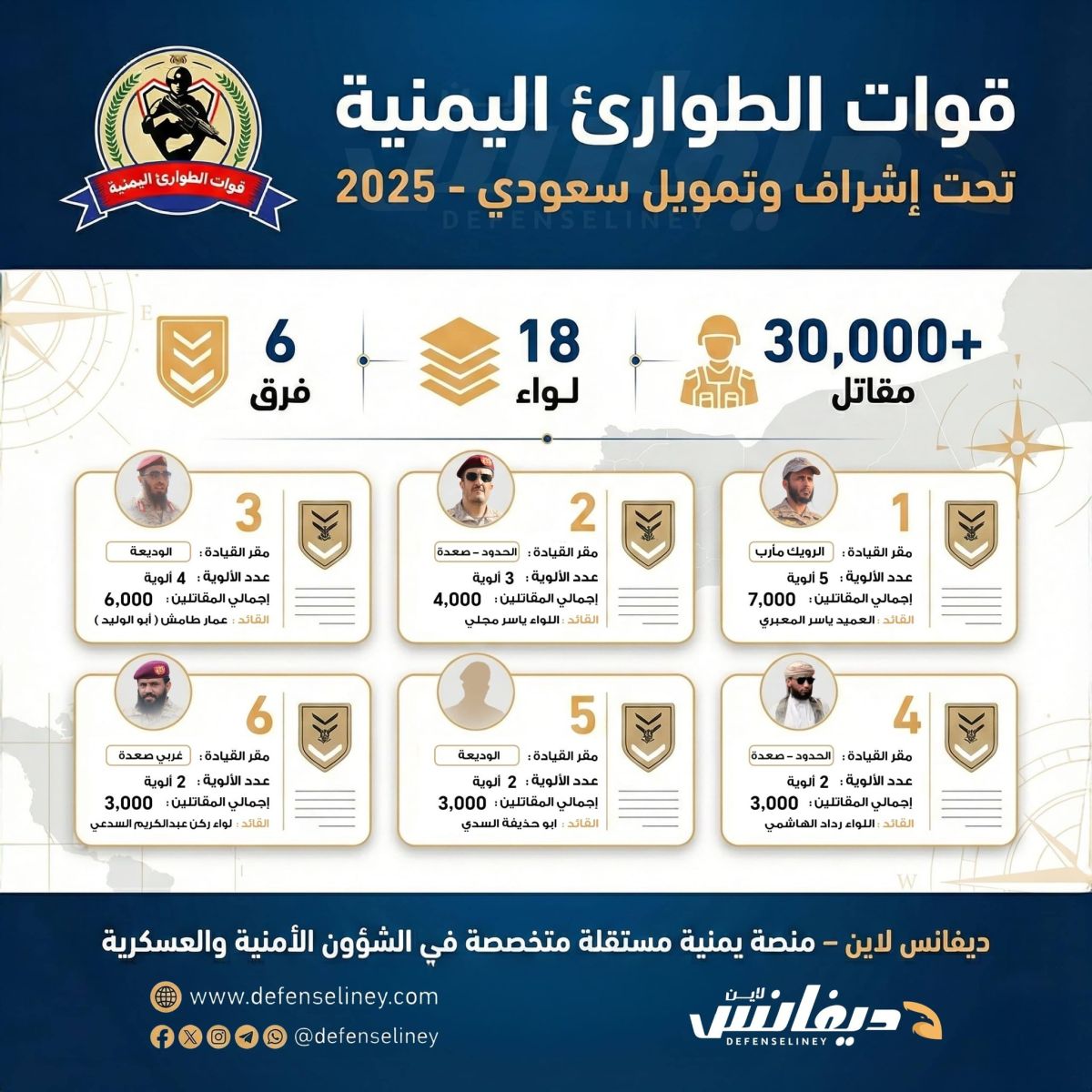
Yemeni Emergency Forces: A Saudi-backed formation that emerged in its current form in 2025. It is estimated to have about 35,000 fighters organized into six divisions and 22 brigades, including infantry, commando, special forces, and military police units. It operates under the command of the Saudi-led Joint Forces and represents a parallel force to the traditional army.
Republican Guards: Led by Tariq Saleh, the force was formed with Emirati support in 2018 and is estimated at about 32,000 fighters across 10 brigades. It possesses heavy weapons, naval capabilities, and drones. It is deployed mainly along the western coast and in Mokha and remained outside the structure of the national army in 2026.
Together, these formations constitute a large military bloc operating alongside Yemen’s traditional army structure, with differences in their sources of funding and chains of command. Some are aligned with Saudi Arabia and others with the UAE, while during 2026 efforts have been underway to redistribute them and integrate their missions into new government military arrangements without fully dismantling them.
Army Restructuring
The army restructuring process began under Hadi in 2012 with the dismantling of Saleh’s military structure and the abolition of the Republican Guards and the First Armored Division, but it collapsed when the Houthis seized Sana’a in 2014. After 2015, the army was rebuilt from the remaining units and popular resistance forces, with the seven military regions reactivated. However, the proliferation of externally backed formations kept the military institution divided.
On April 7, 2022, the Supreme Joint Security and Military Committee was established to restructure the armed forces and security services. It was then formed on May 30 with 59 military and security leaders as members. Over the following three years, however, the committee did little beyond preparing plans and proposals, with no meaningful implementation.
On January 10, 2026, Rashad al-Alimi launched a Higher Military Committee under the command of the coalition forces to restructure the army and security forces in government-controlled areas.
The process included redeploying forces, changing commanders, and renaming and integrating some formations previously affiliated with the Southern Transitional Council (STC). The Security Belt Forces were renamed the National Security Forces, while the Shabwani Elite Forces became the Shabwa Defense Forces. The Hadrami Elite Forces remained in place, with their missions reorganized, alongside a restructuring of the Support and Reinforcement Forces, the Commando Forces, and the Storm Forces.
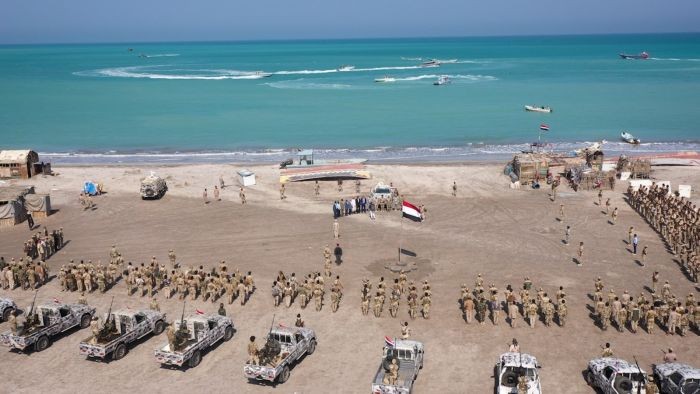
Military Force Display
Saudi Arabia and the government have not sought to dismantle these formations entirely. Instead, they have moved to fold them back into the government structure by changing their names, leadership, and deployment and integrating parts of them into the Defense and Interior ministries.
The 2026 picture points to limited progress toward unifying command, control, and funding, but not to the creation of a unified army fully under the Defense Ministry and a single command. The restructuring therefore appears closer to a redesign of the system of military power and loyalties than to a completed institutional reform.
Marib, particularly the Third Military Region, remains the backbone of the traditional ground force, while the National Shield Forces represent the most prominent component of the new Saudi-backed military structure.
The division of government military power between the regular army and armed formations operating outside its structure, coupled with the stalled restructuring process, remains the biggest obstacle to the government’s ability to launch an all-out war against the Houthis.
The problem is not simply the size or weaponry of the forces, but the multiple centers of command, loyalty, and funding, which limit the political and military leadership’s ability to make a unified decision and carry it out across different fronts.
As a result, entering a large-scale war before addressing this division could turn the government forces’ relative numerical and military advantage into an operational burden, making it difficult to coordinate the fronts, unify the chain of command, mobilize resources, and manage the war over the long term.
War or Better Negotiating Terms?
It is difficult to separate the Houthis’ gradual escalation from the conflict inside Yemen to the Red Sea and then toward Saudi Arabia from Iran’s broader regional agenda. The group has become a key tool for Tehran to increase pressure on its adversaries and threaten shipping lanes and Saudi and U.S. interests, in line with an Iranian strategy of using regional proxies to expand the arenas of confrontation without becoming directly involved.
However, the Houthis’ involvement in this strategy does not erase their local calculations. They also use escalation to secure gains related to salaries, oil revenues, Sana’a airport, ports, and imports, as well as the form of political power they would retain in any future settlement.
In this sense, the question is not whether the escalation is Iranian or Houthi, but how Iran’s agenda intersects with the Houthis’ own calculations. Tehran provides the regional framework and strategic objectives, while the group seeks to turn that role into military and political gains inside Yemen.
This helps explain the escalation’s shift from domestic fronts to the Red Sea and then to attacks on Saudi Arabia as part of a broader campaign of regional pressure, while the Houthis retain room to maneuver over the level and timing of escalation.
The escalation therefore appears more aimed at improving the group’s negotiating position and creating new facts on the ground than at preparing for an all-out war. The Houthis have focused on missiles and drones and on targeting Saudi Arabia and vessels linked to it, while avoiding a large-scale ground offensive that could trigger a direct Saudi response.
The Sana’a Center assesses that the goal is to pressure Riyadh and strengthen the group’s negotiating position, potentially leading to an agreement close to the road map discussed in 2023.
That assessment is consistent with the maritime ban being limited to specific categories of vessels rather than closing the Bab al-Mandab, although the widening attacks, including the deadly strike on the Tihama on August 11, increase the risk that the escalation could spiral out of control.
By contrast, the government forces appear better prepared than they were after the 2022 truce. They have gradually shifted from a defensive posture toward more regular use of reconnaissance, drones and preemptive strikes against Houthi movements and fortifications.
The formation of the Supreme Military Committee in January also improved coordination, alongside Saudi technical, weapons, and intelligence support and an increase in logistical and military assistance during August.
A key part of this shift has been the development of drone capabilities. On July 29, the government announced that reconnaissance and combat systems developed by Yemeni engineers had entered service, and later used them in operations against the Houthis in Marib and Taiz. These capabilities provide continuous surveillance, help detect troop movements, enable artillery fire correction, and allow relatively precise strikes, reducing some of the Houthis’ advantage.
But operational improvements do not mean Yemen has a unified army capable of fighting a prolonged war. The forces remain divided among the regular army, the National Resistance, southern forces, the National Shield Forces, and other local formations, with differences in weaponry, training, funding, and command.
According to observers, efforts to bring the various formations under the Defense Ministry are moving “very slowly and disappointingly,” while efforts to unify salaries remain stalled. As a result, unifying firepower remains easier than unifying military decision-making.
On the ground, the level of escalation has risen. Marib has come under Houthi missile and drone attacks, with government forces responding with artillery and drones, while attacks along the western coast have also continued amid heightened readiness.
With Saudi Arabia once again coming under Houthi attack, the risk of the conflict expanding is growing. Some have warned that this could set Yemen on a path toward “reigniting the war.”
Even so, an all-out war remains on hold because there has been no major ground offensive, the lines of control have remained relatively stable, and Saudi Arabia has sought to avoid a repeat of its 2015 experience, while Omani mediation continues. The cost of war would also be high given the fragility of Yemen’s economy and the millions of Yemenis who depend on aid, with 18.3 million people facing food insecurity.
The picture reflects a controlled escalation in which the Houthis’ negotiating calculations intersect with the government’s growing readiness to respond, rather than an inevitable march toward all-out war. Drones remain an important factor in shifting the balance, but they cannot determine the outcome of a war on their own. Their value increases when integrated with intelligence, artillery, and ground forces.
The government’s current readiness therefore remains geared more toward managing measured rounds of escalation and strengthening deterrence than toward possessing the capability to wage a strategic war to retake Sana’a.
Repositioning the Balance
Recent developments suggest that Yemen’s conflict is entering a phase that goes beyond exchanging military messages toward a broader effort by the parties to reposition themselves ahead of a potential negotiating process.
The government is intensifying its contacts with Washington and London over Houthi escalation, Red Sea security, and the Bab al-Mandab, seeking to turn the protection of international shipping into leverage against the Houthis and strengthen its position as the side capable of safeguarding those interests.
The Houthis, meanwhile, are increasing military pressure by targeting villages, residential areas, and the port of Mokha with ballistic missiles, underscoring that the group does not view this phase as simply a waiting period for a settlement. Instead, it is using force to preserve its ability to influence events and prevent the initiative from shifting entirely to the government and its allies.
The more the government seeks international support under the banner of protecting maritime shipping, the more the Houthis seek to demonstrate that the issue cannot be separated from the balance of power and their ability to threaten interests tied to the Red Sea.

Military Parade
The escalation is taking on a clearer regional dimension in light of Iran’s position. On July 7, Ali Akbar Velayati, an adviser to Iran’s supreme leader on political and international affairs, said during a meeting with a Houthi delegation that Yemen represents “a key pillar of the resistance front.” He called for an end to what he described as the blockade imposed on Yemen and said the “40-day war” had changed the balance of power in the region.
This reflects the Houthis’ continued place within Iran’s regional strategy, rather than their role as a purely Yemeni actor detached from the broader struggle for influence.
In the opposite direction, Sheba Intelligence reported that Emirati security officials offered on August 20 to integrate the Houthis into a new regional framework in exchange for cutting ties with Iran and coordinating with the STC.
Although the report could not be independently verified, its timing, if accurate, points to a parallel regional effort to reposition the Houthis and distance them from Tehran through alternative arrangements.
The government’s diplomatic moves, Houthi escalation, and regional positions therefore do not appear to be separate developments but rather parts of a broader struggle over the shape and balance of the next phase before negotiations begin.
The government is mobilizing international support and reorganizing its forces, the Houthis are raising the cost of sidelining them, and regional powers are competing to determine the Houthis’ place in Yemen’s future political and security arrangements. The ongoing war, therefore, does not necessarily contradict negotiations. The escalation itself can serve as a tool to improve the terms of those negotiations. The question is whether the escalation will remain within the bounds of a war of pressure and attrition or turn into a full-scale confrontation that becomes difficult to contain.
Sources
- Yemen’s Saudi-Driven Security and Military Restructuring: Trends and Key Factors
- Military and Security Developments [Arabic]
- Republican Decree No. (16) of 2013 on the Division of the Military Theater of Operations of the Republic of Yemen, the Restructuring and Renaming of Military Regions, and the Appointment of Their Commanders [Arabic]
- The Southern Giants Brigades: Their Capabilities, Origins, Organizational Structure, and Deployment Map [Arabic]
- Yemen’s Nation Shield Forces: Their Capabilities, Origins, and Organizational Structure [Arabic]
- Yemen’s Emergency Forces: Their Origins, Command Structure, Capabilities, and Organizational Structure [Arabic]
- The National Resistance Forces: Capabilities, Formation, Organizational Structure, and Deployment Map [Arabic]
- In Depth Analysis: Yemen Returns to War, but Not the War of 2015 [Arabic]
- Yemen’s Army and the Fight Against the Houthis: Capabilities, a Stalled Restructuring, and Mounting Crises [Arabic]
- Presidential Leadership Council Approves Formation of Security and Military Committee [Arabic]
- Yemen Forms a Supreme Military Committee Led by the Coalition to Restore State Institutions [Arabic]
- UAE Offers to Bring Houthis into a New Regional Framework in Return for Breaking with Iran
- Senior Iranian Official Calls for an Immediate End to the Blockade on Yemen [Arabic]