Jasser al-Barghouti: The War Has Not Stopped and the Palestinian People Could Erupt at Any Moment (Exclusive)
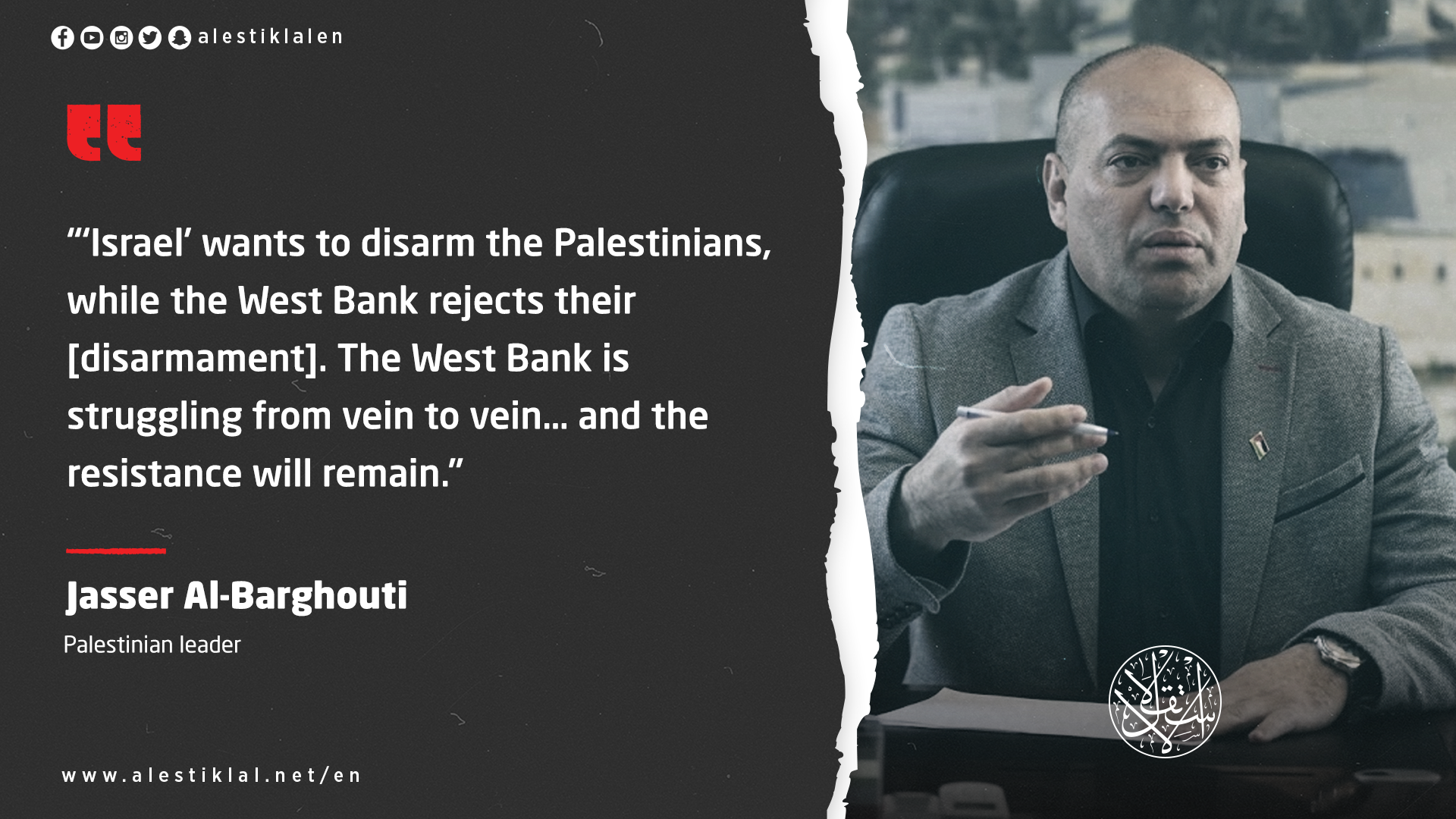
“Israel” wants to disarm the Palestinians while refusing to grant them a state.
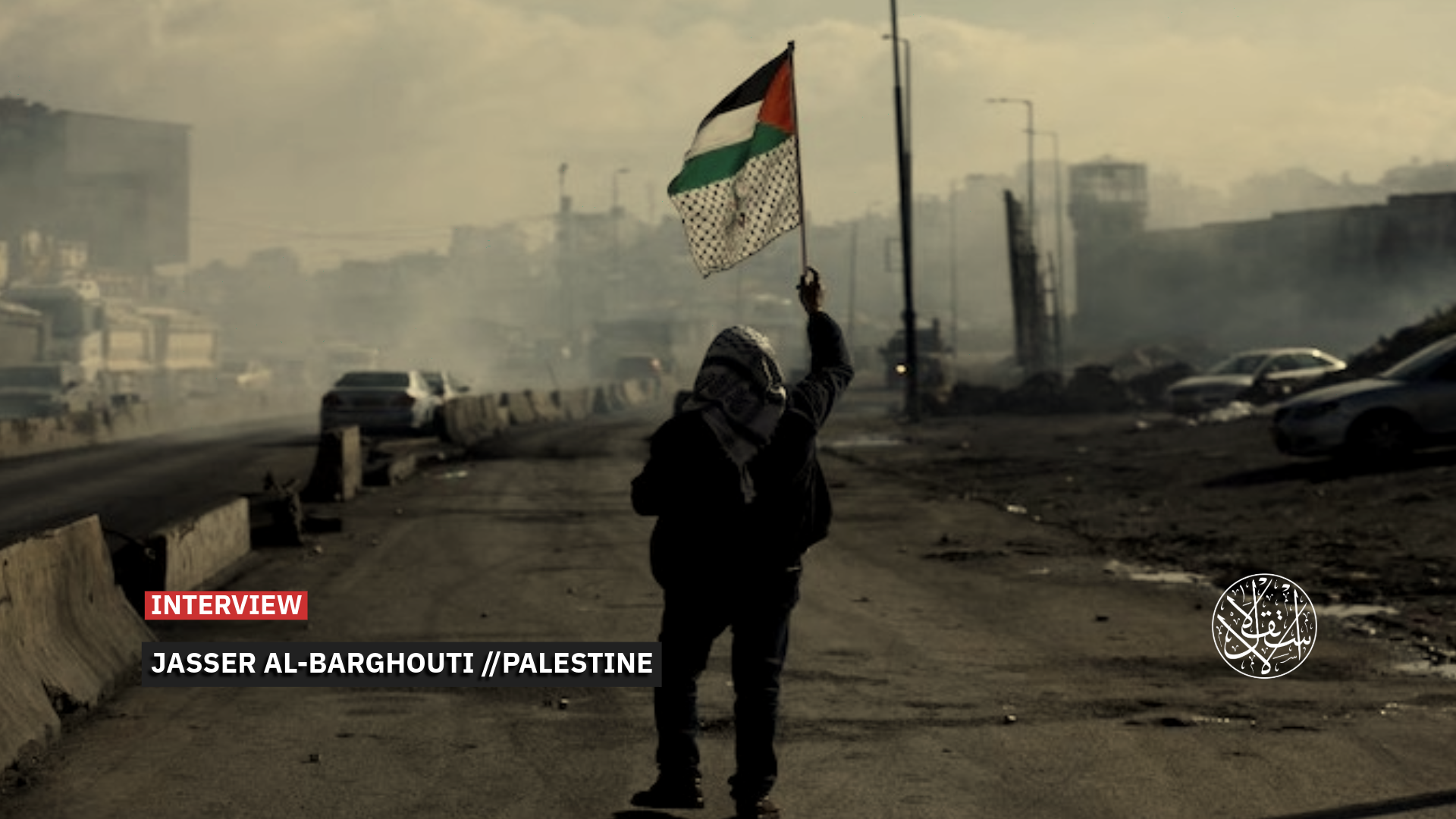
Palestinian leader Jasser al-Barghouti said that the West Bank is currently suffering from “two occupations,” attributing this to the policies of the Palestinian Authority’s security forces, which he said are aligning with the Israeli occupation in restricting resistance fighters in the West Bank.
Al-Barghouti stressed the need to pressure the Israeli occupation, which he said has not halted its war on the Gaza Strip to date and has also failed to honor any of its commitments under the first phase of the ceasefire agreement.
While emphasizing that the resistance factions are not currently considering a military escalation in Gaza or the West Bank, al-Barghouti warned of the “anger of the Palestinian people,” who are subjected to daily violations that could drive them to rise up at any moment.
Al-Barghouti is considered one of the figures involved in Palestinian national action and is active in managing several institutions supporting prisoners and their families.
He was also one of the founders of the resistance movement in the West Bank during the 1980s and 1990s, before being arrested in 2003 and sentenced to life imprisonment.
He subsequently assumed several organizational and administrative roles while in prison, until his release in 2011 as part of the “Loyalty to the Free” prisoner exchange deal.
The West Bank Under Two Occupations
As one of the prominent figures of the West Bank and a Palestinian political leader who supports the resistance approach there, how do you assess the situation in the West Bank now, three years after the Al-Aqsa Flood?
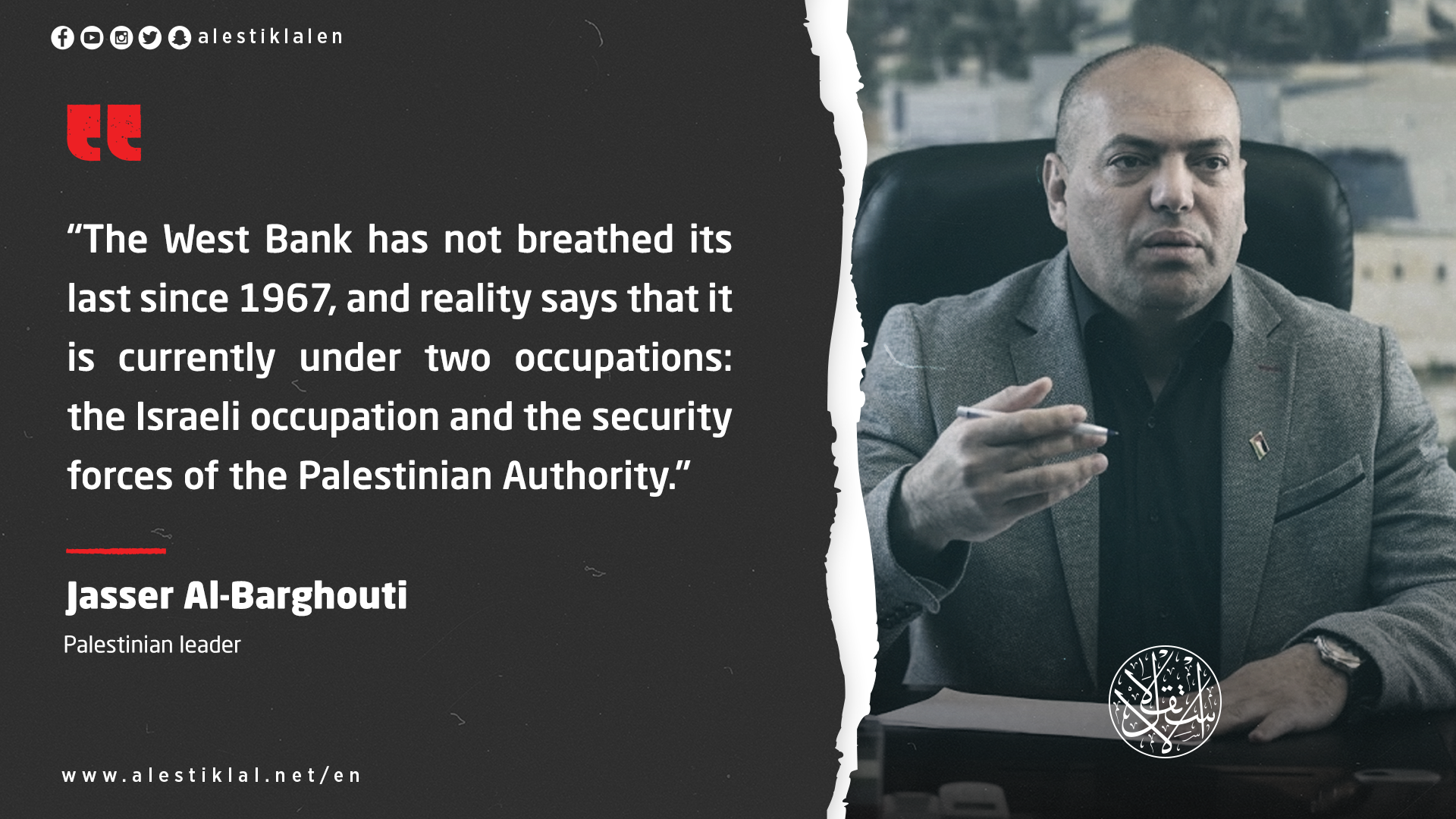
The West Bank has not had a chance to catch its breath since 1967; it has remained in a state of constant mobilization and attrition. The reality is that it is currently under two occupations.
There are 70,000 armed personnel in the West Bank who are committed to providing security for “Israel” so that the Palestinian Authority can remain in place.
Even President Mahmoud Abbas, “Abu Mazen,” made his famous remark, “We bring them information they could never dream of obtaining.”
On the other hand, with regard to the Israeli occupation, we see daily attacks by settler mobs against residents of Palestinian villages and towns, with the support and protection of the occupation army.
At the same time, the Palestinian Authority’s security forces assist them by summoning or arresting anyone suspected of potentially becoming involved in any act of resistance.
The West Bank is being slaughtered from vein to vein, but the scale of the bloodshed and massacres in Gaza since the Al-Aqsa Flood has, to some extent, obscured the situation in the West Bank.
As I mentioned, the process of dismantling the West Bank has been underway for decades. After the 2000 Intifada, the occupation discovered that there was a solid and strong resistance infrastructure.
At the time, the Preventive Security forces, even under the leadership of Mohammed Dahlan in Gaza and Jibril Rajoub in the West Bank, had a revolutionary and national character, and included among their ranks released prisoners and members who supported the resistance approach.
Therefore, when the Intifada erupted, the resistance factions cooperated with some members of the security forces and obtained weapons from them.
For example, most of the weapons I obtained at the time came from members of the Palestinian Authority’s security forces.
The Security Doctrine
And what was the Israeli occupation’s response at the time to the positive cooperation between the resistance factions and the Palestinian Authority’s security forces?
The Israeli occupation realized that this structure had to be dismantled. One of its key strategies for achieving this was to change the security doctrine of the Palestinian Authority. This took shape after 2007 in what became known as the “Dayton Plan,” which aimed to restructure and train the Authority’s security forces in the West Bank and expand their control to confront the resistance factions, particularly in the aftermath of the Palestinian division.
From that point onward, the national elements within the Authority’s security forces were replaced by others who had no connection to resistance activities.
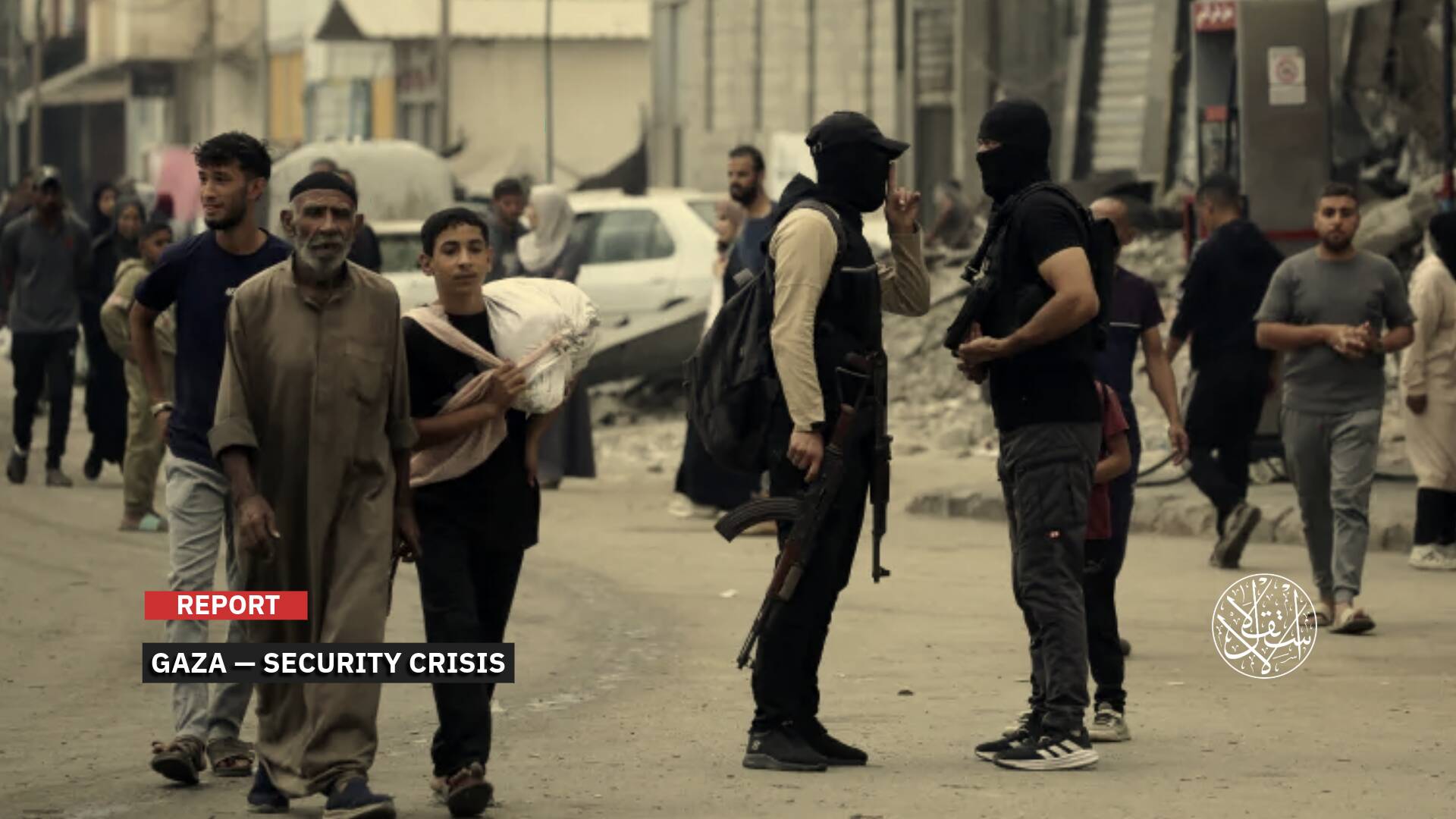
One could even say that their conduct resembles that of the militia members operating inside the “Yellow Line” area controlled by the occupation in the Gaza Strip.
Despite these suffocating circumstances, the resistance in the West Bank was gaining momentum. We saw what happened in the Jenin and Nur Shams refugee camps before the Al-Aqsa Flood.
But things changed considerably after the “Flood,” as the level of violations against the West Bank and its people increased, whether by the Israeli occupation or the Palestinian Authority, in addition to the unlimited Western support for “Israel”.
As a result of the repressive policies of the Authority’s security forces, Palestinians in the West Bank have come to fear even protesting or demonstrating in support of Gaza.
The Authority, along with the occupation, has become fearful of losing control and seeing their project turn in favor of the resistance, and of a repeat of what happened in 2000. As a result, businesses are disrupted, schools and universities are closed, and education shifts to remote learning.
Given this difficult situation that you describe, both in terms of the occupation and the Authority, is there a possibility of restoring vitality and improving conditions in the West Bank once again?
The Palestinian people are a stubborn, brave, and valiant people. We may see the situation now as completely bleak, but their actions could surprise everyone. This is the nature of our people.
When I was arrested in 2003 along with more than 40 people from the national action groups in the West Bank, during the interrogations, the officer said to me, “We have arrested Hamas’s army. This is the last group in the West Bank, and there are no other groups.”
But I corrected him and told him that there was another group. He thought I was going to confess to the existence of another operational cell that they knew nothing about, so he asked me, “Who is it?”
My answer was, “This group is the entire Palestinian people. As long as this people remains on this land, the struggle will continue to exist, even if its people and methods change.”
This conversation took place 20 years before the Al-Aqsa Flood, and we have all seen how the Palestinian people have struggled over the course of two decades, in the West Bank, Gaza, and the occupied Palestinian interior, as well as in the countries of the diaspora.
Therefore, despite the immense challenges facing our cause, I affirm that hope will remain in our Palestinian people, who have grown accustomed to surprising everyone. Indeed, they even surprise the Palestinian leadership itself.
Handing Over Weapons
If we move from the situation on the ground in the West Bank to the scene in Gaza… Since the ceasefire agreement, the Israeli occupation has been citing the provision requiring the resistance factions to hand over their weapons as a precondition for moving to the agreement’s second phase. What is your view of this provision? And will the factions hand over their weapons?
The occupation wants nothing less than to eradicate the Palestinian people, not just Hamas, and not just the factions.
Take the West Bank, for example. Are there heavy weapons or missiles there? No. Everyone knows this, yet the killing machine continues to operate against the people of the West Bank.
The occupation is merely using the issue of weapons as a pretext because it is a broad and vague issue that it can sell to the Americans and Europeans. Its actual objective is to prevent anything from being delivered to Gaza and to displace the people of the Strip, or, at the very least, confine them to a small area with none of the basic necessities of life.
The occupation is pursuing the same policy in the West Bank. They are bulldozing the refugee camps, making people's lives more difficult, and attacking villages and towns, seeking to displace them and drive them from their land, even though there was no “flood,” as they claim in Gaza.
The whole world can see these violations, but the question now is: What is the position of the factions on handing over their weapons?
Before asking the Palestinian people and their factions to surrender their weapons, it is important to answer the question: What is the future of the Palestinian people?
The Israelis are now rejecting any discussion of a Palestinian state, so how can the world ask the Palestinians to disarm for the sake of an entity that does not even want to allow them the right to establish a state?
I say this very clearly: Under the current circumstances, handing over the weapons means accepting the slaughter of the Palestinian people, if not at the hands of the Israeli occupation, then at the hands of those militias and groups that operate under the occupation’s watchful eye, behind the Yellow Line.
Nevertheless, I would say that the Palestinian factions have shown considerable flexibility on this issue, and they will do everything within their ability to serve whatever is in the interest of the Palestinian people. Even Hamas, which carried out the “Flood,” is prepared to go as far as necessary to protect its people.
But before discussing the issue of weapons, or at least alongside it, there are many other points that must be discussed and put on the table.
There is also a fact that many people overlook when discussing this provision or any other: the occupation did not implement any of its previous commitments under the initial ceasefire, so it cannot be said that it needs a pretext to avoid proceeding with the subsequent phases of the ceasefire.
Speaking of the ceasefire and the commitments made under its first phase, the Palestinian Ministry of Health in Gaza reports that more than 1,250 people have been killed since the ceasefire came into effect, in addition to thousands of wounded. Meanwhile, the occupation justifies its attacks by claiming that it is assassinating a member or leader of the resistance. In this context, do you expect the war to resume?
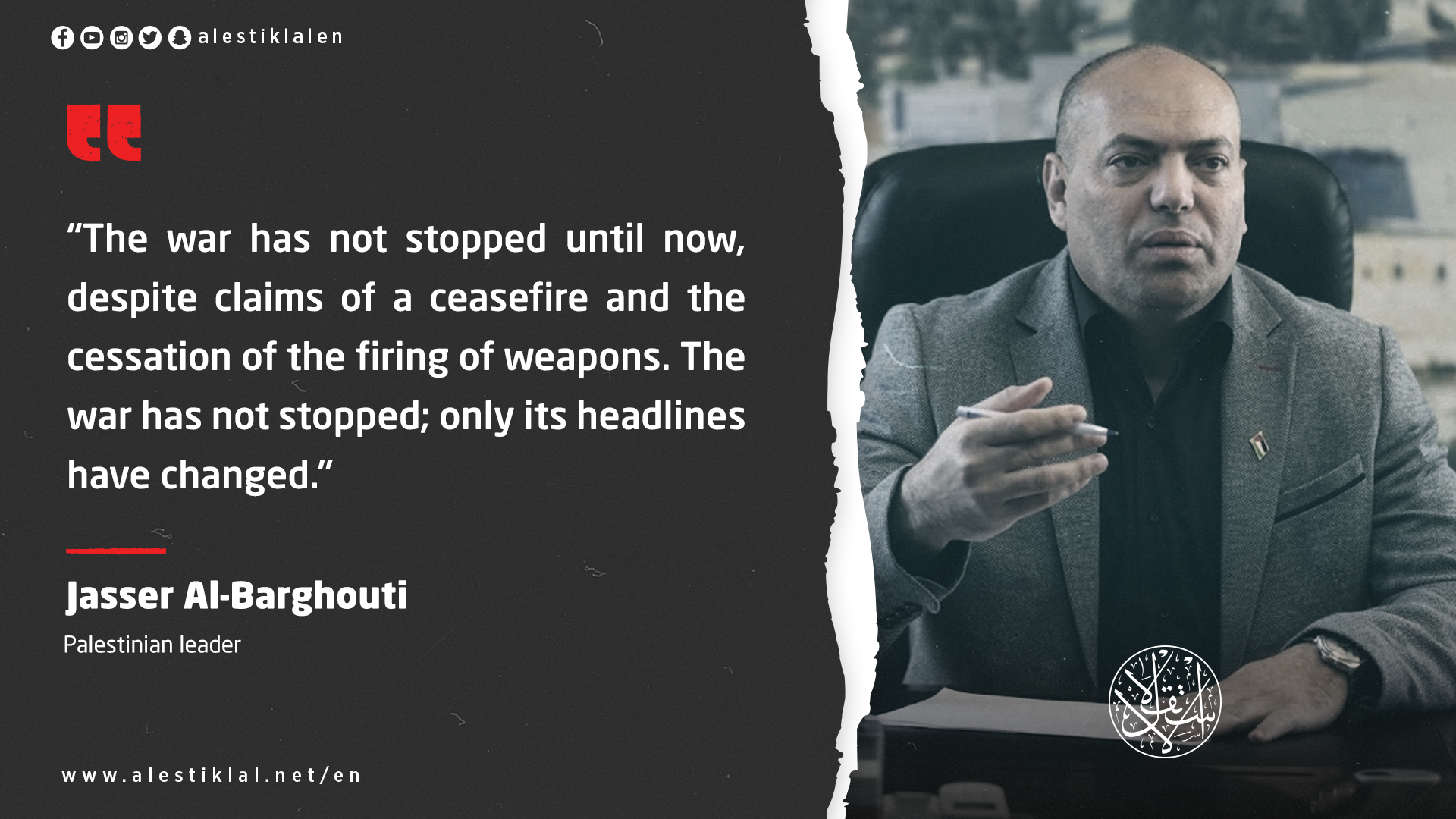
The question should actually be: Has the war stopped? The war has not stopped to this day, despite the claims of a truce and ceasefire. Yes, there has been a decline in the number of people killed, but, as I mentioned, thousands of our people have been killed and wounded over the past few months.
But I would like to point out that this figure represents only those who were killed directly by Israeli occupation fire and airstrikes. There are thousands of others who are dying silently from disease, hunger, and the blockade. The war has not stopped; only its headlines are changing.
The war has not stopped because we are dealing with an extremist right-wing government that has failed on every front and at every level. It has not resolved the situation in Lebanon, nor has it settled the situation with Iran, which constitutes a point of weakness ahead of the upcoming Israeli elections.
Therefore, there is genuine concern that this extremist Israeli government may try to use the blood of the Palestinian people as fuel to keep itself in power for years to come by increasing the pace of killings.
What if the occupation continues its operations and violations, or even intensifies them? Could the Gaza Strip see a return of operations by the resistance factions, which have been suspended since the ceasefire?
Putting the factions aside, the occupation’s policies will bring the Palestinian people to a moment similar to the First and Second Intifadas.
The occupation will be surprised to find ordinary civilians who are not affiliated with any organizations standing up to it and resisting it with knives and stones, if necessary.
With such a huge number of people killed, wounded, and detained, can someone who has lost every member of their family be expected to accept the existence of an agreement? When such a person finds any opportunity to carry out an act of retaliation, they will inevitably act.
The factions themselves are not currently considering escalation or retaliation, out of concern for their people. But those same people could erupt at any moment because of what they are suffering.
What is the position of the mediators regarding these daily violations committed by the Israeli occupation in Gaza?
Unfortunately, the occupation violates its agreements everywhere, not only in Gaza, and there is no state capable of restraining the occupation and making it stop.
It enters Lebanon, strikes Syria, and wages war on Iran. At times, it also seeks to exploit some Gulf countries to escalate the war. The reality is that no one is imposing any limits on the occupation. What, then, of the besieged and unarmed Palestinian people?
The parties sponsoring the agreement are supposed to be responsible for pressuring the occupation to comply.
Even the provisions of the first phase have not been implemented; people are still living in tents, food remains insufficient, institutions are in a state of disrepair, hospitals are deteriorating, medicine is scarce, and the Strip still lacks the basic necessities for normal life.
The Failure of Displacement
Are you calling on these countries to take action and exert pressure to stop these violations?
The parties guaranteeing the agreement should, in principle, take action and proactively pressure the occupation without waiting for us to ask. But it seems that no one is capable of putting pressure on the occupation.
Nevertheless, we thank Turkiye, Qatar, and Egypt. These countries have made significant efforts since the beginning of the war to stop “Israel’s” war against the Palestinian people.
That said, we had hoped that the Arab and Islamic positions would have gone further than what was offered.
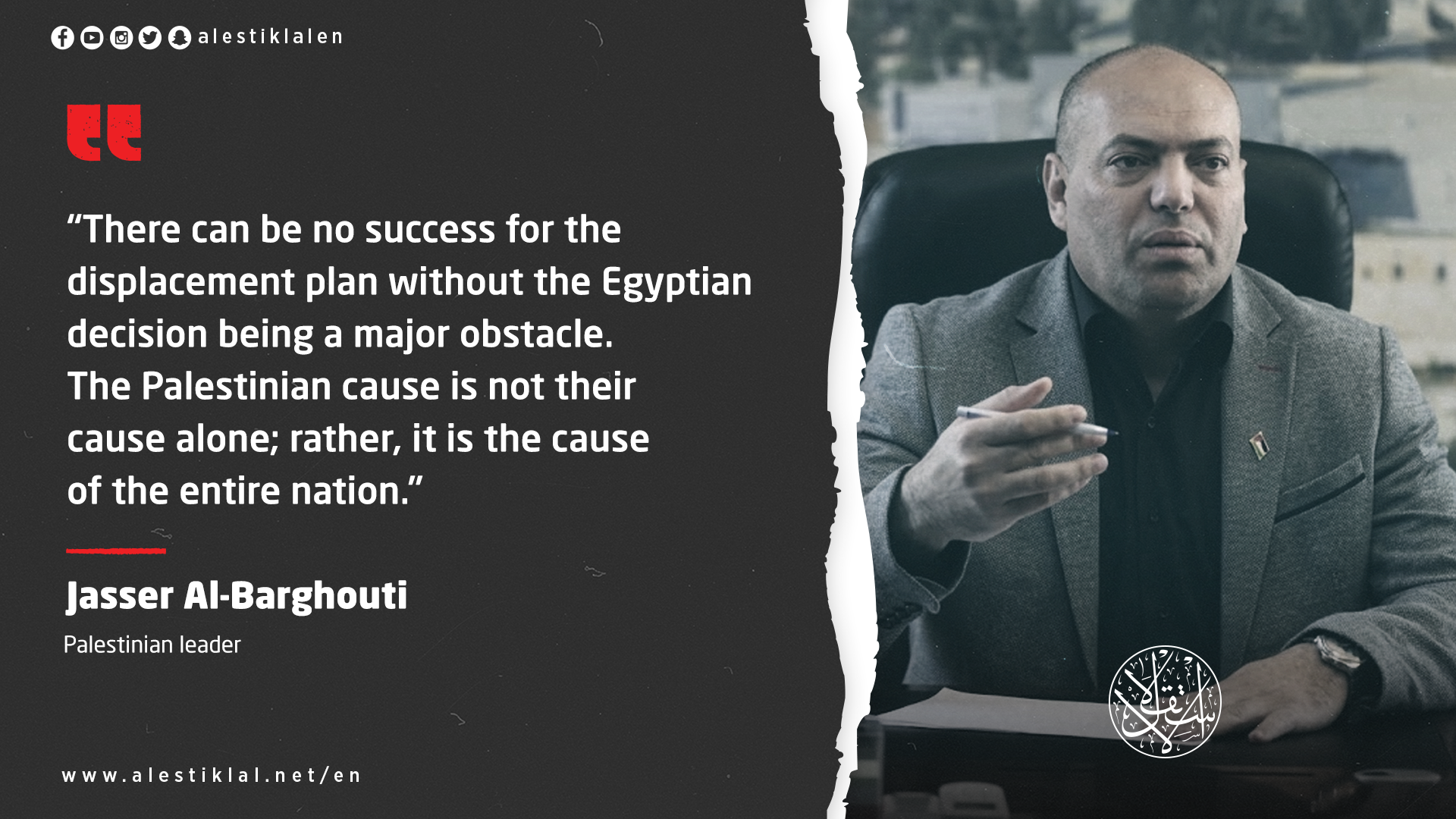
The Palestinian suffering is immense, and this is not an issue concerning Palestinians alone; it is an issue concerning the entire nation.
The occupation does not seek to control Gaza or the West Bank alone; it wants to dominate the entire region.
On that point, many believe that Egypt’s position on the war did not go far enough. Do you agree?
The truth is that the entire world fell short when it came to the war on Gaza. But fairness requires us to state clearly that the Egyptian decision was, to a large extent, what prevented the displacement plan from succeeding.
Imagine if the crossing had been opened to ordinary civilians facing intense belts of fire. What would the situation have been then?
Yes, many members of the steadfast Palestinian people and its valiant resistance would have remained. Nevertheless, as a matter of basic human instinct, tens of thousands of people from the Strip would have left.
Incidentally, this skepticism is not directed at Egypt’s position alone. Even in Turkiye, we meet some Turks who are dissatisfied with the official Turkish position and who say to us: What has Turkiye provided other than some aid?
But the truth is that the Turkish president’s position from the outset served as political cover that protected the political legitimacy of the resistance. From the very first day, he declared that he regarded Hamas and the resistance factions as national liberation movements.
Nevertheless, yes, we had hoped that the Arab and Islamic positions would have gone further than what was offered.
The Palestinian suffering is immense, and this is not an issue concerning Palestinians alone; it is an issue concerning the entire nation.
The occupation does not seek to control Gaza or the West Bank alone; it wants to dominate the entire region.
A few weeks ago, Palestinian Authority President Mahmoud Abbas announced the date of the next Palestinian legislative elections. How do you see this affecting the Palestinian-Palestinian division?
The real problem with the Palestinian division is not the elections; rather, it is a division between two different visions.
Unfortunately, the Authority believes that the closer it gets to Hamas or the other resistance factions, the more its legitimacy in the eyes of the Americans and Israelis will diminish.
President Abu Mazen and those around him believe that renewing his legitimacy is linked to the extent to which he resists efforts to move closer to the Palestinian resistance.
It is also important to maintain dialogue and rapprochement among the national factions of various orientations, because the division causes enormous harm to the Palestinian people, and only the occupation and its allies benefit from it.
Recognizing this fact and acting accordingly can help bridge the gap between Palestinian leaders, at least with regard to official national positions toward external parties.
Internal disputes should be resolved among Palestinians themselves, and the occupation or the Americans should not be allowed to intervene in them or influence their various components.