Ashraf Ghani, the Afghan President Who Fled His Palace After Taliban’s First Attack
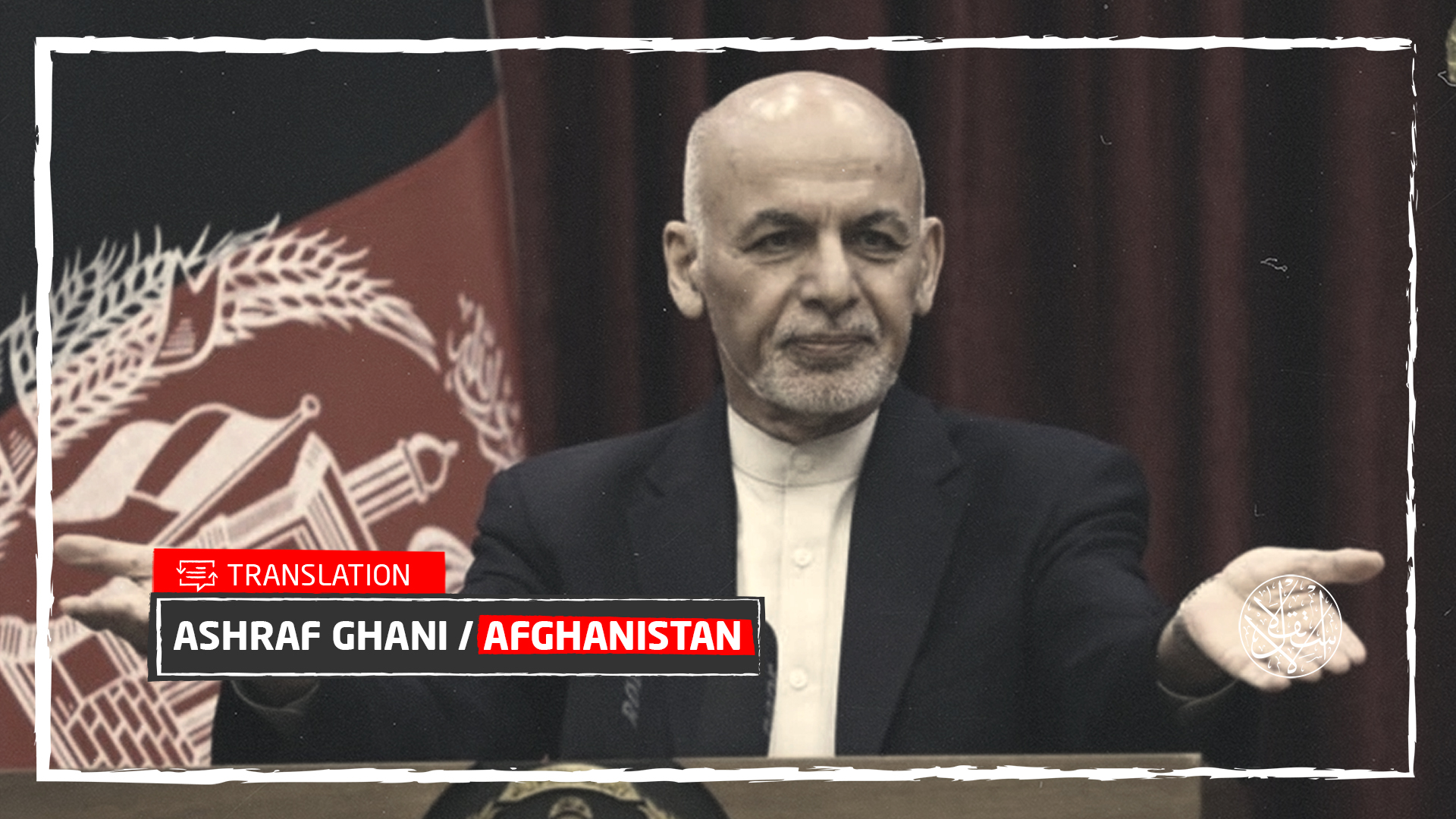
Twenty years ago, when America began its fierce war on Afghanistan, in an operation launched on October 7, 2001, under the name of "The Enduring Freedom"; The Taliban movement was at the forefront of the Afghan political scene.
The Taliban forces have for years been under the American attack in the Afghan capital, Kabul, and in the Tora Bora mountains, in which the movement fought its fiercest battles against the international coalition forces led by Washington.
After about a year of American intervention, specifically on November 13, 2001, Kabul fell and the Taliban were defeated.
After two decades of war, negotiations, and compromises; American forces left Afghanistan, and the Taliban returned to Kabul again, after waging a war against the forces of the government of Afghan President Ashraf Ghani, who fled after the Taliban vowed war and steadfastness.
"America's man," as they say, did not withstand the confrontation after the Taliban army reached the outskirts of the capital, Kabul, so he fled the country amid sharp criticism from members of his collapsing government.
Ashraf Ghani, who started his career in the academic and scientific career and held American citizenship, ended up as a political refugee.
After he ruled his country for years, his history was linked to the defeated leaders in the world, while his name was written in the record of the presidents who fled and left their countries in times of crises and conflicts.
Personal Life
Muhammad Ashraf Ghani, the 14th President of the Republic of Afghanistan, was born in the Afghan state of Logar on May 19, 1949, to a family belonging to the highly influential "Pashtun" tribes in Afghanistan.
To find out the extent of the influence of his tribe, the "Pashtuns" are an ethnic group inhabiting southern and eastern Afghanistan, the northwestern border regions, and the province of Balochistan in western Pakistan.
Afghanistan is the mother country of the "Pashtun" tribes, as they constitute more than 62 percent of the population, equivalent to 25 million people.
In addition, "Pashto" is the official Afghan language with "Dari", and leadership in Afghanistan always belongs to the "Pashtun" tribes alone, according to the prevailing custom.
Ghani received his primary and secondary education in schools in the capital, Kabul, before he traveled to Lebanon to enroll in the American University of Beirut, where he obtained his BA in 1973.
While studying in Lebanon, he met his future wife, Rola Saadeh, a Maronite Christian who studied at the same university.
Ghani returned to Afghanistan in 1977 to teach Afghan studies and "anthropology" at Kabul University before receiving a government scholarship in 1977 to obtain a "Master's" in anthropology, at Columbia University in America.
When the Communist Party took power in Afghanistan in 1978, it cramped liberties, and unleashed the grip of the security services, most of Ghani's family members were arrested, while he was in America at that time.
His could not return to Afghanistan. He continued his academic path and obtained a doctorate in cultural anthropology from Columbia University. Then he taught at the University of California, Berkeley in 1983, and Johns Hopkins University, from 1983 to 1991.
During that period, he worked as a commentator on BBC Radio, which broadcasts to Afghanistan in Persian and Pashto languages, while he joined the World Bank in 1991.

Back to Kabul
During the great years of turmoil in Afghanistan, starting with the Soviet rule, the Afghan-Soviet war, the civil war, and finally the rule of the Taliban, Ashraf Ghani remained outside the country, and his exile lasted for about a quarter of a century.
During that period, Ghani worked as an academic in American universities, as a prominent international employee, and lived in America and obtained its citizenship.
Yet, months after the US invasion of Afghanistan in 2001, he resigned from his international posts and returned to Kabul, becoming a senior advisor to the newly appointed President Hamid Karzai.
In 2002, Ghani held his first official position in the Afghan government, when he became Minister of Finance, while the most distinguishing features of his tenure were that he introduced a new currency, established a tax system, and encouraged the rich Afghan expatriates to return.
Ghani resigned in 2004, after disagreements with President Karzai, to be appointed as a professor at Kabul University, and at the same time set up a research institution based in Washington, to work on the policies of what he called "empowering poor peoples" in the world.

Towards the Presidency
Ashraf Ghani's aspirations for the presidency began in 2009, when he ran for the presidency, but the results were shocking, as he came in fourth place with 4 percent of the vote.
Ghani did not hesitate, continued his public work, and headed the body that oversees the transfer of security tasks from NATO to the Afghans.
In 2010, Ghani was named one of the world's 100 most prominent thinkers, by the American "Foreign Policy" magazine, to increase his popularity in Afghanistan.
In 2014, Ghani fought the fiercest electoral battles in Afghanistan, winning 31.6 percent of the vote in the first round, compared to 45 percent for his rival Abdullah Abdullah.
In the second round, Ghani won 55 percent ahead of Abdullah, despite suspicions of fraud in the polling process, after which his opponent refused to acknowledge the results.
Afghanistan at that time entered a real crisis with which the entire political process was disturbed, until then-US Secretary of State John Kerry intervened and pledged an agreement to share power between Ghani and Abdullah.
Ghani gained the presidency and assigned his rival Abdullah the position of chief executive.
Ghani's first decisions were shocking to Afghans when he chose the Uzbek warlord, General Abdul Rashid Dostum, for the post of vice president, even though he is accused of committing human rights violations against Afghans.

Turbulent Era
There are various differences between scientific theories and practical reality.
Here is Ashraf Ghani, a researcher and teacher of political sciences and humanities, who became president of Afghanistan in complicated circumstances and a difficult reality.
At the beginning of his term, Ghani said: "He does not intend to lead with absolute authority" indicating that he will open up to all Afghans.
Yet, Pakistani writer Ahmed Rashid, who has been close to Ghani for about 30 years, said: "No one was allowed to get close to him."
He considered that his repeated outbursts of anger and arrogance towards his Afghan citizens, "made him a truly hated figure," according to "AFP" August 16, 2021.
Despite Ghani's constant pledges to rebuild his country and eradicate corruption, during his years of rule, he became a symbol of the collapse of the state in Afghanistan.
Although Ghani holds American citizenship and is considered one of the presidents close to the White House, his relations with Washington suffered a setback in recent years.
President Ghani was sidelined in the negotiations that America conducted with the Taliban in the Qatari capital, Doha, starting in March 2020.
Washington excluded him from the talks after the Taliban refused his participation, while he was later forced to release 5,000 members of the movement as part of those negotiations.
The Taliban rejected all of Ghani's peace initiatives, describing him as a mere "puppet" of Washington.

The Great Escape
The Afghan president was on a date with destiny on August 15, 2021, when Taliban spokesman Zabihullah Mujahid announced that military units from the “Islamic Emirate of Afghanistan” had entered the city of Kabul and were advancing towards the presidential palace.
This Taliban advance comes after Ghani promised the Taliban for months of war and resistance, declaring that they would fight the insurgents for generations to come if negotiations failed.
Ghani's promises went unheeded, with his decision to flee the country, when he said on Facebook: "Today I faced difficult choices, either facing the Taliban militants who wanted to enter the presidential palace or leaving the country I dedicated my life to protecting."
The Afghan Defense Minister, General Bismillah Mohammadi, criticized the fugitive president and senior Afghan officials, saying via Twitter: "They let down the country, Curse on Ghani and his gang."
While Abdullah Abdullah, the most senior Afghan official concerned with the peace process, described Ghani as "the former president", and held him responsible for the state of the country, stressing that "the people will judge the former president and God will hold him accountable."
Abdullah, who heads the Supreme Council for National Reconciliation, said in a video message that he posted on Facebook: "He left the country in this difficult situation."