1,000 Quranic Study Circles and 20,000 Students: How Gaza Has Sustained Quranic Education Amidst the War
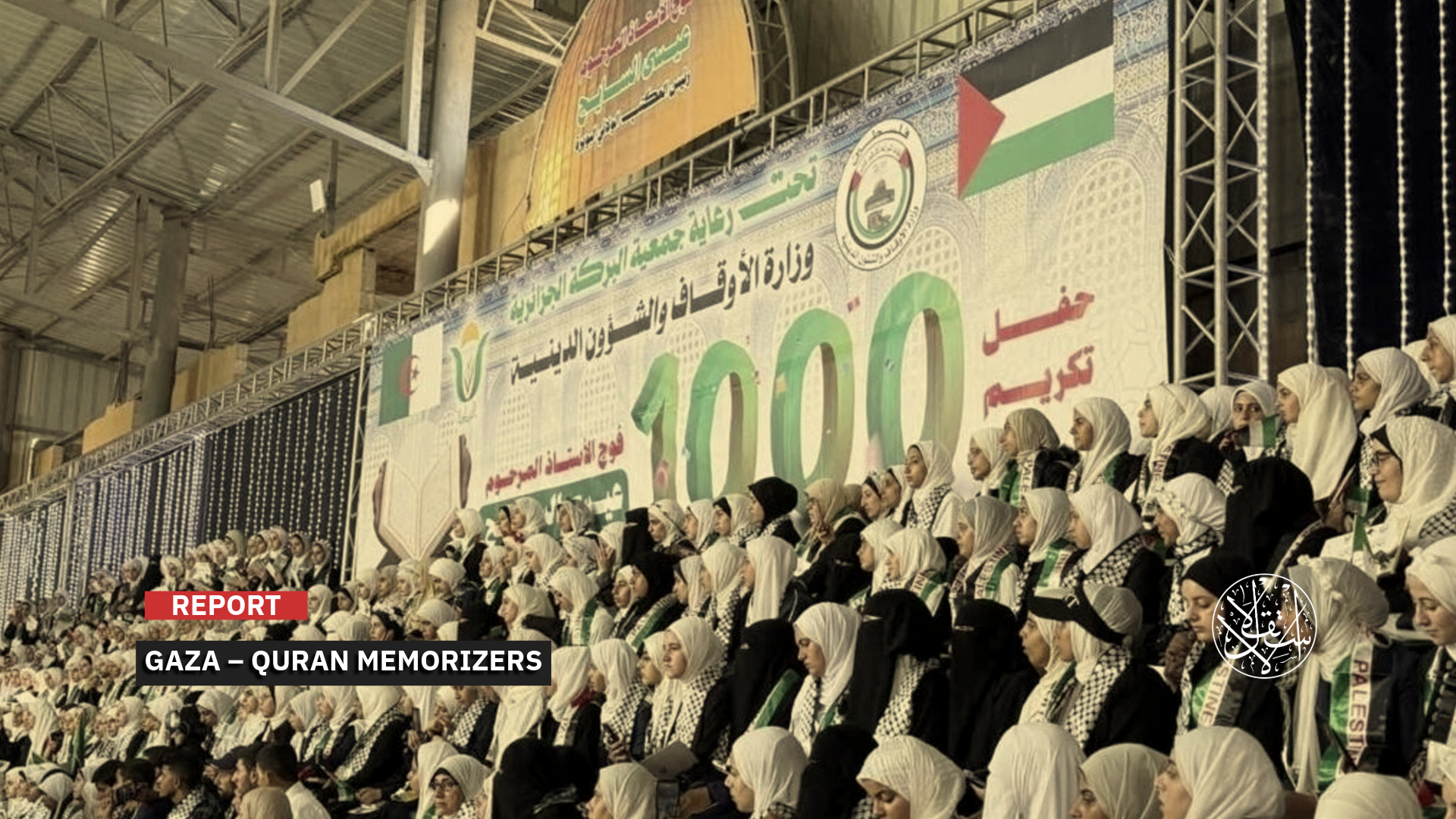
The ceremony honored 1,000 male and female Quran memorizers under the sponsorship of Algeria’s el-Baraka Association.
Children, girls, and young men took to the streets of Gaza, holding up copies of the Quran and chanting religious songs before making their way to a ceremony organized by the Ministry of Endowments and Religious Affairs on November 12, 2026. The event honored 1,000 young men and women who had memorized the Quran, under the sponsorship of Algeria’s el-Baraka Association.
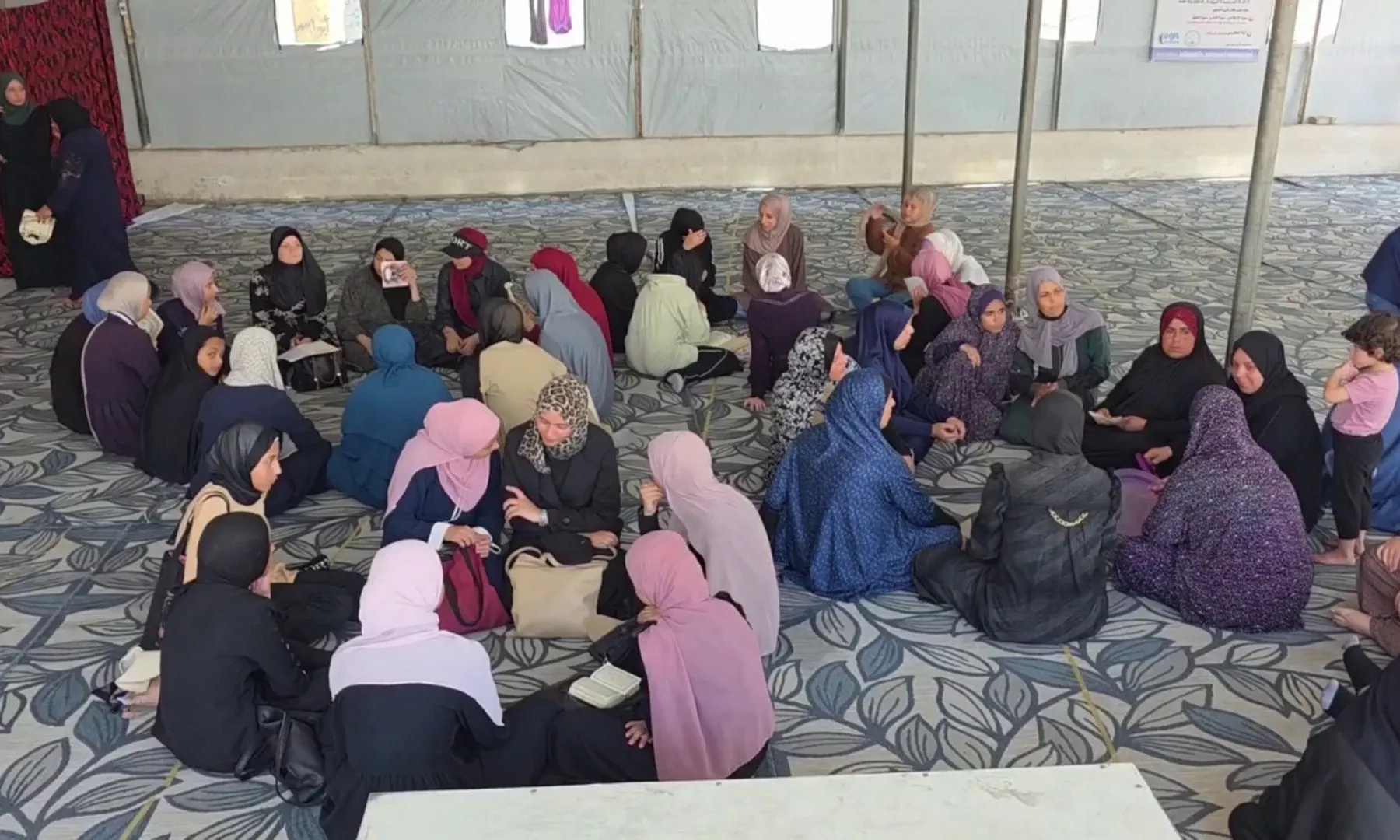
Behind the celebrations were years of perseverance, as children continued learning in displacement camps, cramped homes, and makeshift prayer spaces set up after the Israeli Occupation destroyed most of Gaza’s mosques. Quran teachers and families kept guiding them through the memorization process, despite repeated displacement, loss, and injury. Even as children were forced to move from one shelter to another, Quran classes continued to welcome new generations.
The ceremony came as Israeli Occupation’s aggression on Gaza continued unabated. Since October 7, 2023, the Israeli Occupation has killed nearly 22,000 children, according to the Government Media Office, while 1,244 of the Strip’s 1,275 mosques have been hit in Israeli attacks, according to the Ministry of Endowments. Children continue to die in bombardments despite the ceasefire announced in October 2025.
How have Gaza’s children managed to memorize the Quran amid war? Who has kept them going as families are torn apart and learning centers reduced to rubble? And how have families, charitable organizations, and religious authorities joined forces to keep this tradition alive?
It Starts at Home
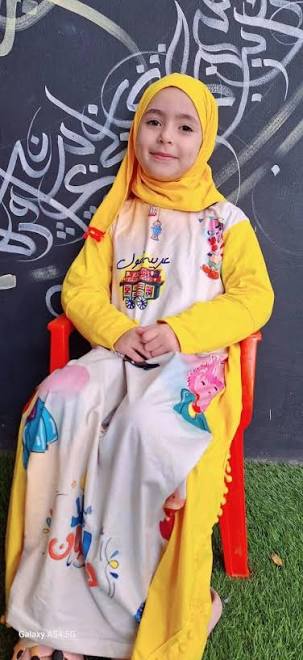
For Alma al-Ghuti, who completed memorizing the Quran at the age of seven, the journey began at home. In accounts shared with local media, she said she initially memorized one page a day while regularly reviewing previous passages, gradually building her capacity. Her family said she completed the Quran in about a year, despite being repeatedly displaced to escape Israeli bombardment. Even after settling in a house, she had no quiet corner where she could sit alone with her Quran.
Her mother, a specialist in Arabic, took charge of teaching and listening to her recitations. The family also relied on repetition and recordings by renowned Quran reciters Abdul Basit Abdus Samad and Mahmoud Khalil al-Hussary. Alma had already mastered reading and writing before beginning memorization. She gradually increased her daily target from one page to two and then three, until she completed the entire Quran.
Memorization did not take over the rest of her day. She still had time for learning languages, drawing, and playing. Her mother kept track of when she was motivated, tired, or distracted, helping her pick up where she left off whenever she lost momentum.
The experience of eight-year-old Fatima Helles shows how this support can extend across three generations. Her parents helped her get started, then she continued learning with her grandmother, who teaches girls to memorize the Quran, before joining camps organized by Iqra Charity.
Fatima was displaced from Gaza City’s Shujaiya neighborhood to the south of the Strip before returning to live in a tent on al-Tunnel Street in Gaza City. There, she found a Quran class where she could continue her studies. She recalled memorizing a surah and reciting it flawlessly to her family. Her progress encouraged her to keep going, even when family members were busy. In September 2026, she celebrated completing the Quran.
Twelve-year-old Habiba Mohammed Abu Ajwa spoke of a woman who took her in after she lost her mother as a young child and supported her for six years until she completed memorization. In July 2026, Habiba appeared at a ceremony honoring 600 children organized by Operation Gallant Knight 3, expressing gratitude to the woman who had stood by her throughout her Quran journey.
Quranic Study Circles Despite Displacement
But finding a Quran teacher or maintaining a regular review schedule has become increasingly difficult, with obstacles extending far beyond the walls of the home. Chief among them is the destruction of most of Gaza’s mosques, traditionally the main centers for Quran memorization classes.
In February 2025, the Ministry of Endowments announced that the Israeli Occupation Army had completely or partially destroyed 1,109 of Gaza’s 1,244 mosques, targeted around 30 religious institutions, and killed 315 ministry employees, preachers, and imams. Faced with the loss of places of worship and learning, the ministry joined charitable organizations in establishing more than 400 prayer spaces, some of which began hosting Quran classes inside displacement camps.
The initiatives launched by charitable organizations reveal what it takes to keep these classes running. Darul Itqan launched a campaign to cover Quran learning spaces with tarpaulins ahead of the winter of 2024, warning that more than 250 centers were at risk. At the start of the campaign, it announced that it had secured coverings for 30 classes.
Quran teachers later spoke of shortages of copies of the Quran and seating, as well as overcrowding and unpredictable weather. Some families turned to their phones to stay in touch with former female Quran teachers who continued monitoring their daughters’ progress remotely.
Repeated displacement has also disrupted children’s ability to memorize regularly. Two girls, Tala and Siwar, had to stop their lessons as their family moved from place to place. They eventually returned to a nearby center after settling in Gaza City’s al-Daraj neighborhood, where their younger sister joined them. In al-Mawasi, Khan Younis, a mother recounted how her daughter continued learning despite being displaced more than 12 times.
For some girls, the journey to completing the Quran continued alongside the struggle to recover from physical injuries. Reem Abu Odeh finished memorizing it while receiving treatment for wounds sustained in an Israeli bombardment, with the support of her sister Safaa. She said she wanted to dedicate her completed memorization to her martyred mother. At the time, she was also preparing for her high school exams.
Another young Quran memorizer lost both parents and her siblings when an Israeli strike hit their home. With the support of her uncle’s family, she continued attending Quran memorization camps, holding on to her father’s wish to see her complete the Quran.
Together, these accounts show how the responsibility for keeping children on track passes between relatives and Quran teachers whenever displacement, bereavement, or medical treatment interrupts their lives.
A War on Mosques and Childhood
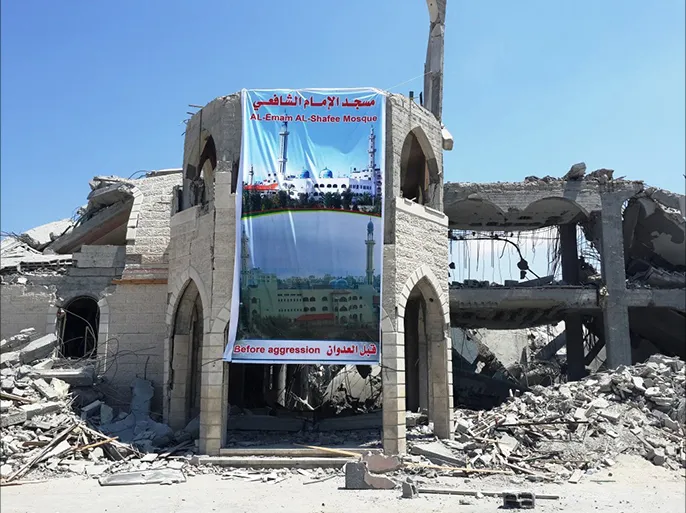
The stories of Gaza’s young Quran memorizers are part of a much larger toll exacted by the Israeli Occupation’s war on the Strip. The Ministry of Endowments says 1,244 of Gaza’s 1,275 mosques have been targeted, with 1,077 completely reduced to rubble. Today, worshippers have only 652 places where they can perform religious rituals: 224 functioning mosques and 428 temporary prayer spaces.
The ministry has used tarpaulins and wooden structures to make 65 mosques usable again, while another 142 remain awaiting rehabilitation. Gaza City has also lost three churches, all completely destroyed. Attacks on places of worship have continued despite “the ceasefire.” Among the latest war attacks condemned by the ministry in August were the bombing of the historic Abu Salim Mosque in Deir al-Balah and the prayer hall of al-Askalan Mosque in Shati refugee camp.
The toll on children is equally devastating. According to figures released by the Government Media Office on October 11, 2026, the number of children martyred has reached 21,976, including 1,125 infants who never lived to see their first birthday. The war has also left 62,247 children orphaned, including 2,774 who have lost both parents. Meanwhile, the overall death toll reported by the Ministry of Health has reached 74,699.
The “ceasefire” has offered little protection for Gaza’s children. Salim Oweis, a spokesperson for the United Nations Children’s Fund (UNICEF), reported that around 360 children had been martyred and more than 1,700 injured since it took effect. UNICEF Regional Director Edouard Beigbeder had called on Israeli Occupation authorities to take immediate and decisive action to protect children in accordance with international humanitarian law.
How Do Endowments Manage Quranic Processions?
With Quran learning centers scattered across the Strip, the Ministry of Endowments has taken responsibility for administering exams and monitoring students through its General Directorate of the Quran and Sunnah and its provincial offices.
Figures released by the ministry for the first half of 2026 show 1,058 Quran memorization classes serving 20,533 students, alongside 167 classes run by the Quran Memorization Council, with 1,709 students enrolled. The ministry also opened 631 new classes during the same period.
On September 6, 2026, full Quran memorization exams began before eight committees spread across the five governorates, following months of preparation and supervision by Quran teachers and program coordinators. When the results were announced in early November, the ministry reported that 946 of the 1,025 candidates had passed, a success rate of 92.3 percent. Of those, 601 received excellent marks.
Hiba Adnan Shafiq al-Hums, from Rafah, ranked first with a score of 99.25 percent. She had attended Quran memorization centers in Khan Younis. Pass rates reached 100 percent in Rafah, 93.7 percent in Khan Younis, 93 percent in Gaza, 91.6 percent in the Middle Area, and 78.8 percent in the north.
Although the graduation ceremony celebrated 1,000 Quran memorizers, the published results listed 946 successful candidates. The ministry did not explain the discrepancy.
Muhammad al-Ghalban, who oversees the General Directorate of the Quran and Sunnah and presented the results, credited the success to the efforts of male and female Quran teachers and supervisors who prepared the students. He said central examination committees assessed candidates according to specific standards to ensure consistency, allowing the ministry to publish the names of successful candidates and top performers across all five governorates once the recitation tests were complete.
The ministry was represented at the ceremony by Mohammed Salem, director general of religious education, who attended on behalf of the undersecretary. He reaffirmed the ministry’s commitment to expanding Quran classes, improving educational programs, and strengthening partnerships with local and international institutions. He also urged families to continue reviewing the Quran with their children after graduation.
Who Is Supporting Gaza’s Quran Memorizers?
Behind these partnerships are organizations with complementary roles in education, direct assistance, and funding Quran-related activities. Algeria’s el-Baraka Association sponsored the November 2026 ceremony, which was named in memory of the late Issa al-Sayeh, the association’s provincial office head in Bouira. The association had also sponsored a conference announcing the results of the national Quran memorization exam at Imam al-Shafi’i Mosque, as part of its cooperation with the Ministry of Endowments.
The association is headed by Ahmed al-Ibrahimi, while its Palestine office is run by Shadi Jneina, with his deputy Hatem al-Yazji. Its work spans orphan sponsorship, water and food assistance, education, and healthcare. Jneina has reaffirmed the association’s commitment to supporting Quran-related programs. The ministry has also praised donations from Algeria for activities linked to the examinations, including contributions made through the Irshad and Islah Association.
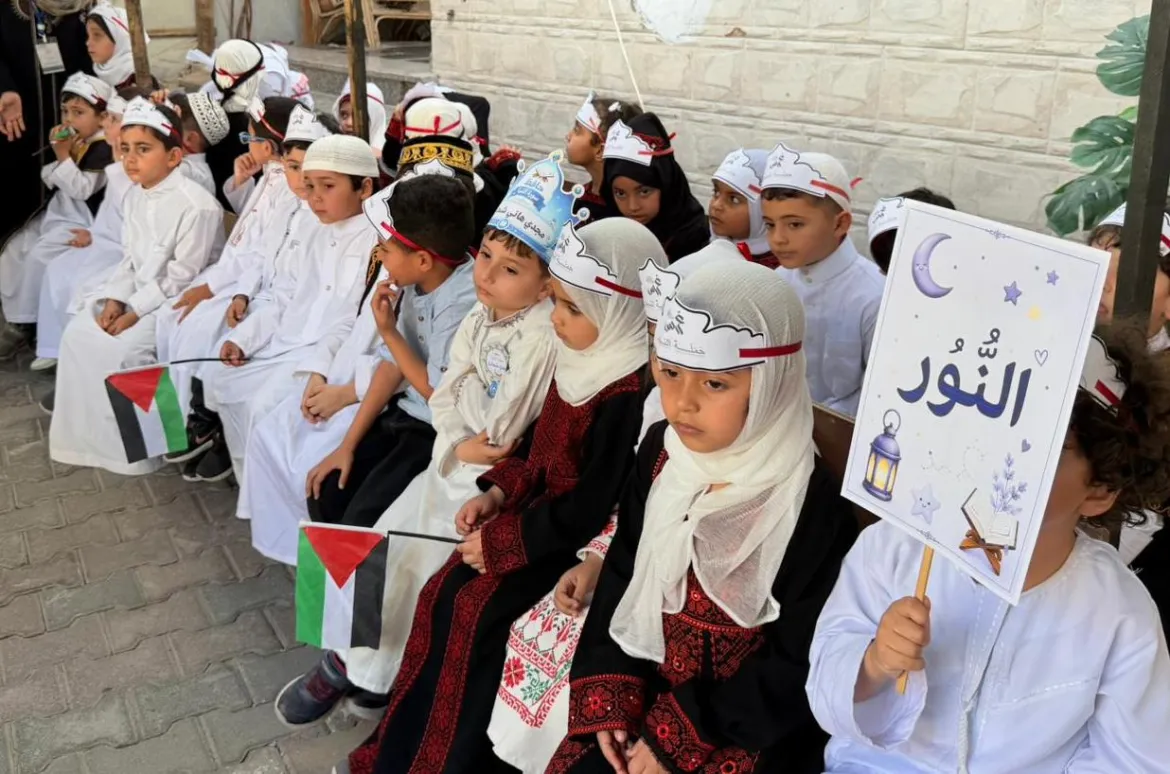
On the educational front, Iqra Charity organized camps under the name “Generation of Quranic Revelation.” In September 2026, it honored around 215 male and female Quran memorizers in al-Mawasi, Khan Younis, followed by another 85 in Gaza City. Ahmed al-Bayouk, head of the association’s Quran department, explained that teachers monitor students’ memorization and review sessions daily, allowing them to identify each student’s strengths and weaknesses.
The Charitable Authority for Relief and Development sponsored these camps. In October, it also joined the association in organizing a workshop on improving Quran memorization programs and operating under emergency conditions. In November, Russia’s Dar al-Khair Foundation supported a Quran-focused event organized by Iqra at the Great Omari Mosque, which was destroyed in Israeli bombardment. The event brought together 60 Quran memorizers.
Umm Ahmed Hajjaj, a Quran memorization supervisor, said the female students spent 50 days at the camps, followed by successive review sessions and examinations before completing their final recitations.
Another source of support comes from sponsorship programs for Quran classes overseen by the Dar al-Quran and Sunnah. The organization has documented visits to sponsored Quran teachers in western Gaza. The delegation was led by the organization’s director, Bilal Imad, who delivered an educational lecture on the role of Quran teachers in educating new generations before hearing their feedback on how the classes were running and ways to improve their performance.
What Comes After Completing the Quran?
Follow-up programs build on an approach that predates the Israeli war. In August 2023, just weeks before the Israeli Occupation launched its aggression on Gaza, 1,471 male and female Quran memorizers took part in the second edition of the “Elite of the Memorizers” project, reciting the entire Quran in a single session. Participants ranged in age from eight to 72. The initiative was organized by Dar al-Quran and Sunnah, founded in 1992, in cooperation with the Ministry of Endowments.
The organization’s director, Bilal Imad, explained that its method focuses on mastering each page before moving to the next, then reciting an entire section, reviewing previously memorized sections, and gradually consolidating the Quran in its entirety. In September 2026, the organization announced that more than 7,000 students had entered the preliminary rounds of its “Lights of Revelation” competition, alongside continued supervision by Quran teachers and support for sponsored classes.
Other organizations are working to improve the skills of Quran teachers. In June, Dar al-Itqan concluded a training course for male and female instructors in Gaza, the Middle Area, and Khan Younis. The program covered teaching techniques, classroom management, communication with students, and educational leadership. In September, it announced that three students had completed memorization and review at a camp in al-Maghazi, while others had memorized and recited individual sections.
For older Quran memorizers, the Ministry of Endowments, in partnership with the Ma’azin Coalition and with funding from the Quds Waqf, launched the “Provisions for the Quran Memorizer” program for participants aged 18 and above. It combines Islamic studies with educational, outreach, and life skills designed to prepare participants for community service, leading prayers, and religious guidance. Separate tracks are available for male and female students.
The coalition’s Secretary-General, Abdullah Abu Alyan, said the program connects Quran memorization with Quranic sciences and reflection, while preparing a new generation of educators capable of carrying the work forward.
At a ceremony honoring students from Quran memorization camps in al-Mawasi, Khan Younis, one mother spoke about her daughter, who continued learning after Israeli bombardment destroyed their home and forced the family to flee repeatedly. Standing beside her was a little girl determined to follow in the footsteps of the Quran memorizers. She summed up her ambition in a simple promise: “When I grow up, I want to be just like them.”
Sources
- With Qur’ans and hymns: A grand Qur’anic procession in Gaza honors 1,000 male and female memorizers [Arabic]
- Gaza’s Ministry of Awqaf: The occupation has targeted 1,244 out of 1,275 mosques since the war began [Arabic]
- 21,976 children have been martyred since the war on the Gaza Strip began [Arabic]
- In video and photos: Despite the war and its bitter hardships, Alma Al-Ghouti completes the memorization of the entire Qur’an at the age of seven [Arabic]
- A scene amidst the rubble and tents: A young girl—who is also visually impaired—memorizes the entire Qur’an [Arabic]