The Rafah Operation: How a Targeted Strike Turned the Tide and Shattered the Myth of Israeli Victory
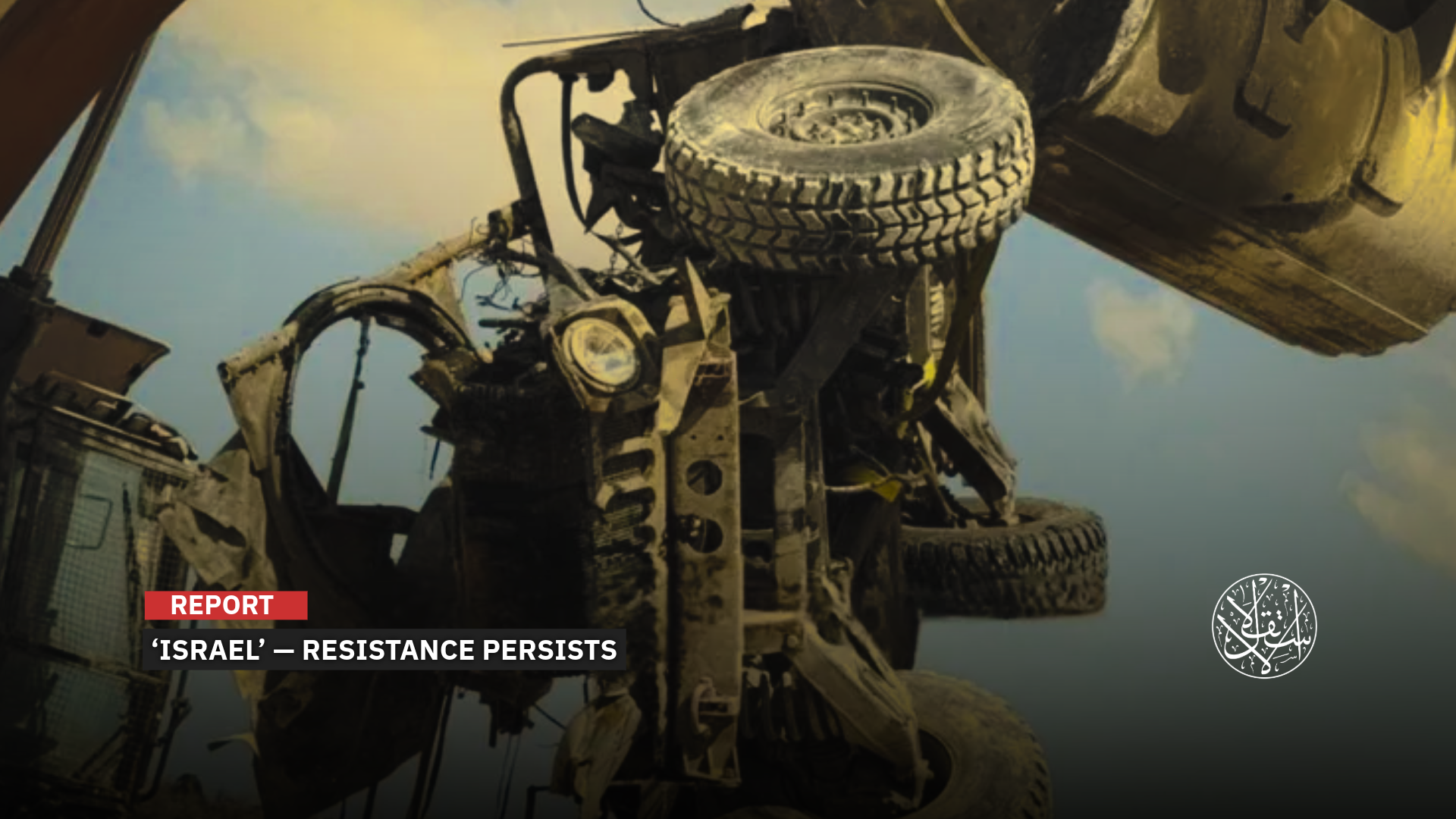
The operation laid bare the occupation’s impotence and the war’s futility.
Evidence has continued to mount over the depth of the Israeli Occupation Forces’ failure in its bloody war on Gaza and its inability to root out the Palestinian resistance from any part of the Strip, particularly after a major operation by Palestinian fighters in the southern city of Rafah.
The attack, carried out on September 18, 2025, left four Israeli soldiers dead, and eight others wounded, some of them seriously, after a group of resistance fighters targeted an armored HMMWV.
The operation took place in an area “Israel” had considered “secure” for its forces, sparking anger and renewed doubts within Israeli society over the army’s actual control of the city and the purpose of its ongoing military campaign in Gaza.
According to Israeli military statements, the soldiers were killed in southern Rafah, near the Philadelphi Corridor along the Egypt–Gaza border, a zone that was supposed to be among the safest for Israeli troops following months of heavy military operations and the army’s continued presence there up until the truce of January 19, 2025.
Who Has Control?
“Israel’s” military announced that it had “taken full control” of the entire city of Rafah on April 12, 2025, claiming to have “eliminated” the Rafah Brigade of the Izz al-Din al-Qassam Brigades, the armed wing of Hamas, following a massive and destructive campaign.
But the credibility of that declaration has since collapsed after the latest attack in the far south of Rafah, which revealed that Palestinian fighters remain capable of breaching Israeli Occupation Forces (IOF) and security apparatus and carrying out painful strikes even in heavily fortified zones.
The ability of resistance fighters to reach that area and launch such an attack has raised serious questions, especially given the heavy IOF’s presence in Rafah.
Ayman Abu Amer, a resident of Rafah who has been displaced near the al-Mawasi area west of the city, said Rafah “still retains a civilian presence despite the scale of destruction it has suffered.”
Speaking to Al-Estiklal, Abu Amer said that “in recent weeks, some residents have managed to return to parts of the city, taking advantage of the brief openings created by U.S. aid deliveries and Israeli military positions near the western side of Rafah.”
He noted that the movement of people has gradually extended as far as the “Alam” area in central Rafah, particularly its southern section.
Responding to Israeli claims of having “cleansed Rafah” militarily, Abu Amer insisted that the reality on the ground “contradicts such assertions.”
He explained that in recent months, the sounds of ongoing clashes from Rafah have never ceased, echoing as far as southern Khan Younis, where gunfire, shelling, and airstrikes remain frequent.
“If there are no resistance fighters left,” Abu Amer asked, “then who are these military operations targeting, and who are these clashes against?”, a pointed reference to the continued presence of active resistance in the city.
He added that the destruction in Rafah “is still ongoing,” pointing to a series of massive explosions recently detected, believed to have struck the al-Saudi neighborhood.
Abu Amer said the situation on the ground “does not reflect full Israeli control as claimed,” noting that the large city includes wide empty areas and others where the occupation forces are not permanently stationed.
He added that the “Abu Shabab militia” remains confined to the eastern part of the city, underscoring the limited extent of Israeli deployment and providing resistance cells with opportunities to move and operate.
He also said that several families and residents remained inside Rafah during the invasion, and the fate of many is still unknown, while others managed to flee toward Khan Younis in recent weeks.
According to Abu Amer, this suggests that civilian groups likely remain inside Rafah, beyond the zones held by the “Abu Shabab militia,” raising questions about the full extent of Israel’s control and what remains concealed on the ground.
The Rafah operation was not the only sign of “Israel’s” failure to defeat the Palestinian resistance or end its grip on the Strip. In the north, an area “Israel” had declared fully destroyed and cleared of resistance, rockets were launched on September 21, 2025, toward the city of Ashdod, with some reportedly reaching their targets.
Israeli Anger
Israeli reactions to Benjamin Netanyahu’s government and the continuation of the war have been sharply critical, following repeated resistance operations in areas the occupation claims to control fully.
The mother of captive soldier Nimrod Cohen said that subjugating Hamas is “a slogan they sell to the public,” insisting that the war has failed to achieve its objectives despite heavy losses. She added that for every fighter killed, ten more appear, according to Haaretz on September 16, 2025.
Avigdor Lieberman, leader of the Yisrael Beiteinu party, accused the government of “utter failure.”
Lieberman noted that “the continued rocket fire proves their incapacity to manage the battle,” according to Walla on September 21, 2025.
Israeli analysts themselves acknowledged that the latest operation highlights a “strategic dilemma” for the army in Rafah.
In a discussion on Channel 12 on September 19, analyst Uri Segal said the operation exposed serious weaknesses in security oversight, and that the element of surprise exploited by the resistance demonstrates the renewal of its capabilities and resurgence in Rafah.
Analyst Daniel Levy emphasized that, despite its technological superiority, the Israeli Occupation Forces remain unable to impose complete control over the city.
Meanwhile, Hebrew commentator Tamar Avineri asserted that Rafah remains a strategic arena for the resistance, and that the success of the operation despite stringent measures proves its resilience and continuity.
Analyst Yitzhak Ben Eliahu pointed to the difficulty of predicting resistance actions, warning that such operations send clear political and security messages, indicating that Israeli control on the ground remains far from secure.
Yoav Bitton, head of Israeli prison intelligence, commented on the Rafah operation, saying, “The fighting takes place on cursed ground, full of suicide operatives. The very high price will continue to be paid in the lives of soldiers.”
Former Israeli National Security Council official Talya Lankri said there is no safe area anywhere in the Gaza Strip, not even in Rafah, and that rubble provides cover for fighters to infiltrate, plant explosives, and withdraw.
Former head of military intelligence Amos Malka argued that “the continuation of the operation is a loss for Israel. When the occupation targets a resistance leader, a replacement is immediately appointed, operations continue, and the Israeli Occupation Forces pay a heavy price.”
“In the end, Hamas will not raise the white flag,” he added.

Military Failure
Israeli analyst Jamal Masameh said the recent Rafah operation clearly exposed the falsity of “Israel’s” narrative, which claimed to have completely eliminated resistance within the city.
Speaking to Al-Estiklal, Massameh explained that “Israel” had announced it had destroyed the resistance’s infrastructure, turning Rafah into a buffer and security zone separating Gaza from the Egyptian border.
However, these claims quickly collapsed when a HMMWV was targeted and destroyed, demonstrating the continued effectiveness of the resistance and undermining assertions of its decline.
He added that for months, Israeli media had portrayed Rafah as militarily finished, promoting alleged battlefield achievements and showing footage of tunnels and other targets that had been hit.
“This media narrative sought to cement the idea that the city was ready for full occupation control, and even to convert parts of it into bases for militias aimed against the Palestinian people, paving the way for detention camp schemes within what was called the ‘humanitarian city,’ planned to concentrate the entire population of the Strip before their displacement.”
He stressed that in recent weeks, particularly since “Israel” declared control over Rafah, military censorship was imposed on reports of clashes with the resistance, and even settlers’ websites were forbidden from sharing such information on social media.
But with the major event of the HMMWV explosion and the high number of casualties, “the occupation could not hide the operation,” Massameh said.
“The operation sparked a wave of anger within Israel. The army had claimed it had ended the threat from Rafah completely, yet it became clear that the city still hosts significant resistance,” he added.
Masameh concluded by warning that “concerns have grown over what Israeli Occupation Forces will face in Gaza City, in terms of operations and ambushes, and the enormous time the campaign will require without reaching any decisive point, considering that Gaza is entirely different from Rafah, with stronger resistance and a higher population density.”
Since October 7, 2023, with U.S. support, “Israel” has been carrying out what many observers describe as a genocide in Gaza, resulting in 66,055 deaths and 168,346 injuries, the majority of them women and children.