Researcher to Al-Estiklal: Water, Funding, and Market Integration Are Essential for the Recovery of Syrian Agriculture
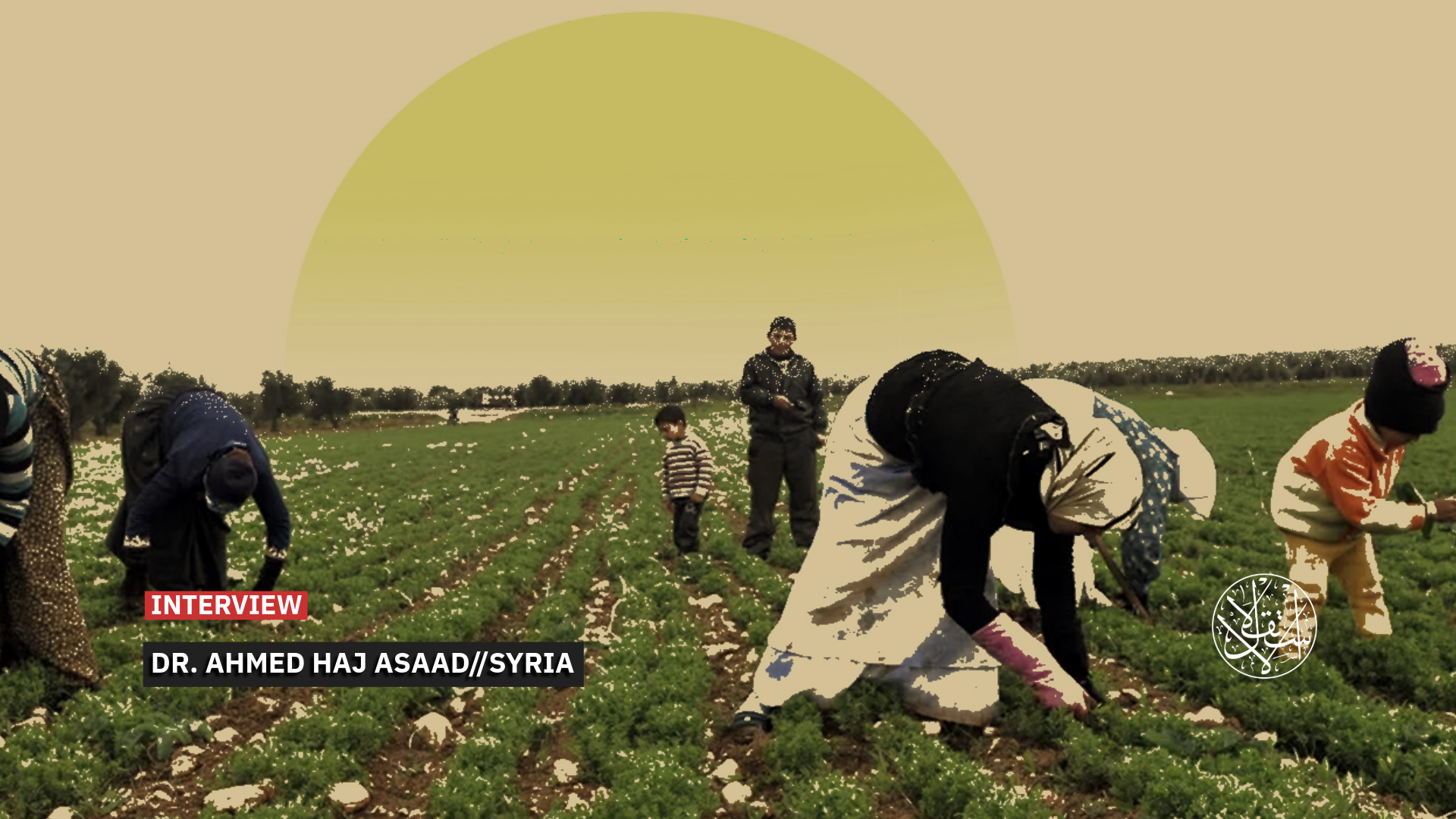
“The agricultural sector’s situation can be addressed by establishing an integrated mechanism to support production.”
Dr. Ahmed Haj Asaad, a researcher in water resource governance and development, stressed that the crisis facing agricultural production and the agricultural sector in Syria is deeply rooted rather than temporary, requiring policies that go beyond a short-term focus on increasing production.
In an interview with Al-Estiklal, Haj Asaad noted that it is necessary to look back in order to understand the erosion of Syrian farmers’ profitability over the past years.
Haj Asaad emphasized that the agricultural sector cannot be addressed through a single measure, but rather through coordinated efforts by government institutions, international organizations, non-governmental organizations, and local communities, alongside the establishment of an integrated mechanism to support production.
He argued that the most important priority at this stage is to develop more effective water governance that balances economic and social needs, particularly those of agriculture, with available water resources and their capacity for renewal.
Dr. Ahmed Haj Asaad is a senior researcher specializing in water issues. His research and projects focus on the geopolitical, social, and economic dimensions of water resource management, their impact on development trajectories, their role in achieving political and social stability, and their potential to strengthen opportunities for peacebuilding.
His work examines how water can be used as a tool of political and military dominance or as a means of cooperation and achieving justice, both at the national level and in transboundary river basins.
He holds a PhD from the University of Lausanne in Switzerland and a master’s degree in development studies from the Graduate Institute of International and Development Studies in Geneva.
He currently serves as director of Geo Expertise. He has also worked as a consultant for several prominent academic and research institutions, including the Geneva Graduate Institute, the Swiss Federal Institute of Technology Lausanne (EPFL), and King Saud University in Saudi Arabia.
He has extensive field experience in Syria, Lebanon, Turkiye, Saudi Arabia, and the Sahel region of Africa. He has led the research and implementation of several field projects addressing water governance and conflict transformation, and has published analytical studies exploring ways to reshape water-sharing policies in transboundary basins to ensure environmental justice and the equitable distribution of resources among riparian states.
Resource Management
How do you assess the state of Syria’s agricultural sector today, and are we facing a temporary production crisis with identifiable causes?
The state of Syria’s agricultural sector is extremely critical, and the challenges facing it are numerous and interconnected. In my view, the current crisis is not merely a temporary production crisis resulting from exceptional circumstances; rather, it is the result of accumulated structural imbalances inherited from previous agricultural policies, which were greatly exacerbated during the years of war, when the assets and resources of rural areas were systematically targeted by the former regime.
Therefore, I believe that the crisis facing agricultural production and the agricultural sector is deeply rooted rather than temporary.
It requires policies that go beyond a short-term approach focused on increasing production and instead address the structural causes limiting the sector’s ability to recover.
This requires rethinking agricultural policies, improving water-resource management, regulating input markets, supporting the rehabilitation of agricultural assets, and encouraging more efficient forms of cooperation among smallholder farmers, enabling them to benefit from mechanization and technology and gain access to markets.
Despite Syria’s extensive agricultural land, climatic diversity, and accumulated human expertise, why have these assets not translated sufficiently into higher agricultural production?
I believe that possessing diverse resources in itself does not make us stable or immune to risks; what matters more is how these resources are managed and governed responsibly.
Therefore, a fundamental part of Syria’s agricultural challenge is linked to the ability of institutions to manage resources and address the risks surrounding agricultural production.
Syria has extensive areas of arable land, estimated at around 32 percent of the country’s total area, equivalent to approximately 6 million hectares, in addition to climatic diversity and generations of accumulated human expertise. Consequently, this land, climatic diversity, and expertise could provide an important foundation for agricultural production and food security.
However, a large portion of this land depends on rain-fed agriculture, making production highly sensitive to fluctuations in rainfall and recurring drought.
As for irrigated agriculture, which previously accounted for around 22 percent of cultivated land, it has declined during the war years as a result of damage to irrigation networks, pumping stations, wells, and water infrastructure, in addition to farmers abandoning their agricultural land.
Therefore, the problem is not fundamentally a lack of resources, but rather the limited capacity to manage those resources and transform them into stable and sustainable production.
What are the main problems facing Syrian farmers today, and which of them have the greatest impact on their decision to continue farming or reduce the area they cultivate?
Syrian farmers today face a range of accumulated challenges. Some stem from previous agricultural policies, while others have been exacerbated by the years of war.
Many farmers, particularly in affected rural areas, have suffered significant losses as a result of losing their homes and means of production, displacement and forced displacement, and prolonged inability to access and cultivate their land. This has reduced their productive capacity while increasing their debts and financial burdens.
However, in my view, the deeper challenge lies in the change that has occurred in the farmer’s relationship with the land.
For some farmers, land is no longer primarily a means of production but has instead become a reserve asset that can be drawn upon when necessary.
Accumulated debt may compel a farmer to sell part or all of their land to meet financial obligations, rebuild their home, or invest the proceeds in another activity that they believe offers higher returns and lower risks.
Another challenge is the fragmentation of agricultural holdings into small and very small plots as a result of inheritance practices and agrarian reform. This limits the efficient use of machinery and makes investment in irrigation and modern technologies more difficult.
Agricultural cooperatives were supposed to help overcome this problem by collectively providing services, inputs, and machinery, but their politicization by the former regime over previous decades weakened their performance.
The sector also suffers from limited agricultural support and financing relative to the scale of its needs, alongside rising input, energy, and transportation costs.
Smallholder farmers in particular face difficulties accessing finance because of their small holdings, collateral requirements, and high production, market, and climate-related risks.
Consequently, a farmer’s decision to continue farming is shaped by an interconnected set of factors: profitability, production costs, access to finance, farm size, availability of water and inputs, climate and market risks, and the existence of an agricultural policy that encourages investment and continued production.
Unless this environment improves in an integrated manner, the risk of reducing cultivated areas or selling part of the land will remain.
Introducing Modern Irrigation Technologies
To what extent have rising prices of seeds, fertilizers, fuel, irrigation, and transportation contributed to the decline in production, and has the return from agriculture become disproportionate to the scale of the risks and costs?
At this point, I believe it is necessary to look back somewhat to understand the erosion of the profitability of Syrian farmers, because the current problem did not begin with the rise in prices during or after the war, but has roots in changes to agricultural policy dating back to the beginning of the 1990s.
These changes led to a reduction in government subsidies for agricultural inputs and an increase in production costs, reaching their peak with the transition toward what was called the “social market economy.”
After fuel subsidies were lifted in 2007 and fertilizer subsidies were reduced in 2008, production costs increased approximately threefold between 1990 and 2007, while the prices of some strategic crops, such as wheat and cotton, remained stable or increased only modestly.
As a result, farmers’ profit margins gradually eroded. This also affected their ability to meet their financial obligations: repayment rates on loans from the Cooperative Agricultural Bank fell from around 80 percent in 2000 to approximately 40 percent in 2008, prompting some farmers to turn to costly informal sources of financing.
The problem is that farmers still have limited ability to influence the prices of their products, as well as the prices of seeds, fertilizers, fuel, irrigation, and transportation.
Therefore, the question is no longer simply: How much will I produce? It has become: Is the expected return worth the capital, risks, and time I will invest?
From this perspective, the deeper problem is not simply rising costs, but rather the imbalance between production costs, the price of the product, risks, financing, and protection against shocks.
How can the problem of declining water resources and drought be addressed, and what realistic options does Syria have for developing irrigation methods and rationalizing water use?
Our research has shown that water-resource governance over previous decades, which was heavily influenced by political power, contributed to increasing pressure on resources, declining groundwater levels, and the deterioration of surface-water quality.
Therefore, addressing the water crisis does not begin merely with introducing modern irrigation technologies; it also requires reforming water-resource governance and the way resources are managed and used properly and efficiently.
To achieve both water and food security, Syria needs policies that strike a balance between water use and resource sustainability.
The objective should not simply be to increase production, but to maximize the value generated from each unit of water while preserving the ability of resources to regenerate.
This requires upgrading irrigation networks, adopting more efficient technologies, such as drip and sprinkler irrigation where appropriate, and improving irrigation management according to crop requirements and prevailing climatic conditions.
This transition requires substantial financial investment, making it necessary to combine national efforts with international support.
The crop mix should also be reconsidered, with crops selected according to their economic returns relative to their water requirements, while maintaining strategic crops such as wheat.
Comparative advantage should not be measured solely by financial returns, but also by water costs, resource sustainability, and food security.
Accordingly, addressing the water crisis requires an integrated package encompassing governance, improved irrigation efficiency, infrastructure rehabilitation, supply and demand management, and crop selection aligned with available resources.
What does agricultural infrastructure, irrigation networks, pumping stations, storage facilities, transportation routes, and marketing systems, need in order for farmers to increase production and gain better access to markets?
Based on our monitoring of the agricultural sector and water-resource management, it can be said that Syria’s agricultural infrastructure has long suffered from neglect, insufficient investment, and distortions in agricultural policies.
During the years of war, it was then systematically targeted by the former regime across large rural areas, affecting irrigation networks, pumping stations, wells, agricultural roads, and storage facilities.
Therefore, revitalizing the sector requires comprehensive rehabilitation covering irrigation, roads, storage, transportation, and marketing, rather than addressing each element in isolation.
Reconstruction should also not be limited to restoring what previously existed; it should provide an opportunity to redesign infrastructure with greater efficiency and sustainability, particularly in terms of water and energy use.
Our experience in rehabilitating the irrigation network in the Al-Ghab Plain demonstrated that local expertise and farmers possess capabilities that can be built upon, even under complex conditions, provided that technical expertise, local participation, collective management, and financing are brought together.
The goal is not to return the sector to what it was, but to build a sector that is more productive and more resilient to drought, climate fluctuations, and market volatility.
Do you believe that current government agricultural support actually reaches farmers as needed? What mechanisms could be adopted to ensure that support is directed toward production rather than limited seasonal measures with little impact?
In my view, the problem lies not only in whether support reaches those entitled to it, but also in the limited scale of support and the mechanisms through which it is delivered.
When support is available, it generally reaches the targeted groups, but the number of beneficiaries remains limited compared with the scale of actual needs.
During the 2024–2025 season, compensation for drought damage was limited to a small proportion of affected farmers, largely because of the requirements and procedures involved, which are not always clear or accessible to farmers.
In the 2025–2026 season, support was focused primarily on wheat production. Although an official purchase price of $400 per ton was set, delays in paying farmers’ dues prompted some farmers, because they needed immediate liquidity, to sell their produce on the open market at a lower price of around $250, while traders benefited from the price difference.
Here, it can be said that reforming the support system should not be limited to its monetary value; it should also encompass the mechanism for accessing support and the speed with which payments are made.
It is important to develop a genuinely participatory model bringing together government institutions, local councils, cooperatives, and agricultural organizations, while preserving the state’s regulatory and oversight role.
This is particularly important because some agricultural land is still registered in the names of fathers or grandparents, while other family members or actual landholders are the ones cultivating it, making proof of direct ownership difficult in some support programs. Complex administrative procedures also create an additional burden, particularly for smallholder farmers.
Here, cooperatives and local structures can play an important intermediary role in documenting needs, helping farmers complete procedures, and facilitating access to support, while applying clear and transparent standards for verification and oversight.
At the same time, the poor experience of cooperatives affiliated with the General Union of Peasants should not be regarded as evidence of the failure of cooperative work itself. In my view, part of their weakness was linked to their politicization and use by the former regime as a tool to strengthen its presence in rural areas, rather than focusing on farmers’ interests.
Therefore, what is needed is to rebuild an independent and effective cooperative model based on farmers’ economic interests, transparency, accountability, and participation, while supporting collective input purchasing, product marketing, access to financing and services, particularly for smallholder farmers.
How can affordable and productive agricultural financing be provided to help farmers purchase production inputs and invest in their land amid rising agricultural costs?
Since I began my professional career at the Cooperative Agricultural Bank in its Idlib and Saraqib branches, I believe the bank has extensive experience that can be built upon by assessing its achievements and the challenges it faced, and drawing lessons to develop financing mechanisms suited to the next phase.
However, the problem is not simply the availability of loans; it also concerns farmers’ ability to access them and meet their requirements, particularly smallholder farmers who face challenges related to the small and fragmented nature of their holdings, collateral requirements, and administrative procedures.
Therefore, financing mechanisms could be developed to encourage cooperative work, whether through multipurpose associations or family and rural enterprises, enabling farmers to pool resources, collectively purchase production inputs, and invest in equipment and irrigation. This would reduce costs and strengthen farmers’ bargaining power.
Loan conditions and repayment periods should also be aligned with the seasonality of agricultural production, climate risks, and price fluctuations.
The objective should not simply be to lend money to farmers, but to provide productive financing that helps them restore their productive capacity and make sustainable investments in their land.
Accessible Agricultural Financing
If we want to develop a realistic roadmap for advancing Syrian agriculture over the next five years, what priorities should be addressed first, and what measures can be implemented in the short term?
In my view, the situation of the agricultural sector cannot be addressed through a single measure. Rather, it requires coordinated efforts by government institutions, international organizations, non-governmental organizations, and local communities, along with the establishment of an integrated mechanism to support production.
Under the current circumstances, the agricultural sector needs support that enables farmers to restore their productive capacity and invest in their land.
One of the priorities is to provide accessible and productive agricultural financing that helps farmers purchase production inputs and develop irrigation technologies and equipment, while reducing their reliance on costly informal sources of financing. The Agricultural Bank and cooperative models could be utilized in this regard.
I also believe it is important to develop an advisory, marketing, and geographic model that helps identify the areas planted with each crop, estimate expected production, and compare it with market needs.
Agricultural extension should not be limited to explaining how to increase production; it should also help farmers determine what to grow, where to grow it, in what quantities, and what marketing opportunities are available, in order to avoid production surpluses and falling prices.
It is also essential to encourage the consolidation of holdings and joint work through cooperatives or rural companies. This would allow farmers to use modern machinery and technologies and reduce production costs, while keeping land ownership with its owners and avoiding excessive concentration of land ownership.
Most importantly, there is a need to develop more efficient water governance that balances economic and social needs, particularly those of agriculture, with available water resources and their capacity for replenishment.
Therefore, support for agriculture should be based on an integrated system combining financing, production and marketing regulation, cooperative work, improved resource-use efficiency, and water governance.
What message would you like to convey to Syrian farmers facing rising costs and declining returns?
I believe Syrian farmers are going through one of the most difficult periods in their modern history, and therefore my message to them must be realistic and cautious.
First, invest carefully and at the lowest possible cost, and avoid high-risk crops or investments whose failure could lead to mounting debt or the sale of part of the land. Preserving the land and the ability to continue producing should be a priority.
Second, move from individual work toward cooperative and organized forms of work. The fragmentation of agricultural holdings limits production efficiency, while cooperatives or family and rural companies can help consolidate the purchase of inputs, as well as the use of machinery, irrigation, and marketing services, while keeping land ownership with its owners.
I also believe that the future of rural areas cannot depend on agriculture alone. It requires diversifying sources of income through food processing, agro-industries, services, and rural tourism wherever appropriate.
Therefore, I would tell the farmer: Do not stop producing, but do not take on risks greater than your capacity to bear. Protect your land, invest cautiously, work collectively, and diversify your sources of income.