Mohamed Beltagy’s Wife Speaks Out After 12 Years of Solitary Confinement: ‘I Cannot Tell If He is Alive or Dead’
“After all this darkness, the light must shine.“
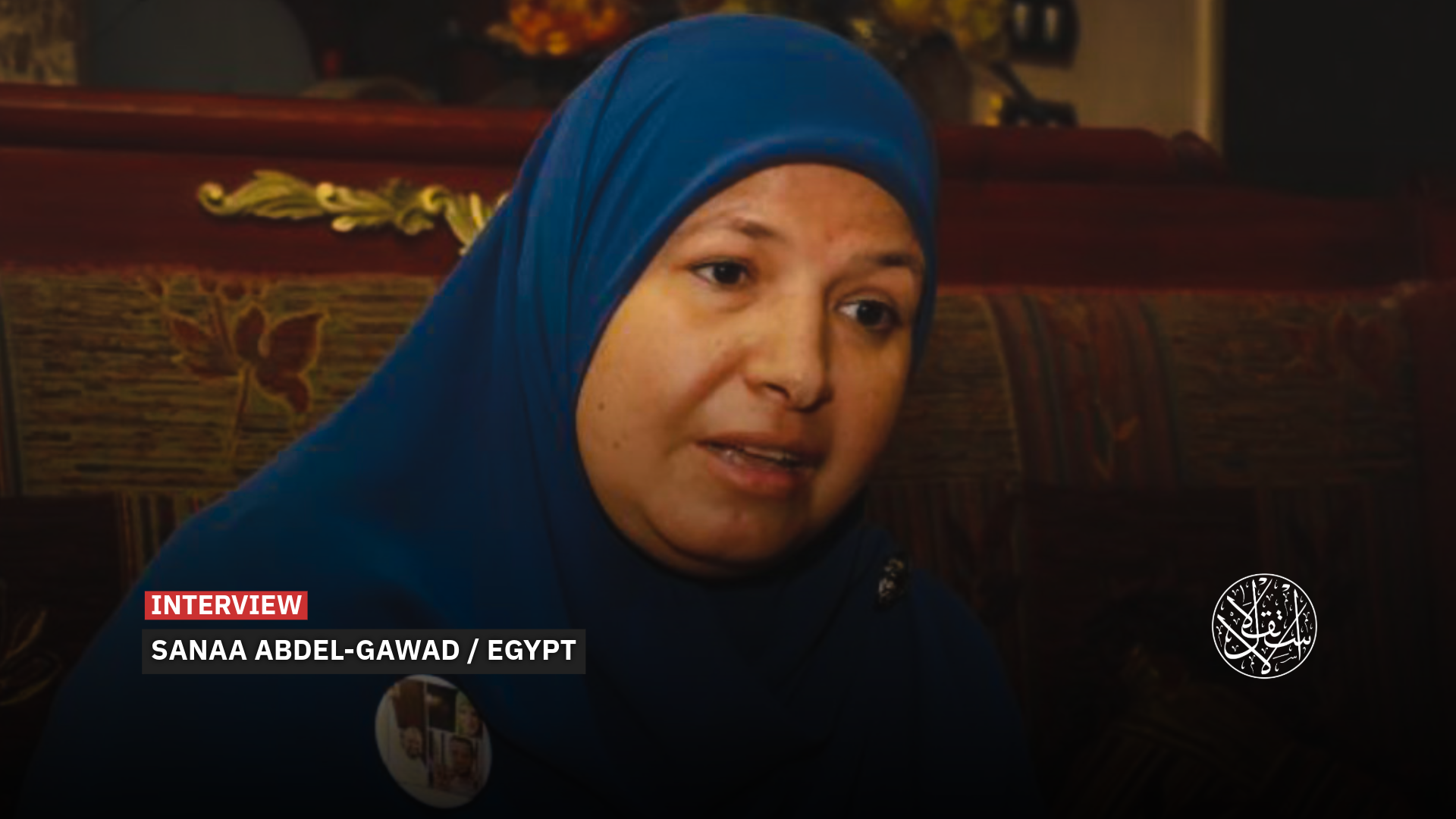
Amid an open-ended hunger strike by dozens of political prisoners in Egypt, Sanaa Abdel-Gawad, the wife of senior Muslim Brotherhood figure Mohamed el-Beltagy, has shared a harrowing personal testimony that lays bare the suffering endured by detainees in the country’s prisons.
In an interview with Al-Estiklal, Abdel-Gawad, the wife of the former parliamentarian who has been imprisoned since the military coup of July 3, 2013, spoke of shocking details documenting the ongoing abuses against both her husband and their son, Anas, who are held in solitary confinement, particularly in the notorious Badr 3 Prison.
Abdel-Gawad said her husband and son, like thousands of other detainees, are living under harsh conditions, deprived of their most basic rights, family visits, exercise, sunlight, adequate food, and clean drinking water, leaving them in a constant state of physical and psychological distress.
El-Beltagy began a partial hunger strike on June 20, 2025, to protest the conditions of his detention.
After the authorities ignored his demands, he escalated the strike into a full one, which led to a severe deterioration in his health and his subsequent transfer to the prison hospital.
Abdel-Gawad said she no longer knows whether her husband is alive, as he has been repeatedly moved to the prison hospital.
She added that she has not seen her son Anas for 13 years, since the military takeover led by then–army chief and current head of the regime Abdel Fattah el-Sisi ousted the late President Mohamed Morsi.
In her message to the Arab public and the international community, Abdel-Gawad urged people to take action and unite in demanding the release of those detainees who, she said, have been denied their most basic rights for many years.
A former spokeswoman for the group Women Against the Killing of Protesters and a member of the Revolutionary Women’s Alliance of Egypt, Abdel-Gawad is not only the wife of el-Beltagy but also the mother of Anas, who was arrested on December 31, 2013, simply because of his family name after police checked his ID. He was 19 years old at the time.
Tragic conditions
Can you describe the circumstances under which your husband, Dr. Mohamed el-Beltagy, and your son, Anas, are living under in Egyptian prisons?
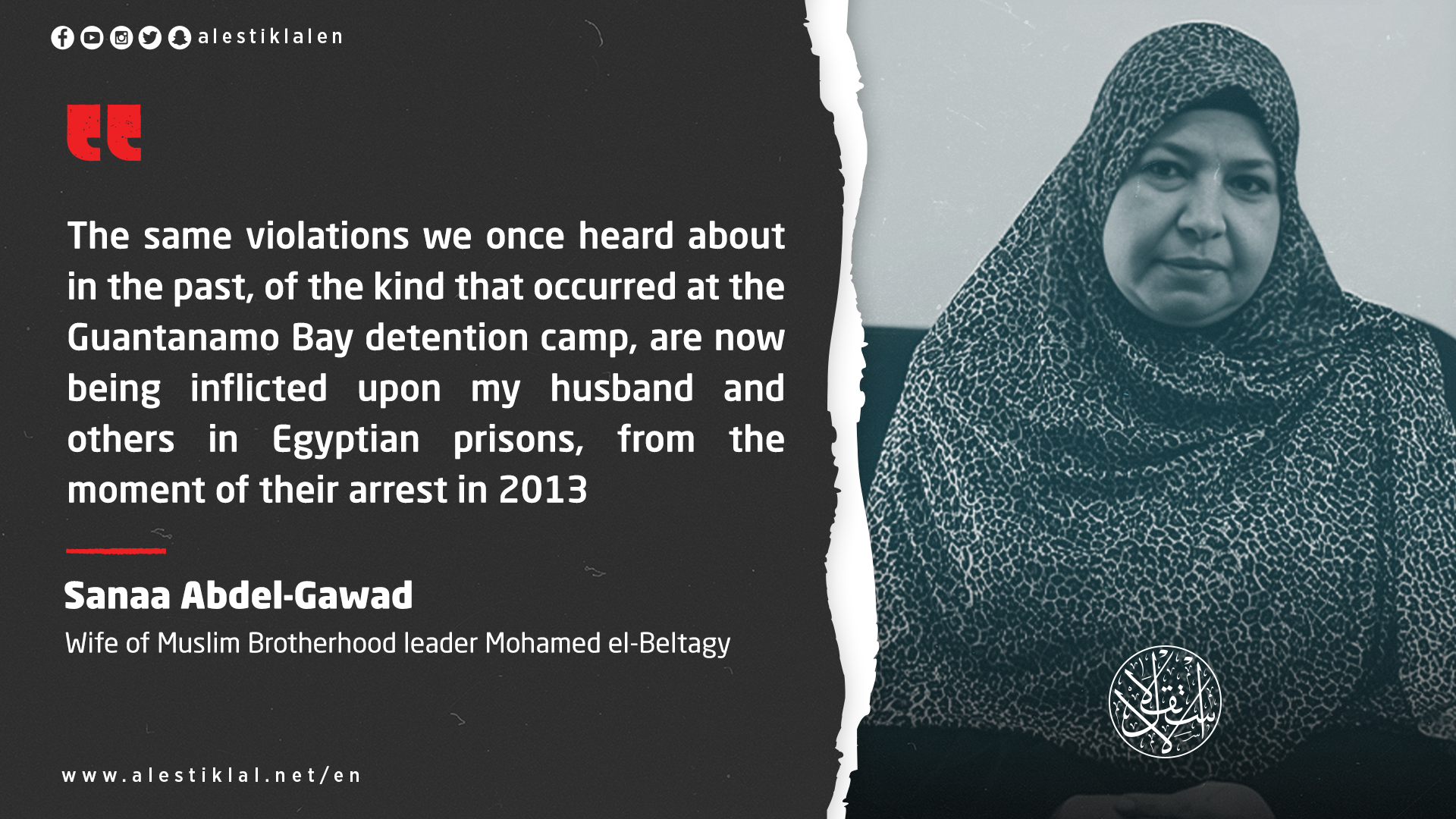
Sadly, all the violations we used to hear about in the past, such as those reported in the infamous American detention center at Guantanamo Bay, have been inflicted on my husband and son in Egyptian prisons since their arrest in 2013.
Since that time, they have both been held in solitary confinement. During the first two years of their imprisonment, they were occasionally allowed out for brief periods of exercise, but that stopped almost entirely after around two years. For more than nine years now, they have not been permitted to leave their cells at all.
Each of them is held in a separate ward, not in a cell block shared with other inmates, but completely alone, surrounded by empty or sealed cells.
This prolonged isolation seems deliberately designed to cut them off from the world, to slowly destroy them without anyone hearing their voices or even knowing they exist. There has been no contact with other prisoners, not even through the door slot.
Often, days go by without them receiving any food. And when meals are provided, they are of extremely poor quality, barely enough to survive on, and unfit for human consumption, whether in quantity or quality.
These harsh conditions have taken a severe toll on both their physical and mental health, with deeply damaging effects. Many other detainees have been subjected to the same discriminatory and degrading treatment.
To this day, there has been no response from the authorities to even the most basic demands, such as allowing family visits or outdoor exercise.
As for my husband’s health, he has been transferred to the prison hospital three times after his condition deteriorated. The facility itself is severely under-equipped and lacks even the most basic medical supplies.
That alone indicates how serious his condition has become, since prisoners are usually transferred to the hospital only in the most critical cases.
Tragically, I still do not know whether he remains in the hospital or has been returned to his cell. I have no information about his current health, even though it is my natural right to know what illnesses he suffers from and to deliver the medicine he needs.
On many occasions, the medication I tried to bring during visits, which have since been suspended, was not allowed in. Even when our lawyer obtained official authorization and waited for hours at the prison to deliver clothes or medicine, the authorities refused to accept them. All these practices have severely affected the health of both my husband and my son.
What are the main abuses your husband and other detainees have faced inside Badr 3 Prison, particularly regarding solitary confinement and the denial of visitation rights?
I can point to many abuses that my husband and son have suffered inside Egyptian prisons, violations that contravene even the most basic rights guaranteed under both local and international law.
According to prison regulations, every inmate is entitled to certain rights, including family visits and daily exercise for up to four hours, even if serving a sentence. Prisoners must also be allowed access to sunlight, medical treatment, and proper healthcare inside the facility.
But what happened to my husband goes far beyond words. He suffered two strokes over the past few years. Normally, a patient in such a condition should be transferred to intensive care, yet the prison authorities repeatedly refused to allow him medical treatment outside the prison walls, even though we offered to cover all expenses ourselves. This, of course, has had a devastating impact on his health.
The conditions of detention are extremely harsh. There is no exercise, no visits, and no contact with the outside world whatsoever. Medical care is completely absent, contrary to what the authorities claim in state media.
Whenever complaints about prison conditions increase, the government responds with a kind of theater, staging visits by the National Council for Human Rights to facilities like Badr Prison.
Photos are then taken showing the prison as if it were a five-star hotel, complete with sports fields, dining halls, healthy food, and advanced medical services. But all of this is pure propaganda, a media facade that has nothing to do with reality.
My husband and son have not known the meaning of the word “bed” for years. They sleep on the bare floor in prisons like al-Aqrab, built entirely of concrete, where the cells turn into freezers in winter and ovens in summer, with no ventilation at all.
Later, they were transferred to Badr Prison, where the lighting inside the cells is kept blindingly bright around the clock. This constant exposure exhausts the nervous system and causes serious psychological and neurological problems.
Surveillance cameras operate 24 hours a day, making the prisoners feel constantly watched and under mental pressure.
These detainees, including my husband and son, are not allowed to leave their cells. We don’t understand what the state fears so much that it keeps them under such total control.
The isolation extends to every form of communication with the outside world, newspapers, books, magazines, even the Qur’an. Copies of the Qur’an are often confiscated during cell inspections.
Whenever prisoners complain, they are sent to disciplinary cells, even though their regular cells are already unfit for human habitation. The punishment cells are far worse.
But the greatest violation of all is the denial of their freedom itself. They remain imprisoned without any legitimate reason, held in fabricated cases that lack evidence.
We are asking for nothing more than a fair trial before an independent judiciary, free from military influence. If that were granted, their innocence would be clear to everyone.
My husband, Dr. Mohamed el-Beltagy, has given nothing but love to his country. He served in parliament, took part in national movements, and was a member of the National Council for Human Rights. Before 2013, he personally visited al-Aqrab Prison and wrote a report stating that it was unfit for human life.
The painful irony is that he later returned there, this time as a prisoner, confined to the same cell he once condemned.
What my husband and son have endured, from psychological and physical torture to complete isolation and deprivation of their most basic rights, is part of a deliberate and systematic policy aimed at breaking prisoners and severing them from life itself.
Even the right to make a phone call to their families, a right clearly stipulated in prison regulations, is denied to them. The same applies to letters, which prisoners are supposed to be allowed to exchange with their relatives.
All these practices are meant to slowly kill them inside the prisons. This is not an exaggeration, it is a grim reality we witness with our own eyes. Almost every day, we hear of another detainee dying as a result of medical neglect.
In most cases, the prisoner’s condition is left to deteriorate until it becomes critical. Fellow inmates plead for help, but no one responds. Eventually, the prisoner dies, and only then are the family informed to come and collect the body.
This is the harsh truth of what is happening inside Egypt’s prisons.

Solitary Confinement and Hunger Strike
How have solitary confinement and the denial of sunlight affected the physical and psychological health of the detainees, particularly your husband, who suffers from chronic illnesses?
Naturally, solitary confinement is one of the harshest and most severe forms of abuse my husband and son have endured, perhaps the worst of all.
To be locked inside a narrow cell, no more than two meters by two meters, never allowed out, cut off from every human being, unable even to hear another voice, is in itself a form of intense psychological torture.
My husband and son have spent long periods under this type of isolation, often without books, and in many cases without even a copy of the Qur’an. It is only natural that such solitary confinement would have severe effects on both their mental and physical health.
For example, my son Anas had no illnesses before his imprisonment, yet today he suffers from chronic high blood pressure and kidney problems, caused by the contaminated water they are forced to drink and the spoiled, barely edible food they are given.
During the few visits we were once allowed, we saw the containers in which food was served, which were filthy and appallingly poor in quality. It is inconceivable that food intended for humans could be served in such vessels, let alone that the food itself is unfit for human consumption.
Sadly, we face immense difficulty in obtaining any information about my husband or my son. Over the past years, they were occasionally brought to court sessions, but this did nothing to change their tragic situation.
My husband has been charged with around 29 separate counts, 29 separate cases, and has received sentences totaling approximately 230 years, in addition to two death sentences, one of them in the case of the Rabaa dispersal, in which our only daughter, Asmaa, was killed.
The irony is staggering, that he should be accused in the very case where his daughter was murdered and sentenced to death, an outcome of extreme injustice and cruelty.
As for Anas, there is no clear case against him, no specific charge. He is being punished purely in retaliation for his father.
Yet he is treated with the same cruel measures as his father, including the denial of visits, solitary confinement, and the complete absence of any form of communication.
As a wife and mother, I am completely deprived of any contact with my husband and son. A year or more can pass without any news reaching us.
Sometimes we find ourselves asking the most painful question, are they even still alive? There is nothing to indicate it, no calls, no letters, no visits, no means of reassurance.
They are held under total siege inside the prison, and we are trapped in an external siege that prevents us from knowing anything about them.
Despite our repeated appeals to human rights organizations and international bodies, demanding the right to a visit or even a short phone call to check on them, we receive no response, as if we are speaking to a wall, no one listens, no one answers.
What motivated your husband to go on a hunger strike? And were there specific demands that the prisoners put forward during this strike?
The hunger strike began on June 20, 2025, after years of solitary confinement and total isolation from the outside world.
My husband and son, like many other prisoners, are cut off from all contact with their families, unaware of what is happening beyond the prison walls.
Many of their children have married, graduated, or experienced major life events, yet they know nothing of it. One prisoner only learned of his mother’s death long after the fact, and was not even allowed to see her or say goodbye.
The isolation imposed upon them has been unbearable, its purpose clear: to sever all ties with the outside world. The hunger strike is a peaceful form of protest, a plea for two fundamental rights, access to exercise and permission for visits.
They are demanding to be allowed to see their families, to know they are safe, to leave their cells even briefly, to meet fellow prisoners, and to hear human voices other than their own.
A prisoner hears only his own voice; he cannot even see himself. Imagine someone who has spent more than twelve years without ever glimpsing their reflection, because there is no mirror in the cell.
In normal life, we see our faces daily, style our hair, attend to our appearance. But a prisoner cannot even identify the color of their skin or the shape of their features, they forget entirely what they look like.
As a mother, I do not know what my son Anas looks like now. He entered prison at nineteen and is now over thirty-two. I have no idea how he appears, or even what his voice sounds like, as I have long forgotten its tone.
He has undoubtedly changed, yet he remains imprisoned, far from us, as does his father, Dr. Beltagy, about whom we have no news after all these years.
All these conditions drove them to the hunger strike. They said, “We are human, and we have rights.” Their strike is a cry from the depths, a desperate call for the world to hear them and respond to their demands.
They are asserting their rights and asking others to defend those rights on their behalf. When no other means of protest was available, hunger became the only option.
Sadly, over time, after years of being erased from life and forgotten by the world, their demands were reduced.
Rather than insisting on release for being unjustly detained, their demands were pared down to the most basic: access to visits and exercise. They felt that no one spoke for them, that no one advocated for their rights, as if the world had grown accustomed to their existence behind bars.
The strike, initially partial, eventually became total. Dr. Beltagy’s serious health problems worsened significantly after it began, forcing his transfer to a prison hospital.
But this was not an external medical facility; it was the prison’s internal hospital, devoid of the most basic equipment, incapable of providing even minimal medical care.
Deprivation of Rights
What difficulties do your family face in communicating with the detainees, and are there any ongoing attempts to break through the imposed wall of silence?
Regrettably, the situation is dire. We endure immense hardship simply trying to communicate with my husband and son, or to receive any news of them, especially after learning of their hunger strike from outside the prison, with great difficulty.
There is, unfortunately, no way for me to reach them, and I do not know how such communication could ever be possible. Visits are the only conventional channel, yet these have been prohibited for many years, both for my husband and for my son. The situation is identical for both.
As a wife and mother, I am entirely cut off from them, enduring long stretches, sometimes a year or more, without any information about their wellbeing. No letters arrive, no phone calls, no means of communication at all. It is as if they are under total siege inside the prison, and we know nothing of their lives.
Despite repeated efforts through human rights organizations, issuing statements and appeals demanding their right to visits, or at the very least a phone call or letter to reassure us, there has been no response. It is as though we are addressing those who do not exist.
How would you assess the role of the Egyptian authorities in dealing with political prisoners and their basic rights?
It can be said without hesitation that they are denied all their legal and human rights, without exception.
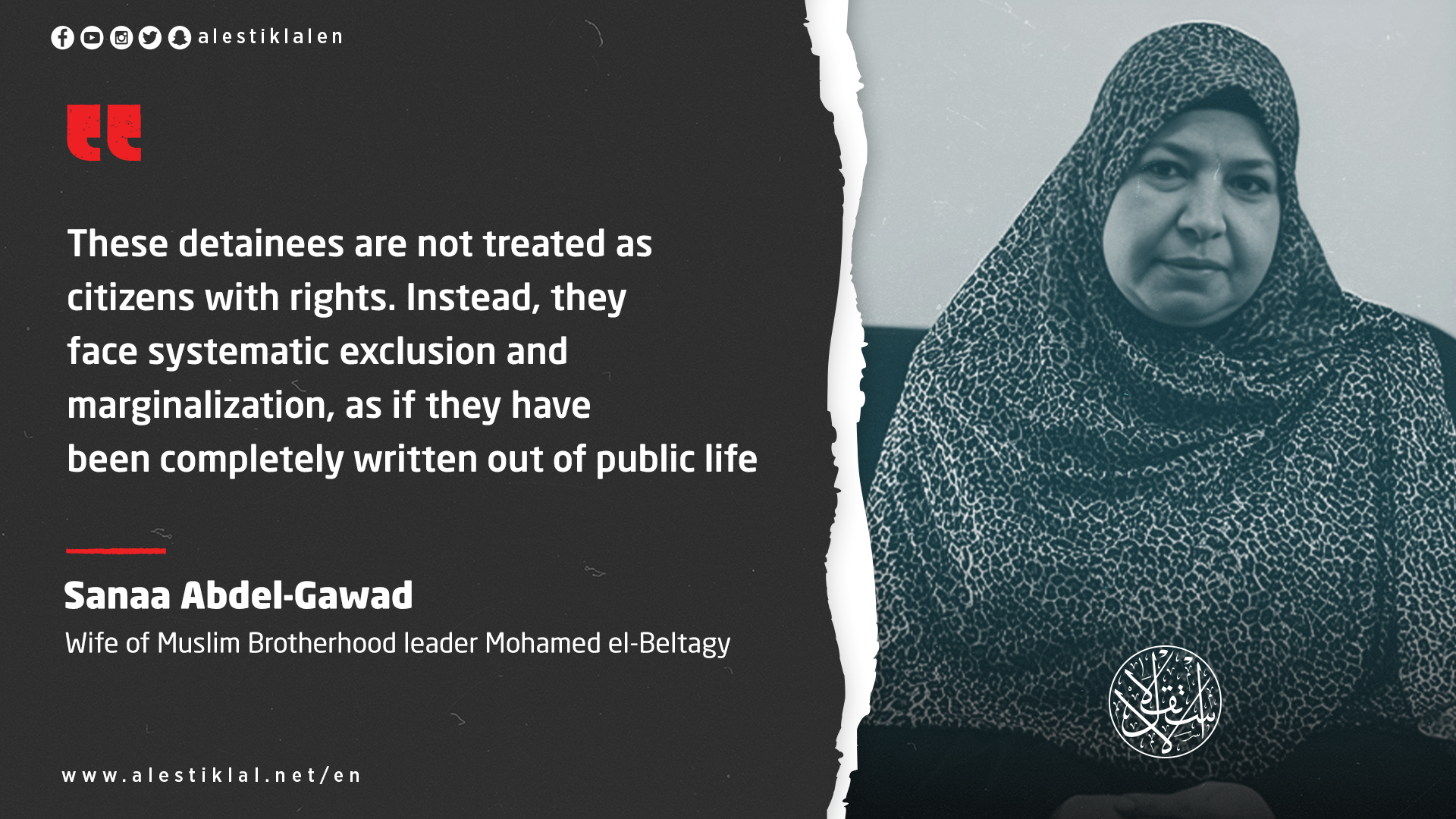
These prisoners are not treated as citizens entitled to protections; rather, they are subjected to systematic exclusion and marginalization, as if they were entirely ostracized from public life.
What is particularly striking is that most of these detainees are highly accomplished individuals, university professors, doctors, and professionals with significant scientific and social standing.
My husband, for example, was a university professor, a senior physician and surgeon, with notable contributions to society. Yet he was completely marginalized and treated as though he were a terrorist.
The crucial question is: how did this sudden transformation occur? How did these elite figures become labelled as terrorists overnight, especially after the 2013 coup?
How does someone who was once treated with respect, who served two terms in the Egyptian parliament, was active in every national association, ran a prominent medical center, and taught at al-Azhar University, suddenly become a defendant facing the death penalty?
Even the private hospital my husband founded was completely dismantled after the coup, a stark illustration of the scale of targeting and retribution.
What is happening today confirms that these detainees are not seen as individuals whose rights should be protected; they are treated as enemies to be eliminated, even through death sentences.
This narrative is actively reinforced by state-controlled media, in a systematic campaign to criminalize them and strip them of their humanity.
Holding on to hope
What messages would you like to convey to international human rights organizations and to the Arab and global public on this matter?
My message goes out to all Arab peoples, the international community, and everyone aware that thousands of political prisoners remain behind bars in Egypt: it is time to act, to unite, to raise a single voice demanding the release of those who have been denied even the most basic of rights for far too long.
How long must they remain imprisoned? Every individual has a responsibility to speak out, to demand their freedom, and to allow them to resume their lives after spending years of their youth behind bars.
Some entered prison as young men; my son, for instance, was nineteen when he was detained, today he is thirty-two. A whole youth has been lost behind prison walls.
People must feel the suffering of these prisoners, raise their voices, and awaken their consciences. We need genuine societal reconciliation.
These prisoners have committed no crimes; many, including my husband, have faced no real charges. My husband, thankfully, is innocent.
He has never been accused of bribery, corruption, embezzlement, or abuse of power. Every allegation leveled against him was for his political beliefs.
Everyone has the right to express their opinion, to disagree peacefully. And yet, in Egypt, political dissent can bring imprisonment, torture, and even a death sentence, twice in my husband’s case, simply for exercising a fundamental right. How can this ever be justified? People must learn to respect differing opinions.
Prisoners are human beings, deserving of rights and dignity. The least we can do is stand in solidarity and demand their basic freedoms, foremost among them their liberty.
We call for their release, or at the very least, fair and transparent trials. What is happening today is a crime that has persisted for over twelve years. No society can prosper, no nation can enjoy dignity, while thousands of innocent people remain behind bars.
These prisoners are not merely “the best of Egypt’s youth”, they are citizens of this nation, individuals of proven integrity, who have devoted themselves to society, opposed corruption, and worked for reform. Yet they are targeted and erased from public life.
Human rights organizations, journalists, and all those with a conscience must act. They must witness the suffering of those dying silently in prison cells and lend their support in any way they can. We ask for nothing impossible: merely the right to freedom. And we must ask: why are they imprisoned at all?
As a family, we endure immense hardship. Losing our daughter, witnessing arrests, living in exile, these past twelve years have been unbearably harsh. Yet we find strength in God, in patience, and in hope. We believe this situation will not last forever. Darkness may be deep, but the dawn is inevitable.
We endure this suffering with faith, not resignation. It is our duty, as a family, as individuals, and as members of a global community, to act, to bear witness, and to confront the injustice. Especially when innocent people are slowly dying inside, while others live safely outside, with their families, as if nothing is happening.
Despite everything, we remain steadfast in faith and patience, awaiting God’s justice and relief, which we are confident will come. This injustice cannot last forever.
These harsh years have been painful and long, but our hope remains undimmed: rights will be restored, and freedom will return to those who deserve it, if not today, then tomorrow.
After all this darkness, the light must shine.