Libya’s Election Commission Between Independence and Political Pressure: What Lies Ahead
“Libya’s political scene has entered a new, complex phase.”
Libya’s internal divide is still playing out, despite repeated pledges to turn the page, and the latest flashpoint has been the country’s election commission.
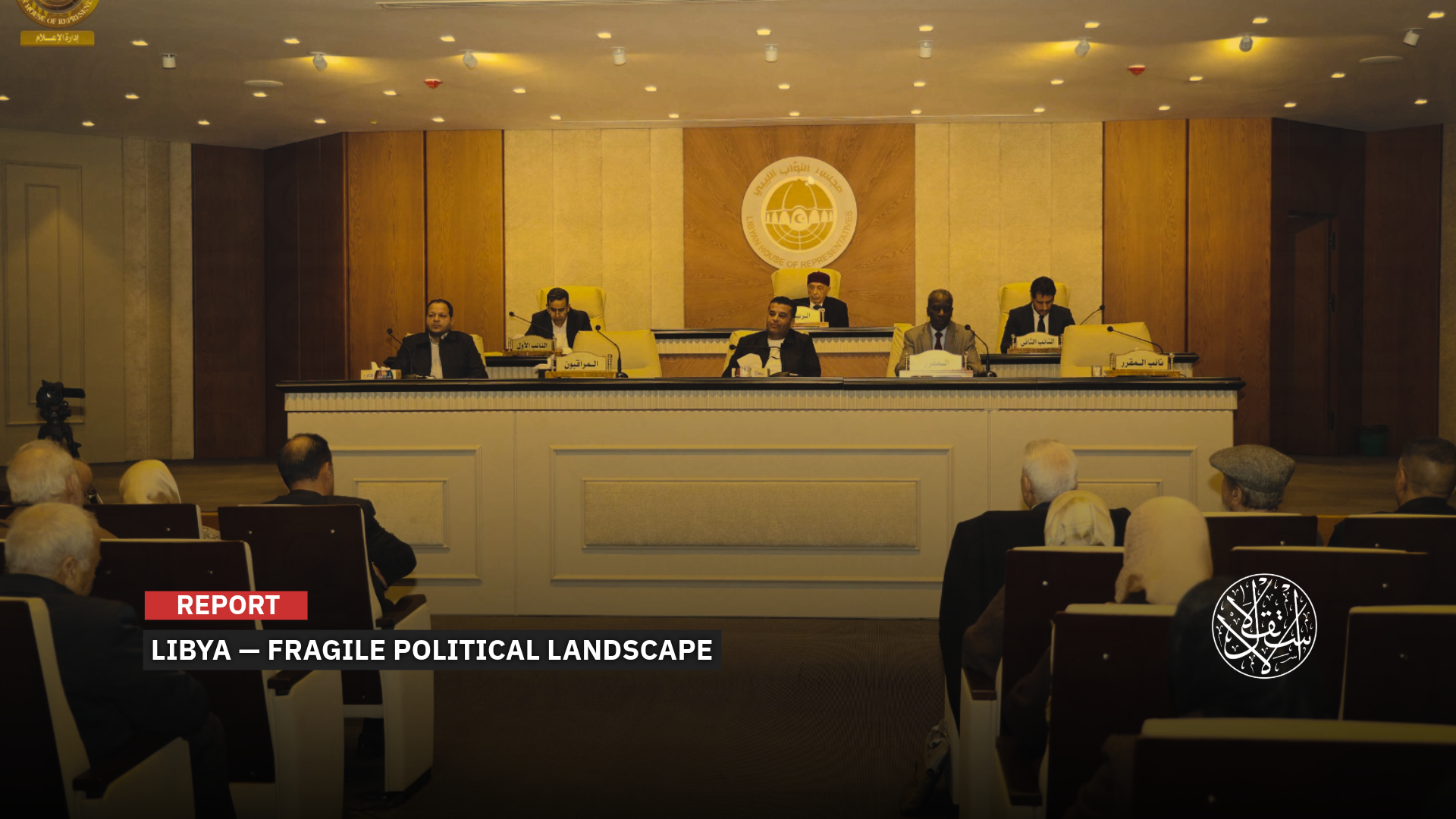
On December 29, 2025, the Libyan House of Representatives voted in a formal session to fill vacant seats on the High National Election Commission (HNEC). A day later, it unanimously approved the HNEC’s budget, placing it under the supervision of the parliamentary finance committee.
The first vote immediately set off a fresh round of political disputes, drawing in rival Libyan actors, institutions, and figures.
Legal Flaw
The High Council of State (HCS) swiftly rejected the move. In a statement issued on December 29, it said the vote was marred by procedural and legal flaws and amounted to “a unilateral step” that ran against existing political understandings between the two bodies.
The HCS said it remained fully committed to what had been explicitly agreed upon by joint committees from both sides, namely a full change of the HNEC’s board to safeguard its independence, rebuild trust in the electoral process, and genuinely pave the way for fair and transparent elections that would bring the transitional period to an end.
It warned that any unilateral action touching this sensitive national issue would undermine political consensus and erode the foundations of partnership between the two councils, arguing that such steps would only deepen divisions and further complicate an already fragile political landscape.
The HNEC’s board said it was following the decisions taken by the Libyan House of Representatives, which addressed filling vacant seats on the HNEC’s board and approving the budget needed to run presidential and parliamentary elections, in line with the electoral laws referred to the HNEC on October 5, 2023.
In a statement issued on December 30, the HNEC said the appointments were made in accordance with Article 10 of Law No. 8 of 2013 governing its establishment, stressing that the move had no connection to the political agreement that some parties, it said, were trying to drag into the issue to serve their own agendas.
The HNEC added that it was not seeking to cling to its leadership of the institution but rather to set the record straight at a time when its independence and integrity were being questioned and its credibility targeted.
It said the criticism came despite what it described as its clear success in organizing municipal elections across the country, its ability to deal with all parties, and its capacity to overcome obstacles and challenges.
The HNEC also urged political elites and activists who had joined what it called a campaign of distortion to be accurate and fair in presenting the facts and to familiarize themselves with the relevant laws and regulations governing the commission’s work before addressing the Libyan public through television or social media.
A More Complicated Phase
On the political and academic front, Khalifa Ahwas, former dean of the Faculty of Law at Sirte University, said Libya’s political scene has entered a new, complex phase, driven by overlapping internal crises, institutional splits, and international involvement. Together, he argued, these factors pose serious challenges to national sovereignty and to holding presidential and parliamentary elections.
In remarks reported by the local outlet Alsaaa24 on December 30, Ahwas said the Libyan House of Representatives’ latest session showed it acting as a political actor rather than a legislative body, creating a clear clash with the HCS on several issues. He said the HCS’s statement was a direct response to the parliament’s recent moves.
Ahwas argued that the decisions taken in that session ran counter to earlier agreements and added another layer of complication at a time when divisions within the political process have become unmistakable. This, he said, gives the international community justification to push compromise solutions between rival parties.
He noted that the Libyan House of Representatives has failed to reach agreement on organizing elections, even after three months beyond the set deadline. The session itself, he said, was disorganized, with the speaker and lawmakers unable to achieve the level of political partnership required. The divisions, he added, extend into the judiciary, making the implementation of any decisions difficult on the ground.
Ahwas stressed the need for new political outcomes, whether through popular forums or formal institutions, to move toward elections or an effective founding conference. He added that what happened in parliament would remain under dispute and would not be implemented due to opposition from legislative, executive, and judicial actors, even if the decisions were nominally in favor of the electoral process.
Any political path, Ahwas warned, must serve the Libyan people and reflect their will, cautioning that continued disputes between local actors and the international community would only deepen the complexity.
Journalist Ramadan Moaitek called for completing the legal and constitutional frameworks governing elections and for accurately regulating national and administrative records to prevent fraud or abuse, alongside effective judicial oversight.
Speaking to Libya’s Almasar TV on December 30, 2025, Moaitek said the Bouznika process in Morocco on elections was clear and defined, and that all parties should commit to the agreed democratic process with the HCS.
He said the HCS had already submitted all nominees to the HNEC, and that any attempt to complete the latter’s board without clear partnership between the two councils would violate previous agreements.
Moaitek added that the rules of the electoral process were not shaped by local actors alone but stemmed from Libya’s international obligations under Chapter VII. International and regional agreements such as Skhirat, Geneva, Tunis, Berlin, and Bouznika, he said, succeeded only because of a national will to reach consensus among Libyan factions.
He concluded that the real solution lies in unity and cooperation among Libyans to hold fair elections that represent all citizens, stressing that elections must be conducted under a unified government. He also said the two councils cannot amend or reverse these laws, as they emerged from a designated advisory committee and form part of a clear international framework endorsed by the UN Security Council as the sole recognized path to ending Libya’s crisis.

A Legal Reading
Legal analyst Abdalla al-Daibani said the current debates inside the Libyan House of Representatives over filling vacant seats on the HNEC do not reflect genuine consensus or full consultations on how commissioners should be selected or how voting should be conducted.
In an interview with Libya Alahrar TV on December 30, al-Daibani pointed in particular to the absence of a number of lawmakers from the voting session, warning that this raises serious questions about both the process itself and the mechanism used to make the selections.
He argued that both the Libyan House of Representatives and the HCS have drifted away from the internationally backed political track originally designed to manage these milestones.
Al-Daibani believes the best approach would have been to fill the vacant seats, especially since they are allocated to the Cyrenaica region, and that the selection should ideally have been made by Cyrenaican representatives in both councils.
He noted that similar meetings had taken place in the past, including in the city of al-Bayda, with the aim of reaching consensus on key files and on how positions assigned to Cyrenaica should be filled, given the region’s historical weight and its place within Libya’s power-sharing arrangements.
According to al-Daibani, the majority favors filling the vacant seats in the HNEC while maintaining its current leadership. He noted this approach aligns with the United Nations, highlighting that UN envoy Hanna Tetteh supports keeping chair Imad al-Sayeh in place while completing the board.
He warned that the ongoing lack of agreement between the Libyan House of Representatives and the HCS continues to shape the selection process and shows that core disputes remain unresolved. Al-Daibani cautioned that reopening the door to rigid quota logic and dismantling the HNEC could create further complications, particularly with senior political and leadership posts allocated to Cyrenaica still unsettled. The priority, he stressed, should be a return to a broadly agreed political path.
Looking Ahead
Libyan political analyst Ibrahim Assifar said the parliamentary vote reopened the elections file from a procedural angle, but at the same time ignited a political dispute that exposed the depth of the crisis rather than bringing it closer to resolution.
“Despite its institutional significance, the move can’t be separated from the deep divisions and mutual distrust between political bodies,” Assifar told Al-Estiklal. “In that light, it feels less like the start of a credible election and more like a strategic repositioning.”
“On the surface, the parliament seems to be moving to fill a long-standing institutional gap and revive stalled bodies,” he said. “But in reality, it doesn’t answer the key question: can these measures lead to actual elections without broad political agreement?”
“Filling the vacant seats on the HNEC and approving its budget may give the impression of readiness, but administrative preparedness does not automatically translate into political or security readiness,” the analyst added. “The backlash after the vote, especially the statement from the HCS, cannot be seen as a purely legal dispute.”
At its core, he said, the reaction reflects genuine fears of marginalization and an attempt to defend the principle of consensus embedded in earlier political frameworks. This overlap between legal and political concerns has turned objections into a tool for shoring up negotiating positions rather than shaping a clear alternative path to elections.
Looking ahead, Assifar said the standoff is unlikely to end with a swift victory for either side. Parliament lacks the power to impose an electoral track on its own, while the HCS cannot block the process indefinitely without paying a growing political price.
In the meantime, he said, the HNEC remains a focal point of indirect confrontation, treated as leverage rather than as an independent institution meant to stay out of political tussles.
Assifar stressed that the deeper problem lies not in procedures or statements, but in the absence of agreement on the basic rules of the political game. He noted that many players still refuse to accept electoral defeat, driven by mutual fears of being sidelined or losing influence once the votes are in.
The ongoing executive and security split places any electoral deadline at real risk, reducing talk of elections to a political slogan rather than a viable project.
Beyond internal dynamics, Assifar said the regional and international dimensions cannot be ignored, as any electoral process in Libya requires a minimum level of external understanding to ensure stability. Current signals, he argued, suggest that such understanding is still incomplete, slowing the shift from crisis management to resolution.
As a result, he concluded, the dispute over the HNEC and its budget is likely to persist as part of a broader battle over political positioning, not as a direct prelude to imminent elections. Without a genuine political settlement that addresses the roots of the conflict, he said, elections will remain a deferred goal, endlessly debated but never realized.