Legal Expert Maps Out Transitional Justice Roadmap for the New Syria (Exclusive)

"What Syria needs is a homegrown model built on the universal principles of transitional justice."
Almoutassim al-Kilani, a specialist in international criminal law and human rights, affirmed that transitional justice is not a political option that can be postponed, but rather a legal and national obligation imposed by the scale of the violations Syria has witnessed over more than a decade.
In an interview with Al-Estiklal, al-Kilani said that what Syria needs is a national model grounded in the universal principles of transitional justice, while at the same time responding to the specific characteristics of Syrian society.
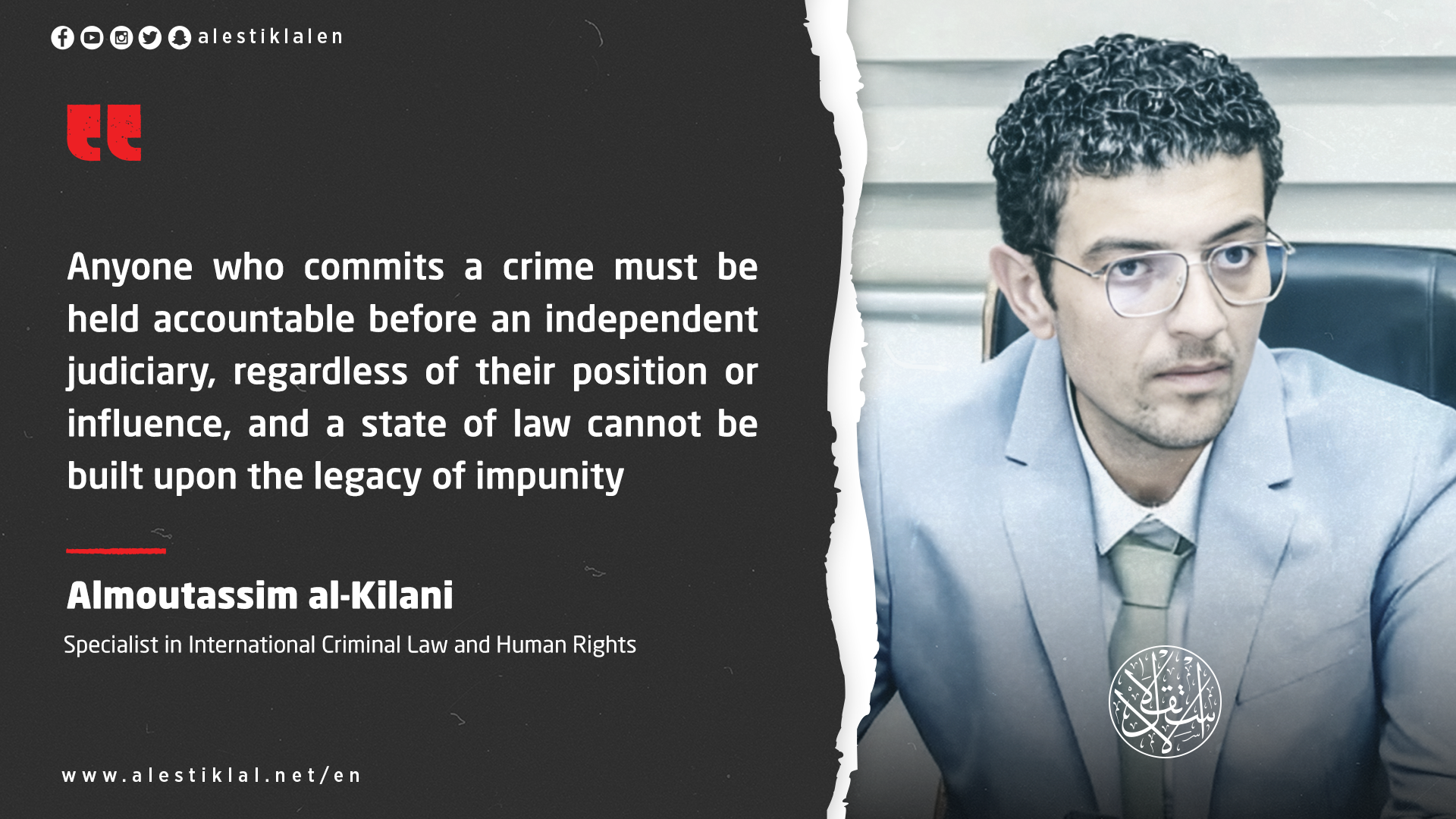
He argued that the success of trials should not be measured by the severity of the sentences, but by their ability to establish a principle that has long been absent in Syria, namely that anyone who commits a crime is held accountable before an independent judiciary, regardless of their position or influence.
He pointed out that one of the top priorities of Syria's new People's Assembly should be the enactment of a comprehensive transitional justice law that defines the mandates of the relevant institutions, guarantees the rights of victims, and regulates mechanisms for uncovering the truth and providing reparations.
Almoutassim al-Kilani is a Syrian lawyer and human rights advocate specializing in international criminal law and human rights, and a PhD researcher in international relations.
He stressed that transitional justice is not about putting the past on trial, but rather a legal and constitutional process to rebuild the relationship between the state and society on the basis of the rule of law, so that impunity does not become part of the future, as it was part of the past.
A Legal and National Entitlement
To begin with, why is transitional justice, and its implementation, considered an urgent national necessity for achieving recovery and sustainable stability at this sensitive stage in the life of the new Syrian state?
Transitional justice is not a political option that can be postponed; rather, it is a legal and national obligation imposed by the scale of the violations Syria has witnessed over more than a decade.
A state governed by the rule of law cannot be built on a legacy of impunity, nor can stability be achieved by ignoring the rights of victims or reducing justice to criminal trials alone.
Comparative experiences have shown that countries emerging from conflict regain the trust of their citizens only when everyone feels that the new state stands at an equal distance from both victims and perpetrators, and that it addresses the past through the rule of law rather than the logic of revenge.
In the Syrian context, transitional justice represents the broader framework that brings together criminal accountability, truth-seeking, reparations, the search for the missing, institutional reform, and guarantees of non-recurrence.
These are not merely slogans, but well-established obligations under international human rights law, affirmed by the United Nations' principles on combating impunity and protecting victims' rights.
Today, following the establishment of the National Commission for Transitional Justice, the National Commission for the Missing, and the launch of several trials, Syria has entered a new phase distinct from the period of armed conflict.
However, the success of this phase will not be measured by the number of trials held, but by the state's ability to build a justice system that encompasses all victims and all suspects without discrimination, while simultaneously guaranteeing the rights of the defense and the right to a fair trial.
Transitional justice is not intended to reproduce divisions, but to rebuild the social contract between the state and society.
If managed properly, it will serve as the genuine guarantee of Syria's stability because it addresses the root causes of the conflict, not merely its consequences, and lays the foundation for a state in which the law stands above authority and human rights take precedence over political considerations.
How do you assess the Syrian government's seriousness in implementing transitional justice?
It can be said that there are positive indicators that cannot be ignored, most notably the establishment of the National Commission for Transitional Justice, the National Commission for the Missing, and the initiation of judicial proceedings against a number of former officials. In addition, the formation of the transitional People's Assembly is expected to complete the legislative framework. These steps represent a shift from the stage of declarations to the stage of institution-building.
However, assessing the government's seriousness should not be based solely on the creation of these bodies, but rather on the substance of their work, their independence, and their inclusiveness.
Legitimate legal questions remain regarding the scope of the National Commission for Transitional Justice's mandate, whether it covers all violations regardless of the identity of those responsible, and the need to involve victims and civil society organizations in shaping the public policies of transitional justice.
The government's success will also be measured by its ability to safeguard judicial independence, refrain from interfering in the work of prosecutors and courts, ensure the enforcement of judicial rulings, provide the resources needed to protect witnesses and preserve evidence, and prevent any political or security considerations from influencing the course of justice.
In my view, we are witnessing an important beginning, but it is not yet sufficient. Transitional justice is not a single event, but an institutional process that may extend over years.
It requires sustained political will, advanced legislation, public oversight, and cooperation with international mechanisms in order to earn the trust of Syrians and achieve its objectives.
Incremental Reforms
Is the current Syrian judicial system capable of delivering transitional justice, or does it require further reforms?
I do not believe that any judicial system emerging from a prolonged conflict can carry out the task of transitional justice without deep institutional reforms, and Syria is no exception.
The judiciary is the backbone of any accountability process, but at the same time it is one of the institutions most affected by the conflict, whether in terms of its legislative framework, human resources, or public trust.
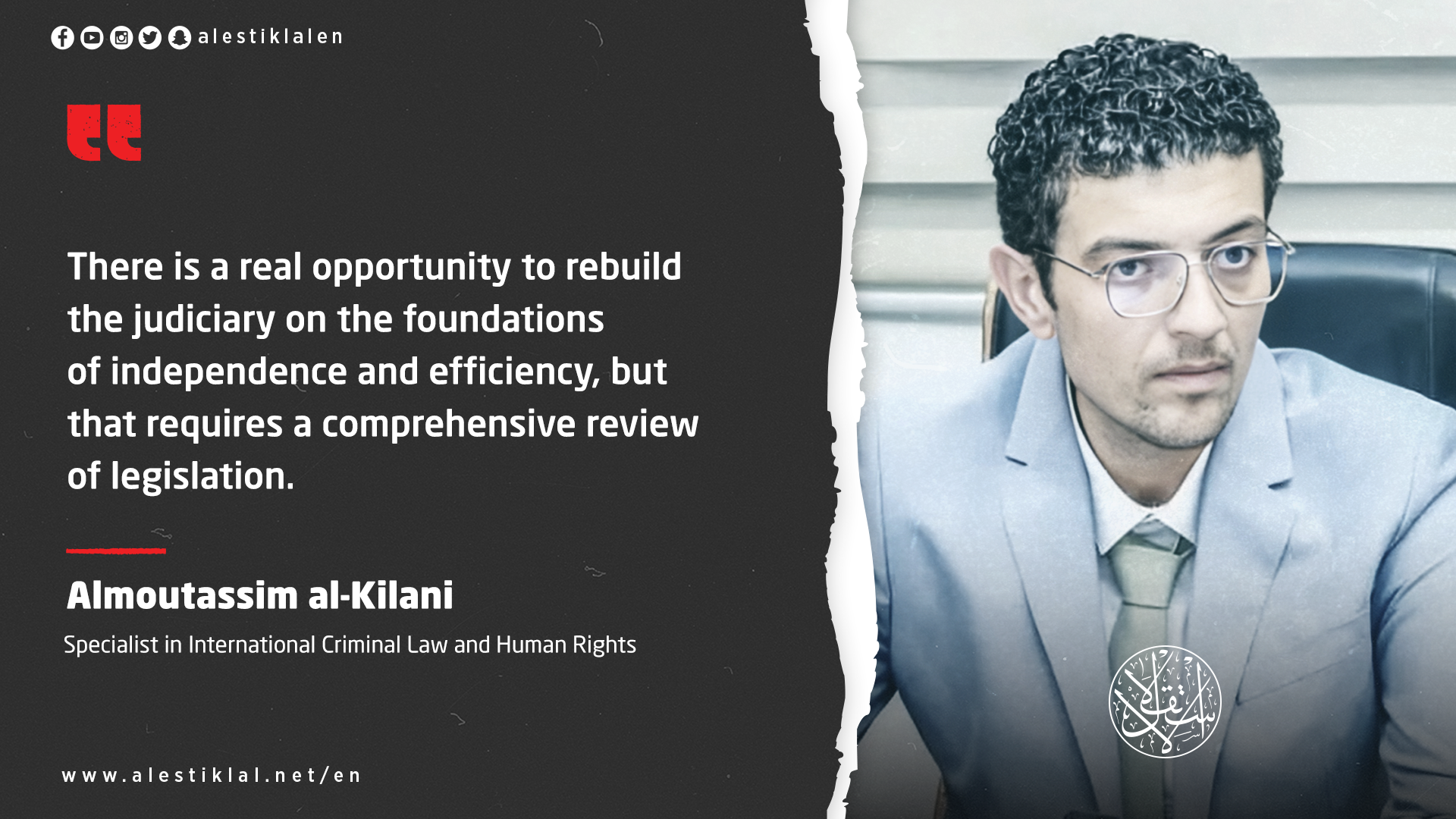
Today, there is a genuine opportunity to rebuild the judiciary on the foundations of independence and competence. However, this requires a comprehensive review of legislation, strengthening the independence of the Supreme Judicial Council, insulating the judiciary from any political or security influence, and reassessing the status of judges and public prosecutors according to professional and legal standards that ensure integrity, while respecting their rights and guaranteeing their employment protections.
Transitional justice also requires the judiciary to deal with categories of crimes that differ from ordinary criminal offenses, such as crimes against humanity, war crimes, enforced disappearance, and torture. This calls for the establishment of specialized judicial chambers and continuous training for judges and prosecutors in international criminal law and international humanitarian law, alongside enhancing the capacities of forensic medicine, criminal evidence, and digital investigations.
It is also important to recognize that transitional justice is not the responsibility of the judiciary alone. Rather, it is a comprehensive system involving the judiciary, independent bodies, the legislative branch, the executive branch, and civil society. The judiciary issues rulings, but it cannot, on its own, uncover the truth, provide reparations, reform institutions, or rebuild trust between the state and society.
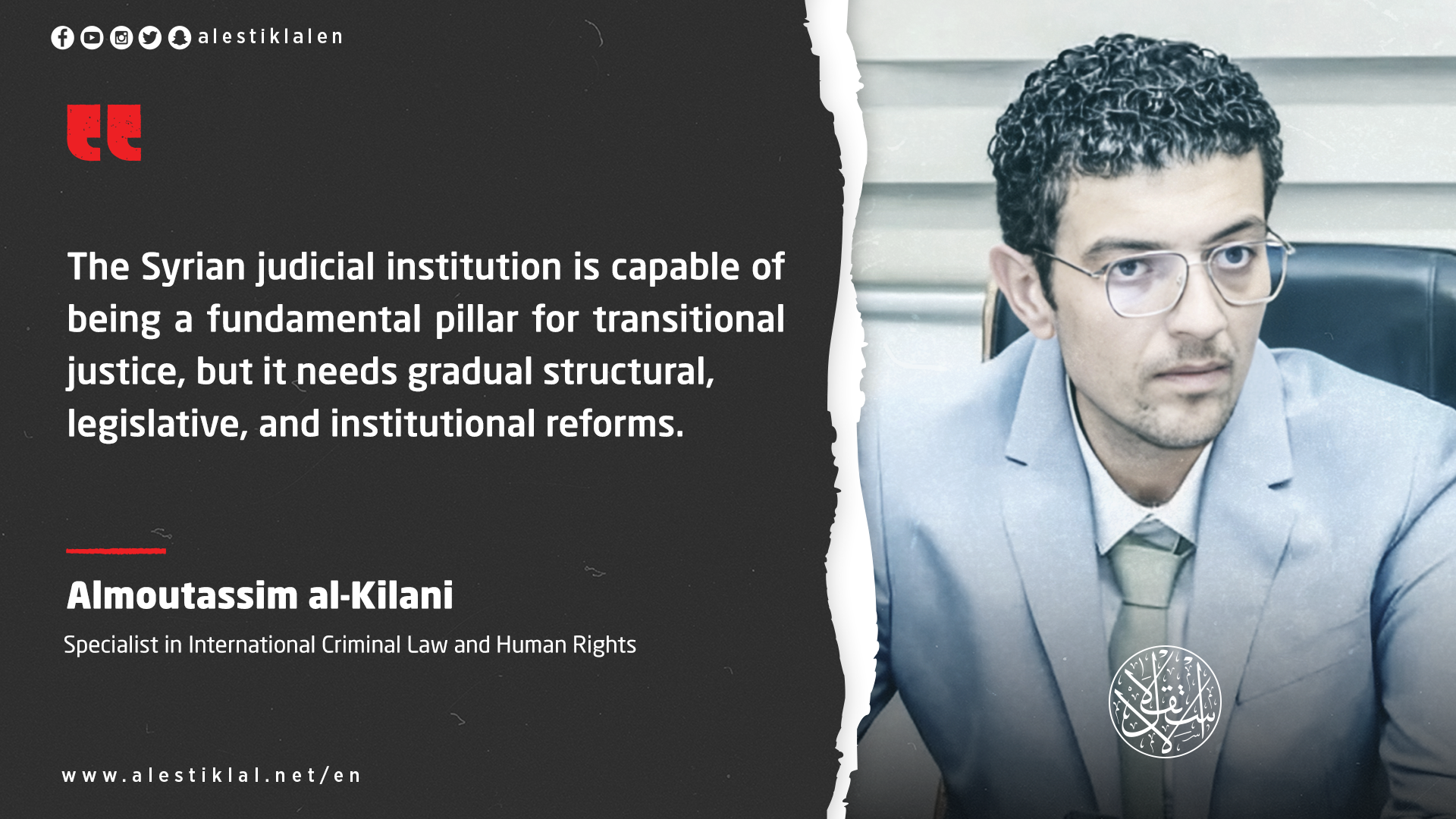
Therefore, I believe that the Syrian judiciary is capable of serving as a fundamental pillar of transitional justice, but it requires gradual structural, legislative, and institutional reforms, because the success of transitional justice is measured by the judiciary's ability to deliver justice independently and impartially, not merely by the issuance of judgments.
Establish an Effective Framework
What mechanisms are needed to ensure witness protection and prevent the loss of evidence given the existence of thousands of case files?
Protecting witnesses and preserving evidence are not merely procedural matters; they are among the most important guarantees for the success of any transitional justice process.
International experiences have shown that many trials have collapsed due to inadequate witness protection or the loss, destruction, or tampering of evidence. Therefore, international law considers witness protection an essential component of the right to a fair trial.
In the Syrian context, where crime scenes are numerous and victims and witnesses are spread inside and outside the country, there is a need to establish an independent national witness protection program with a dedicated budget and clear authorities. Such a program should include, when necessary, identity changes, secure accommodation, psychological and social support, protection of personal data confidentiality, and legal protection for whistleblowers and experts.
As for evidence, it is essential to establish a unified national database linking evidence collected by judicial authorities, national commissions, civil society organizations, and international mechanisms, while fully adhering to the rules of the chain of custody to ensure that evidence remains admissible in court and that its integrity or source cannot be challenged.
Special priority should also be given to digital evidence, satellite imagery, video recordings, mobile phone analysis, and DNA evidence, given their critical importance in complex cases, particularly those involving mass graves and missing persons.
Finally, the large number of case files should not justify rushed procedures or violations of fair trial guarantees. The goal should be to build an effective case management system based on clear criteria for setting priorities, while preserving every victim’s right to access justice and every defendant’s right to a fair trial.
Does the new People’s Assembly have a role in enacting laws that contribute to implementing transitional justice?
Undoubtedly, because transitional justice is not merely a judicial project; it is also a legislative one. Many transitional justice mechanisms cannot function effectively without a clear legal framework issued by the legislative authority.
Therefore, the new People’s Assembly bears a constitutional and national responsibility to complete the legislative foundation for the transitional phase.
One of the Assembly’s priorities should be issuing a comprehensive transitional justice law that defines the mandates of relevant institutions, guarantees victims’ rights, regulates mechanisms for truth-seeking, reparations, witness protection, access to national archives, and coordination between the judiciary and independent bodies.
The Assembly is also responsible for reviewing existing legislation, repealing or amending provisions that conflict with the constitution or Syria’s international human rights obligations, and aligning national laws with the international conventions to which the state is party.
The Assembly also has a crucial oversight role by monitoring the performance of transitional justice institutions, holding them accountable for their compliance with the law, and ensuring their financial and administrative independence. The absence of parliamentary oversight could turn transitional justice into a mere administrative process lacking effectiveness.
In my assessment, the success of the People’s Assembly will not be measured by the number of laws it passes, but by its ability to produce consensus-based legislation that strengthens trust between the state and society and establishes a phase in which the law becomes the supreme reference, rather than political power balances.
What practical proposals can address the harm suffered by victims beyond traditional financial compensation?
When discussing reparations in transitional justice, we do not mean financial compensation alone, because the harm suffered by Syrians over the past years cannot be reduced to a monetary value.
Some people have lost family members, while others have endured torture, enforced disappearance, displacement, loss of property, or deprivation of education and employment.
Therefore, the United Nations principles on the right to remedy and reparation view reparations as a comprehensive system that includes restitution, compensation, rehabilitation, satisfaction, and guarantees of non-recurrence.
In the Syrian context, I believe the priority should be determining the fate of missing persons and those subjected to enforced disappearance, because knowing the truth represents a form of justice for their families that is no less important than any financial compensation.
A national program for psychological and social rehabilitation of survivors should also be established, particularly for children, women, and victims of torture and sexual violence, while providing free health and educational services to the most affected groups.
Another practical proposal is the creation of a national reparations fund, financed through the state budget, legally recovered assets, and legitimate international contributions, ensuring fair and transparent compensation free from favoritism. It should also restore the professional and civil rights of those who were unjustly deprived of them, and return property whenever possible, or provide compensation when restitution is not possible.
Equally important is official recognition of victims, commemorating their experiences, and establishing national museums or documentation centers that preserve collective memory. Public acknowledgment of what occurred is considered part of reparations under international standards. Transitional justice is not only about punishing perpetrators, but also about restoring dignity to victims and reintegrating them into society as rights holders, not merely recipients of aid.
Finally, the best guarantee of reparations is preventing recurrence. Therefore, institutional reform, strengthening judicial independence, enhancing oversight of public institutions, and promoting a culture of human rights are all integral parts of the concept of reparations under international law.
Establish a National Program
How do you assess the trials held for figures from the ousted Assad regime? And what sentences do you expect to be issued against them?
It is too early to make a final assessment of the trials, as they are still in their early stages. Any legal expert should also avoid preempting the judiciary or predicting convictions before the completion of the proceedings.
The fundamental principle of criminal justice is that a defendant is presumed innocent until proven guilty through a final judicial ruling, and this principle must apply even in cases involving the most serious violations.
However, the process can be assessed from a procedural perspective. If the trials are being conducted before an independent judiciary, respecting the rights of the defense, allowing defendants to review evidence, call witnesses, and appeal rulings, then they represent an important step toward consolidating the rule of law.
But if these guarantees are absent, then the judgments, regardless of their outcome, could raise legal concerns and undermine the trust of victims and public opinion.
Trials should also not be limited only to high-ranking political and military officials. Rather, based on the evidence, they should extend to anyone proven to have been involved in committing crimes, issuing orders to commit them, or assisting in their commission, while taking into account the principles of individual criminal responsibility and command responsibility when their legal conditions are met.
At the same time, trials must not become a means of political revenge or collective punishment against individuals merely because of their former affiliation with state institutions.
As for the sentences, it would be unprofessional to predict the type or duration of punishment, as this depends on the proven facts, the legal classification of each crime, the evidence presented, the role of each defendant, and any aggravating or mitigating circumstances determined by the court. A criminal judge does not rule based on impressions or political positions, but solely on evidence and the law.
In my view, the success of these trials will not be measured by the severity of the sentences, but by their ability to establish a principle that has long been absent in Syria: that anyone who commits a crime is held accountable before an independent judiciary, regardless of their position or influence.
Does Syria need to develop a national model based on leading international experiences in transitional justice?
Absolutely, but not in the sense of copying another country’s experience. Transitional justice is not a ready-made model that can simply be transferred from one country to another; rather, it is a process designed according to the national context while benefiting from comparative experiences.
This is also emphasized by the United Nations and specialized international centers, as there is no single model that can be applied exactly in every country.
Syria differs from South Africa, which focused on truth commissions; it differs from Rwanda, which combined international and domestic judicial mechanisms with specific community-based approaches; it differs from Bosnia and Herzegovina, which established a special international tribunal; and it differs from Colombia, which developed a model combining accountability with restorative justice.
Each experience has its own historical, constitutional, and social circumstances, and none can simply be imported as it is.
What Syria needs is a national model grounded in the universal principles of transitional justice, while also responding to the specific characteristics of Syrian society.
This model should be built on four interconnected pillars: first, criminal accountability based on fair trial standards; second, truth-seeking and ensuring victims’ right to know; third, comprehensive reparations in all their forms; and fourth, institutional reform and guarantees of non-recurrence. If any of these pillars is missing, the transitional justice system will remain incomplete.
This model must also be based on broad societal participation, with victims, civil society organizations, universities, bar associations, and public authorities involved in shaping its policies, because transitional justice cannot be imposed from above; it must be built through national consensus.
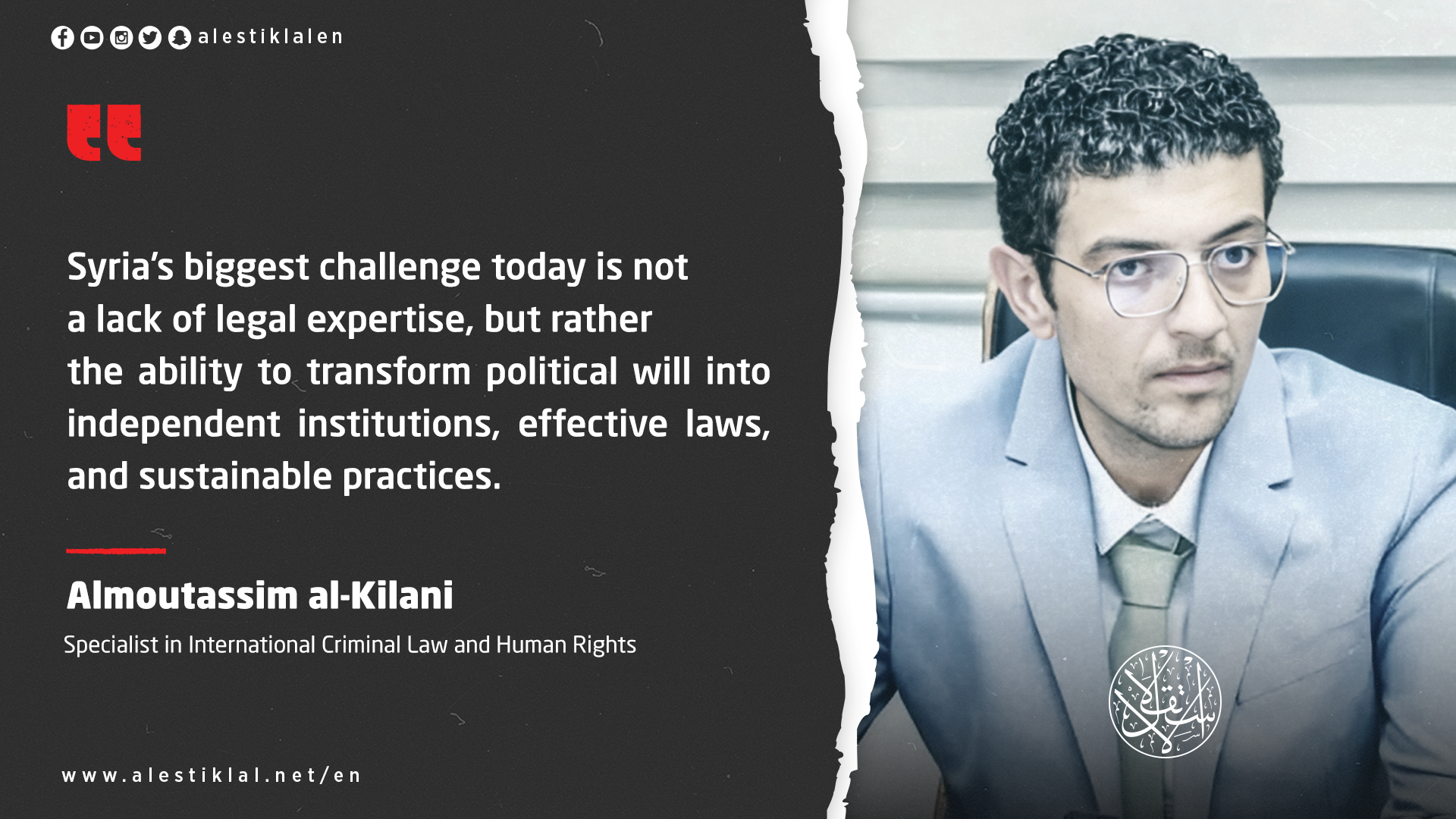
I believe Syria’s greatest challenge today is not a lack of legal expertise, but rather the ability to transform political will into independent institutions, effective laws, and sustainable practices.
If the state succeeds in doing so, it will not only deliver justice for the past, but also establish a rule-of-law state capable of preventing the recurrence of violations in the future.
This is the true purpose of transitional justice: to serve as a bridge that carries Syria from the legacy of conflict toward a state based on citizenship and the rule of law, rather than merely a tool for addressing the mistakes of the past.