Five Years on: Morocco’s Gains and Losses from Normalization with ‘Israel’

Mass rally in Rabat opposes normalization and supports Palestinian cause
s 2025 draws to a close, Moroccans are marking the fifth anniversary of the normalization agreement between Rabat and “Tel Aviv,” brokered by the United States in late December 2020, as part of what became known as the Abraham Accords.
While local media outlets aligned with the authorities, as well as others backed by the United Arab Emirates, have promoted what they describe as the “success” of Morocco’s policy on normalization, analysts and activists warn of the growing Israeli influence within the country and the negative implications this may have for Morocco’s national security, politically, militarily, and culturally.
In this context, the Moroccan Commission for the Support of the Nation’s Causes said that Moroccan-Israeli relations have seen significant development over the past five years, noting that the pace of rapprochement has accelerated unprecedentedly since the signing of the agreement.
The commission, in a statement released on the occasion, said that more than 40 agreements and memoranda of understanding have been signed between the two sides, covering multiple sectors, including security and defense, the economy, scientific research, tourism, and other sensitive areas.
The statement added that official relations have involved more than 20 reciprocal visits by government, military, and security officials, accompanied by military and security cooperation deals covering drones, surveillance systems, and intelligence equipment, reflecting, according to the commission, Morocco’s deep engagement in the security aspect of normalization with “Israel.”
On the economic front, the statement noted that trade between the two countries has risen from near-zero levels prior to normalization to more than $300 million annually in some years, with a clear trade imbalance in favor of “Israel.”
Meanwhile, the Moroccan Front for the Support of the Nation’s Causes and Anti-Normalization, outlined its activities opposing the Israeli occupation and the normalization process, for the period from October 7, 2023, to October 7, 2025.
During a press conference on the occasion, the front said its activities included organizing 11 nationwide popular marches, 17 national protest days, more than 210 local demonstrations, around 700 protest sit-ins, 33 conferences or festivals, and 90 field and awareness initiatives.
The front also said that more than 33 demonstrations were banned during the same period, which it described as reflecting increasing restrictions on popular activism against normalization, even as official relations with “Israel” continue to expand.
An Existential Threat
Aziz Hanawi, secretary-general of the Moroccan Observatory for Anti-Normalization, described the fifth anniversary of what he calls the “ominous event” as presenting Moroccans with a highly dangerous scenario.
This, he said, is reflected in the way some groups have celebrated the anniversary, at a time when Israeli crimes against the Palestinian people continue unabated.
Speaking to Al-Estiklal, Hanawi said these groups, whether individuals or media outlets, are in one way or another aligned with the Israeli state or conform to its narrative, deliberately ignoring the scale of bloodshed and criminality committed by the occupation in Palestinian territories.
“We are witnessing a dangerous transition from covert normalization to full-blown Zionism within Morocco,” he said, citing a recent statement by a lawyer in Marrakesh who described “Israel” as his “second homeland,” calling it a blatant remark that reflects a moral and ethical decline.
Hanawi insisted that “such people are agents of Zion,” noting that they have established associations under names like ‘Moroccan-Israeli Friendship’ in an attempt to legitimize Israeli infiltration within Moroccan society.
The political and human rights activist reaffirmed that the Moroccan people, along with its active forces, reject normalization outright, emphasizing that supporters of normalization “cannot even mobilize a fraction of the numbers” who have taken part in demonstrations and popular marches opposing normalization.
He added that “normalization is ethically, socially, doctrinally, and humanly invalid,” and said it now exists only “with an authoritarian and controlling background,” failing to reflect the people’s consciousness or historical choices.
Nevertheless, Hanawi warned that popular rejection does not remove the need for vigilance against what he described as “Zionist infiltration into the core of the Moroccan state,” and efforts to control institutions and positions to serve a Zionist agenda, potentially provoking an artificial clash between the state and the people.
He stressed that the critiques and observations voiced by anti-normalization activists, while they may irritate some circles of power, “stem from the depth of our patriotism and our faith in our state and country,” aimed at protecting Morocco from a “surreal scenario” incompatible with its history and principles.
From this perspective, Hanawi argued that logic and reason demand the closure of the Israeli liaison office in Morocco, especially following the brutal massacres committed and still ongoing in Gaza and the West Bank.
He also criticized those who present Moroccan-Israeli relations as a “historic achievement,” citing a widely covered doctoral thesis on the topic, which he dismissed as “invalid,” arguing that it cannot overshadow the enduring historical reality that Moroccan universities and the student movement have long championed the slogans: “Palestine is a national cause” and “Cursed be the supporters of Zionism.”
Hanawi condemned the promotion over the past five years of Moroccan Zionist figures as advocates of peace and dialogue, insisting that these individuals “lack all honor,” as they, in his words, defile Morocco’s values of tolerance in service of a Zionist agenda, particularly in education, media, and cultural spheres.
“For these principles, namely patriotism and loyalty to the just and humanitarian Palestinian cause, we will remain steadfast in confronting Israel and its agents in Morocco, and we will not bow to the criminal Benjamin Netanyahu or his allies,” he concluded.
Damaging Consequences
Meanwhile, researcher and writer on Palestinian affairs Hisham Tawfiq said that the growing ties between “Tel Aviv” and Rabat over the past five years represent “a dangerous indicator of the extent of Zionist infiltration within the country.”
Speaking to the local outlet Sawt al-Maghrib on December 23, 2025, Tawfiq warned that this infiltration could have destructive effects across multiple sectors, rather than contributing to Morocco’s progress or stability, adding that it carries worrying implications both strategically and socially.
Tawfiq noted that “Morocco has signed several agreements with Israel in agriculture, health, trade, economy, and the military, without producing even a single scientific study on the outcomes of countries that previously normalized relations, such as Egypt and Jordan.”
He said this suggests that Morocco “has not studied the consequences of normalization in previous cases, nor evaluated whether these countries achieved real economic gains, or whether normalization became a source of threat,” citing the 1996 carcinogenic tomato scandal in Egypt as a stark example of the uncalculated costs of normalization.
According to Tawfiq, “these troubling figures in the normalization process raise a fundamental question”: why is Morocco among the countries most targeted by Zionism, both in terms of accelerating normalization and deeply penetrating society and the state?
He continued, questioning, “Why, after normalization, were schoolchildren subjected to visits to a Jewish temple and forced to wear the kippah, under the false pretext of ‘coexistence,’ without their parents’ knowledge, sparking widespread public rejection?”
Tawfiq emphasized that “these practices did not stop there,” explaining that there have been attempts to infiltrate other educational institutions and universities covertly, before extending to high school and middle school clubs, as well as some civil associations.
He stressed that “normalization was not merely a fleeting commercial, cultural, or political agreement, but has taken on deeper dimensions,” describing it as a “second occupation,” or what Moshe Dayan once called a “strategy of territorial expansion.”
Tawfiq concluded that “Israel clearly expresses its true objectives behind normalization in its religious literature and the statements of its extremist religious parties,” while Arab states “remain in denial or reluctant to understand the long-term consequences and implications of normalization.”
Societal Reactions
Societal expression of rejection of normalization on its fifth anniversary came from a number of activists, civil society actors, and human rights organizations.
In this context, Islamic scholar and researcher in jurisprudence and objectives of law, Mohamed Awam, said that “our stance on normalization does not change with the passage of time, no matter the circumstances, because it is a doctrinal and principled position.”
Awam added in a post on his Facebook page on December 24, 2025, “Those who bet on the passage of time, forgetfulness, or apathy are mistaken; normalization is religiously forbidden, a betrayal of sacred values, and a failure to the nation.”
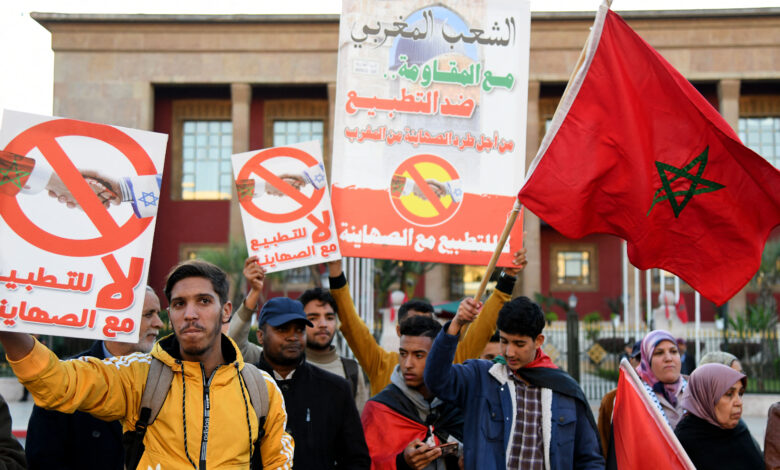
Meanwhile, the National Action Group for Palestine organized a popular protest on Friday, December 26, 2025, outside the parliament building in Rabat, as part of the ongoing Moroccan grassroots mobilization in support of the “Al-Aqsa Flood” campaign.
The group emphasized that the protest was held in rejection of normalization, all forms of Zionist-normalization infiltration, and what it described as the “comprehensive Zionisation” of the country.
The National Action Group also said that the demonstration aimed to renew calls for “the annulment of official state normalization, after five continuous years of shame,” in their words.
On the same occasion, the secretariat of the Justice and Development Party, led by Abdelilah Benkirane, reaffirmed its steadfast and decisive rejection of all forms of normalization with what it described as the usurping and criminal entity, currently facing international courts over charges of committing some of the most heinous war crimes and crimes against humanity.
In a statement issued on December 22, 2025, the opposition Islamist party warned of the dangers posed by Zionist infiltration in Morocco and highlighted its ongoing encroachment across national, academic, cultural, economic, agricultural, industrial, and service sectors.
Similarly, the Progress and Socialism Party and the Left Federation have consistently issued statements calling for a halt to normalization with “Israel,” a position also echoed by the Movement of Unity and Reform, the Justice and Charity Group, and a number of other civil society organizations and associations.
On the human rights front, the Moroccan Association for Human Rights issued a call on December 19, 2025, asserting that the signing of the normalization agreement with “Tel Aviv” was carried out against the will of the Moroccan people.
The association described the “ominous anniversary” as having become a day of national struggle, commemorated by anti-Zionist forces seeking to end normalization and push for legislation criminalizing it.
The statement highlighted the serious repercussions of normalization in all its forms for the Moroccan people, with particular concern over educational normalization, which it said targets the minds, consciousness, and memory of future generations.
In this context, the association urged educational and administrative staff, professional and student unions, and all members of the teaching community to remain vigilant, resist all Zionist schemes, and oppose anyone exploiting the Palestinian cause.
The association added that these schemes aim to strip the Moroccan education system of values of solidarity, instill submission and obedience, distort facts, narrow young people’s awareness, assert control over Moroccan memory, and attempt to erase the Palestinian cause from the consciousness of students, while aligning curricula and programs with the malicious plans of “Israel.”
In conclusion, the association called for the boycott of any cultural or scientific exchanges between Moroccan educational institutions and Israeli institutions, and urged efforts to protect future generations from all forms of Zionist infiltration, expose its normalization plans, and denounce its ongoing brutal conduct against the Palestinian people.
Zionist Propagandists
In contrast to the widespread popular opposition to normalization, the local outlet Hespress, funded by the United Arab Emirates, published an analysis on December 23, 2025, arguing that the signing of the normalization agreement with “Tel Aviv” “was not simply a leap into the unknown, nor a response to pressures from certain international powers.”
The site emphasized that the agreement represented “a sovereign Moroccan choice, crafted within a deep understanding of emerging transformations on the international stage, and aimed at repositioning the kingdom within regional influence maps, as part of a broader vision for national security and strategic positioning.”
The analysis added that this approach was pursued “without compromising the constants that have always formed the core of Morocco’s foreign policy, foremost among them the centrality of the Palestinian cause in Moroccan diplomacy.”
It noted that the strategic shift Morocco adopted in its approach to the Palestinian issue and relations with “Israel” enabled Rabat to recalibrate its alliances according to principles of reciprocity and mutual interest.
The piece went on to argue that this path put a definitive end to any attempts to manipulate principles or bargain over the state’s core values, ensuring Morocco’s full independence in decision-making, serving the aspirations of the Moroccan people, and safeguarding national security from targeted regional interventions.
Responding to this framing, Moroccan writer and political analyst Abdelaziz Ben Saleh said that a closer reading of the article reveals it is less a sober evaluative assessment of the five-year normalization process than an attempt to restructure collective memory in Morocco.
In a post on Facebook on December 23, 2025, Ben Saleh wrote that the site seeks to shift “normalization” from a contested decision to a celebrated national achievement, from a circumstantial political event to a symbolic anniversary worthy of commemoration.
He elaborated that the danger of this discourse lies not only in the decision itself, but in the language of celebration, and in the transformation of political time into a tool of psychological and cultural normalization, reshaping public consciousness regarding the Palestinian cause and Morocco’s relationship with “Israel.”
Ideological Indoctrination
The writer explained that Hespress does not pose simple questions such as: what has actually been achieved? What are the points of failure? What is the cost of this decision? Instead, it starts from a predetermined assumption that Morocco has “succeeded,” that balance has been “achieved,” and that the discussion is no longer about legitimacy but about the quality of management.
He emphasized that what was published is not an objective poll, but an attempt to frame public opinion within a specific lexicon, using terms such as “strategic maturity,” “Moroccan school,” “quiet diplomacy,” “separating functions without separating principles,” “sovereign decisiveness,” and “strategic reasoning.”
He added that this lexicon does not explain reality, but numbs the mind, as it does not discuss facts objectively, instead elevating them to vague concepts that are difficult to question or critique.
The writer pointed out the absent question in the piece: where is Palestine in all these “successes”? The article repeatedly reassures readers that Morocco has not abandoned the Palestinian cause, yet it provides no tangible indicators or clear evidence to support this claim.
He noted that the use of the term “anniversary of normalization” in Hespress is not limited to marking five years, but carries an implicit call to psychologically reconcile with normalization, presenting it as a historical milestone to be viewed from above, rather than as an event still open to critique and review. In short, it is an attempt to normalize normalization itself.
The writer also argued that the site’s approach does not address the ethical cost of normalization, nor does it question the contradictions and disparities between official human rights discourse and the ongoing bloodshed in Gaza and the West Bank. This, he said, turns the “analysis” into a plea, and the “survey” into an unannounced statement.
In this context, Abdelaziz Ben Saleh said that what Hespress published is not merely a five-year assessment, but an exercise in rewriting collective memory.
The discussion is not about balancing national constants with interests, but a symbolic declaration in favor of interests, while keeping the constants as empty slogans with no real substance.
He concluded that the real danger does not lie in Moroccans disagreeing over normalization, which is natural, but in the demand to celebrate normalization, in portraying opposition as ignorance, and acceptance as rationality.
The danger, he said, lies in transforming the Palestinian cause from a matter of national and ethical justice into a minor detail within “political realism.”