Hamdi Hassan: The Parliamentarian Who Led the January Revolutionaries in Alexandria Killed in Sisi's Prison
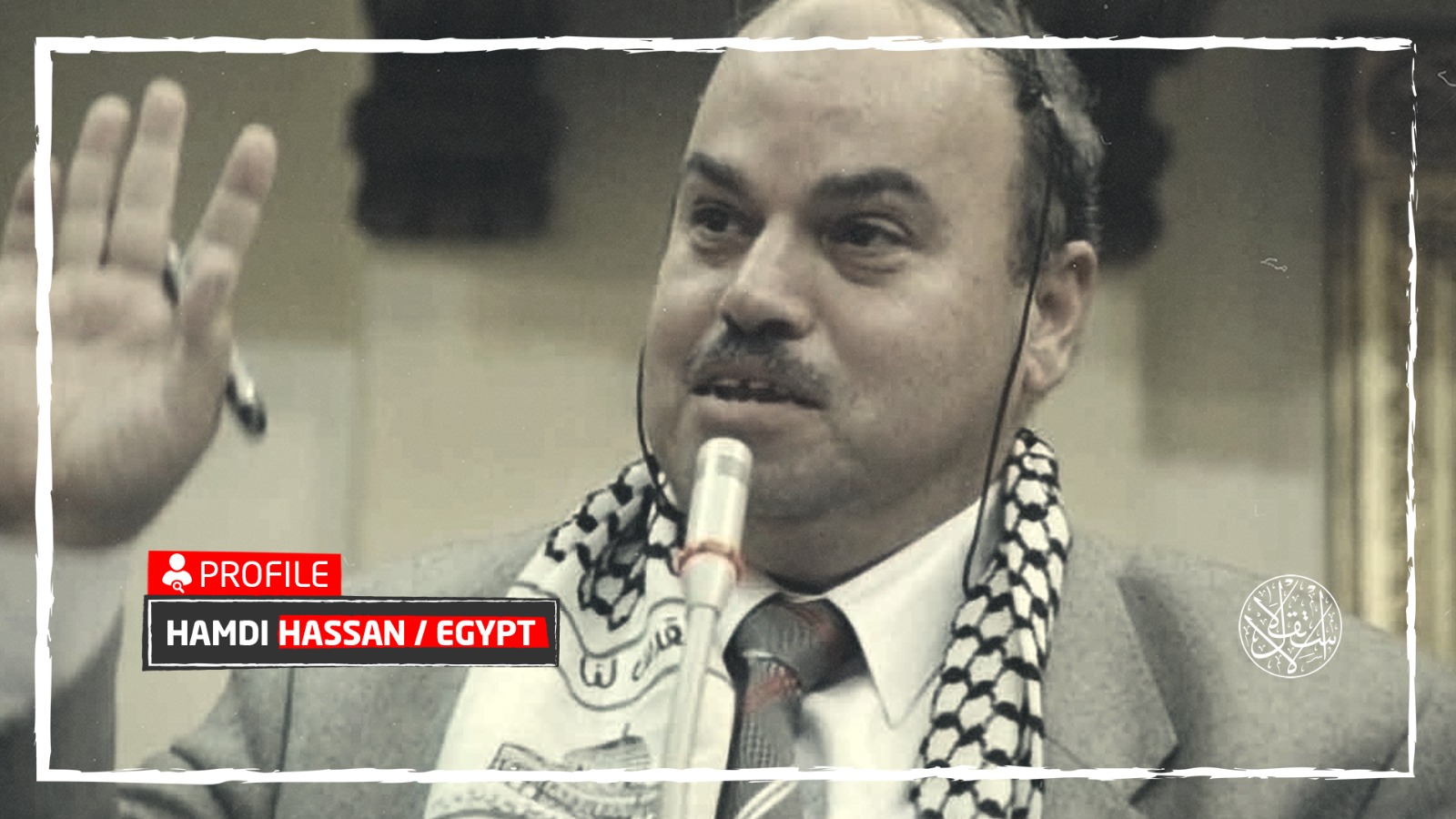
The former Egyptian parliament member and leader of the Muslim Brotherhood, Hamdi Hassan, joined the list of victims of the military coup in Egypt. He died inside the regime's harsh prisons, after suffering for many years of violations and medical neglect.
Hassan, 64, from the city of Alexandria, and a representative for its people for years, made a long journey in parliamentary life until he was one of the most famous representatives in the country, as well as a prominent activist.
His stance rejecting the military coup on July 3, 2013, and his descent into the demonstrations against it, made him one of the most wanted list of the military system, to be arrested, and placed in the most dangerous prisons of the regime, which is the high-security and notorious Scorpion Prison, according to what was announced on November 26.
Years later, Hamdi Hassan died in prison, having the same fate as many senior politicians and opponents who preceded him, such as former President Mohamed Morsi.

Confronting the Regime
Hamdi Hassan Ali Ibrahim was born on August 12, 1956, and grew up in the Egyptian city of Alexandria, and at its university he obtained a Bachelor of Medicine and Surgery in 1981.
During that period, he became acquainted with the Muslim Brotherhood and joined it, and through it he became active in public, and union work to serve the community. He became a member of the Islamic Medical Association, which was inaugurated in 1977, and for decades it provided great services to the poor in society in terms of treatment and medication, for those who could not afford it.
Hamdi Hassan held the position of Rapporteur of the National Work Committee of the Medical Syndicate by election, then he was a member of the Coordination Committee between the Professional Syndicates, then he became a member of the Arab Doctors Union.
The union activist began to realize the importance of being present in the service tracks within the framework of the state and unions. He improved his performance and political thought, with his success in 1992, and his election as a member of the local popular council for the West Alexandria neighborhood.
The years that Hassan spent in community work qualified him to run for parliament during the era of former regime president Hosni Mubarak, and that era was characterized by the police grip and restrictions on those who wanted to run for parliament outside the framework of the regime, especially if they belonged to Islamic currents.
Hamdi Hassan broke the rule with his overwhelming success in the 2000 parliamentary session, after which he became the people's deputy for the Mina al-Basal district in the West Alexandria district.
Because of his distinguished performance and strength in interrogations, in addition to his field activity among the neighborhood’s residents, and his strong relations with voters, he was one of the few who managed to maintain their positions as an opposition deputy and was elected to a second parliamentary term that began in 2005.
Hassan did not forget his duty towards the fateful issues of the nation outside the borders of his country. He was a member of the International Association of Parliamentarians Defending the Palestinian Cause, based in the Lebanese capital, Beirut.
On April 30, 2001, when the masses of Alexandria rose in solidarity with the Palestinian cause, which was witnessing the years of the second intifada, the Egyptian authorities arrested 11 leaders of the Muslim Brotherhood on charges of inciting the masses about the Palestinian cause.
At that time, Hamdi Hassan, one of the Brotherhood's representatives in Parliament, led the scene and defended them in a famous session. He said, "They arrested 11 people, including university professors, teachers, and lawyers…all of them are prominent figures in the Brotherhood, and they are accused of inciting the masses with regard to the issue of Palestine."
With the start of the revolution of January 25, 2011, Hamdi Hassan was among the forefront of the participants in the revolution, and he went to demonstrations in the squares of Alexandria, calling for the fall of the Mubarak regime, and the empowerment of freedom and the people.
Representative Hamdi Hassan’s activity was not focused on his parliamentary performance only, but he took to the streets and participated in the demonstrations claiming the rights of the Egyptian people, which is what happened on May 18, 2006, when he participated in demonstrations supporting the independence of judges.
On March 25, 2007, there was a massive rejection of the constitutional amendments passed by the Mubarak regime, with the aim of inheriting and empowering the "dissolved" National Party. While the security forces were suppressing demonstrators, Hamdi Hassan and other opposition representatives rejected these amendments, describing them as a constitutional coup.
Representatives, including members of the Muslim Brotherhood (88 deputies at the time), also boycotted the sessions discussing the amendments in the People’s Assembly before their approval. Hamdi Hassan, who was a spokesman for the Muslim Brotherhood’s bloc of Representatives, said that “the atmosphere in which the amendments are made is not encouraging in the first place, in terms of the emergency law and the arrest of students and referring some to military trials.”
This is his stance that he always maintained in confronting the Mubarak regime until its fall in 2011.
Years of Oppression
On August 19, 2013, 5 days after the bloody dispersal of anti-coup sit-ins in Rabaa al-Adawiya and al-Nahda squares, and the killing of large numbers of civilians, the security forces in Alexandria arrested Representative Hamdi Hassan.
Hassan was arrested by the director of Alexandria's Investigation Department, Major General Nasser al-Abed, according to human rights reports, after an extensive security campaign launched by the National Security Agency.
Hamdi Hassan's suffering began after his deportation to Scorpion prison along with senior leaders of the Muslim Brotherhood, in addition to prominent politicians and activists.
To find out the extent of the violations and severity of the late parliamentarian, we need to know the nature of the prison in which he lived and died. “Tora 992” or “Scorpion” prison is one of the most famous and most brutal Egyptian prisons ever located in front of the Tora el-Balad metro station in the Tora region southwest Helwan, Cairo.
The terrifying prison was built as a fortress in 1993 and was surrounded by a seven-meter-high wall, with guard towers and an armored gate from the inside and outside.
Scorpion Prison, nicknamed "Guantánamo Egypt" in reference to the famous American prison, is divided into four buildings, each building in the shape of the letter H and consists of four wards, each of which contains twenty cells, bringing the number of cells to this prison to 320 cells.
On December 17, 2020, the international human rights organization Human Rights Watch published a report on the subjection of hundreds of Egyptians to collective punishment inside Scorpion Prison.
It talked about the sounds of torture that are not absent from the cells in Scorpion prison, noting the multiplicity of means in this, including the use of sticks, electric shock devices and ceiling chains to suspend the prisoner.
The organization said that "the detainees are subjected to beatings and electric shocks, while they are suspended for long hours, in addition to torture, starvation, deprivation of medicine, preventing the entry of food and lack of furniture."
Among the most exciting testimonies about the Scorpion prison, in which the late parliamentarian Hamdi Hassan died, is what was issued by the former prison warden Major General Ibrahim Abdel Ghaffar. He came out in a television interview after the January 25, 2011, revolution, and gave a terrifying testimony about the nature of the detainee.
Abdul Ghaffar said that "the prison of the al-Aqrab [Scorpion] is really a scorpion, it is as if a scorpion stings the prisoners inside, a prison that neither sun nor air enters, and in the summer the smell is stench (bad)," and added that "the prison was designed so that whoever enters it does not leave it except dead."

Deep Sadness
The death of MP Hamdi Hassan caused a wave of great sadness that appeared on social media pages, as well as a number of politicians and activists, in addition to human rights organizations.
Hassan was detained for eight years in connection with several cases described as political and malicious, and he was prevented from visiting his family for a long time.
The Egyptian jurist Haitham Abu Khalil said: "The martyrdom of Dr. Hamdi Hassan in the Scorpion prison, the ear, nose and throat specialist, the successful and distinguished parliamentarian in many sessions from 2000 to 2012. The martyr was detained since August 19, 2013, in prison."
The Egyptian politician Ibrahim Al-Zafarani wrote: “The soul of my brother Hamdi Hassan ascended to its Creator. His pure soul rose from inside the prison of Scorpion, the crematorium and the cemetery of the pure faithful, to the Merciful, Just, and Generous Lord.”
Political activist Abdul Rahman Fares wrote: “The death of Dr. Hamdi Hassan, the father of our friend Baraa, the parliamentary representative of the Muslim Brotherhood, and the son of Alexandria Governorate, inside his prison in the notorious Scorpion prison. It is also worth noting that Dr. Hamdi is the 43rd martyr since the beginning of 2021 inside the prisons of the regime."
The Egyptian journalist Abdel Moneim Mahmoud commented, "Hamdi Hassan's death inside his prison’s cell. He was a distinguished parliamentarian, and I knew him on a personal level as a kind and gentle person and his smile never left him."
On January 25, 2021, Amnesty International published a report entitled "Egypt: Prisoners' Lives at Risk Due to Abuses and Denial of Health Care."
In which, it stated that the Egyptian authorities refuse to disclose the number of prisoners in the country, while estimates indicate that the number is about 114,000 prisoners, which is more than double the prison capacity (including about 60,000 political detainees, according to human rights reports).
According to a report on November 26, 2021, the human rights organization We Record stated that until the end of the first half of 2021, 23 detainees had died in Egyptian prisons, either as a result of infection with the COVID-19 or deliberate medical negligence.
While the year 2020 witnessed the death of at least 73 people inside prisons and various detention centers.
Sources
- The death of Hamdi Hassan, the leader of the “Brotherhood” inside his prison in Egypt [Arabic]
- The death of Hamdi Hassan, the former deputy and leader of the Brotherhood, in Scorpion Prison [Arabic]
- Dr. Hamdi Hassan [Arabic]
- 11 Muslim Brotherhood leaders arrested in Alexandria [Arabic]
- Urgent | Security arrests Brotherhood leader Hamdi Hassan in Alexandria [Arabic]
- Scorpion: Learn about the most terrifying prison in Egypt [Arabic]
- Egypt: Prisoners' lives at risk due to abuses and denial of health care [Arabic]