Exclusive: Egyptian Economist Warns Big Projects May Be Thwarted for the Sake of Foreign Investors like the UAE
“Investors across the board are losing confidence in the Sisi regime.”
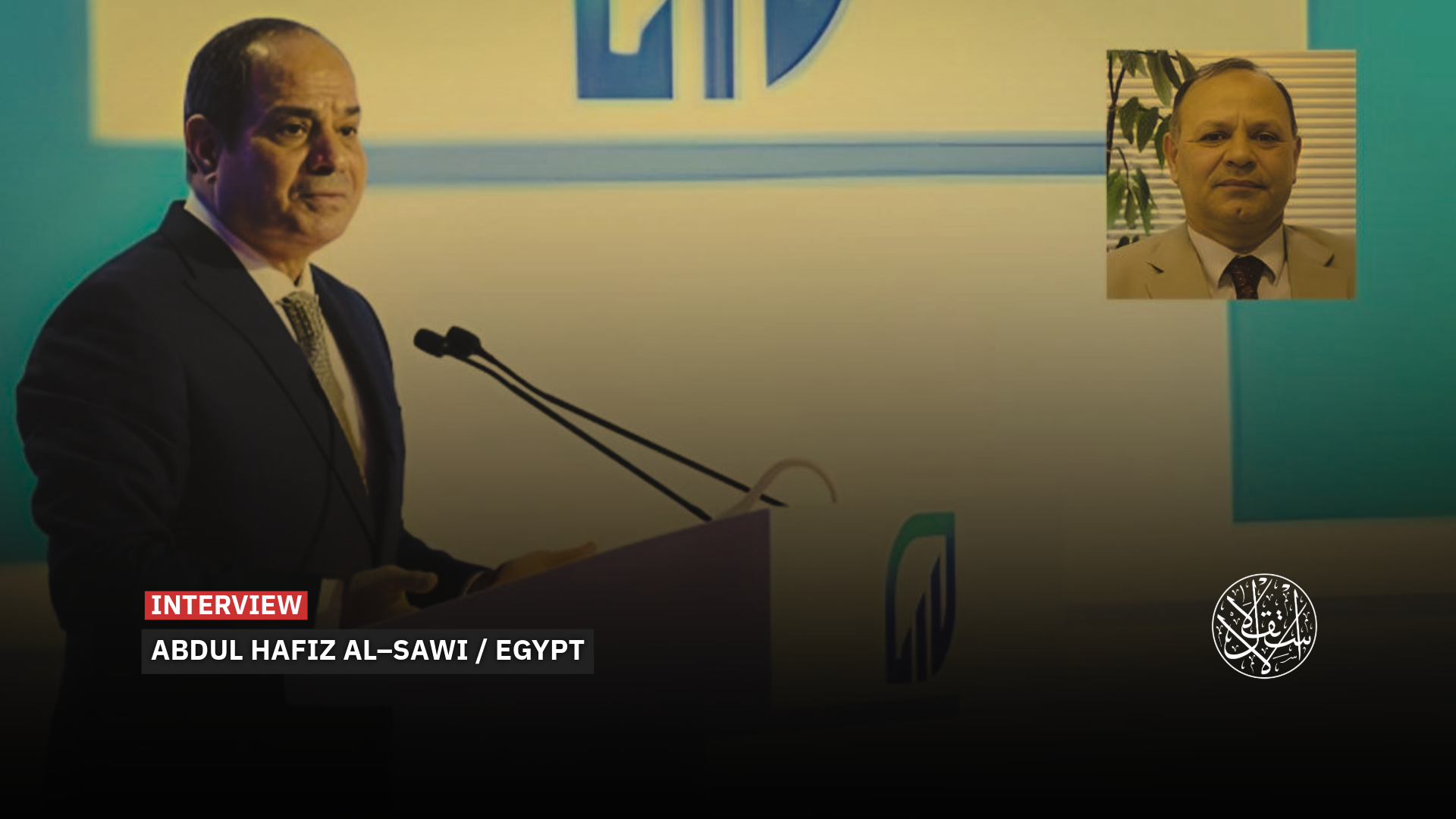
Egyptian economic expert Abdul Hafiz al-Sawi criticized the decision to reopen the famous Helwan Iron and Steel Factory, calling it a sign of confusion and inconsistency in the country’s economic policymaking after the plant was shut down in 2021.
In an interview with Al-Estiklal, al-Sawi stressed that the factory was never just an ordinary industrial facility. For decades, it symbolized the birth of Egypt’s industrial base and stood as an icon of heavy industry in the Arab world, making its closure a symbolic end to an entire era of Egypt’s industrial dream.
The Helwan Iron and Steel Company, founded in 1954 by then-President Gamal Abdel Nasser, was Egypt’s oldest public-sector company and the first iron and steel manufacturer in the Middle East. It was closed in 2021 under the head of the Egyptian regime, Abdel Fattah el-Sisi, after 67 years of operation.
“Now the factory is back in the spotlight, but in a way that reflects administrative confusion and randomness,” al-Sawi said.
He highlighted contradictory statements, recalling that Deputy Prime Minister and Minister of Industry and Transport Kamel al-Wazir announced plans to study converting the site into a textile and garment-supply industrial complex to attract foreign investment and reduce imports—only for regime directives to soon order the factory to resume steel production.
“How can a factory be closed for losses and inefficiency, then considered for textiles, and finally reopened for steel?” the expert asked, emphasizing that such shifts reveal a lack of strategic vision in managing Egypt’s industrial sector.
He warned that the sector’s future requires stable, long-term policies based on thorough feasibility studies, not ad hoc reactions or improvised solutions, or else Egypt risks further erosion of its remaining industrial capacity.
Abdul Hafiz al-Sawi, an economist who graduated from al-Azhar University in 1987 and earned a diploma in economic sciences from the Institute of Arab Research and Studies in 1999, is the author of several books analyzing the Egyptian and Arab economies and their transformations.
Chaotic Decision-Making
How do you explain shutting down the Iron and Steel Factory in 2021 as “loss-making and unviable,” only to later consider partially reopening it?
This flip-flop highlights the lack of coherent thinking and decision-making: a proper industrial strategy would have weighed alternative options, calculated costs, and then decided whether the factory should remain open or close.
The most serious concern is that iron and steel production remains a strategic industry that should never be compromised, yet the closure and subsequent reversal appear to have been made in a haphazard and ad hoc manner.
It seems the decision was made by someone lacking expertise in development, not necessarily the official tasked with narrow profit-and-loss calculations.
Another possibility is that the factory’s prior losses were deliberate, perhaps as a prelude to privatization and eventual sale.
If losses and massive debts shut it down, what’s changed to bring it back to life?
Several explanations have been floated for this sudden reversal. When the factory’s sale was first proposed, the land was slated for real estate development, but the buyer may have balked at the price or terms. Alternatively, the actual losses over the past five years may have far exceeded expectations, especially after dismantling machinery for scrap and selling off land. On top of that, the government shouldered hefty costs for laid-off workers, further deepening the financial hit.
Lack of Feasibility Studies
Where were the feasibility studies the regime claimed to rely on for the factory’s liquidation—and can they even be trusted if they exist?
Most observers of Egypt’s economic scene since the days of Hosni Mubarak, along with reports from the Accountability State Authority, know that virtually all government projects are carried out without any feasibility studies.
The absence of feasibility studies reflects a systemic issue in governmental planning: initiatives are undertaken and abandoned without proper analysis, leading to inefficiency, inflated costs, and repeated failures in infrastructure and other projects. Even foreign investors and business leaders evaluate opportunities independently, often distrustful of official reports.
How can a massive steel factory be restarted without a clear restructuring plan, a debt-resolution strategy, or a defined financing roadmap?
Operation and planning require a competent government and accountable oversight bodies, capable of explaining to Parliament why the factory is being restarted, along with a clear plan showing that public investments will yield returns and prevent corruption or further debt.
Unfortunately, under the current system, such strategic planning seems unlikely. Continuing on the same path, as the saying goes, will only produce the same results.
Empowering the UAE
Is the factory’s reopening a sign of the regime’s failure of strategic assets or the result of outside pressure from investors like the UAE?
Egypt’s investment climate currently faces major challenges, including the military’s dominant control over the economy and widespread corruption. The legislative framework is also far from transparent or democratic, meaning the pressure to reverse the factory’s liquidation stems from multiple factors, not only UAE interests.
For any investor, a critical consideration is energy availability, particularly natural gas, as steel production is highly energy-intensive. We’ve seen how Israel can control Egypt’s industries; when it cut off natural gas for weeks, key sectors, including fertilizer production, ground to a halt.
Is the goal of closing and then reopening the factory to orchestrate a “planned failure” scenario, clearing the way for Gulf investments in a strategic Nile-side location?
The proposed scenario of a deliberate failure, paving the way for the UAE or other Gulf investors to take control of a strategic site like the Iron and Steel Factory on the Nile, is a very real possibility.
As the saying of Imam Ali ibn Abi Talib goes, “Those who jump to conclusions should not blame those they mistrust.”
We have seen numerous investments, whether public or private, come under the control of the UAE, Saudi Arabia, and more recently Qatar, as well as other Gulf investors, all dominating these national projects despite their profitability.
Given the complete absence of oversight from government watchdogs, civil society organizations, or local communities, this scenario cannot be ruled out.
Between Sisi and the Minister
The regime says it wants to turn the site into a textile hub, so how does that square with Sisi’s later announcement about producing iron slabs there?
There’s no doubt that the glaring contradictions between Sisi’s statements and those of the transport minister expose sheer chaos in decision-making. There is no investment roadmap, no development roadmap, and no plan for building a serious industrial base in Egypt.
The contradictions in statements and decisions are simply the natural result of the chaos at the heart of the system. They also reveal something else: much of what Sisi and his officials say is little more than political showmanship, messaging designed to convince Egyptians that progress is happening, when the reality is closer to a mirage.
What losses did the state, workers, and the local community suffer from the factory’s 2021 shutdown, and who is responsible for this bleeding?
The costs were extensive. First, five full years of lost production. The factory wasn’t producing “zero”; it had an output—whatever its scale—and that output vanished overnight.
Worse still, domestic production was replaced by imports, a decision that raises clear suspicions of corruption, as such moves often benefit specific actors.
Then came the massive payouts to workers, early retirement packages, and compensation settlements, all added to the liquidation bill.
This leads to a crucial question: How will the factory be restarted now?
Will the workers who were compensated be brought back?
Or will the government hire entirely new staff with fresh contracts and pay grades, especially since this is a state-owned complex, not a private plant?
There’s also the issue of opportunity cost. For years, the site sat idle. No alternative industries were established. No real investment was made. The only thing that happened was what Egyptians call land banking (freezing the land in place so its market value quietly climbs).
Investor Reluctance
How can local and foreign investors take the government seriously when its policies are so full of contradictions?
Investors hardly need proof of the government’s lack of seriousness. The evidence is everywhere: the sweeping transfer of state assets to the sovereign fund, soaring public debt, total opacity, widespread corruption, street-level thuggery, and constant volatility in the exchange rate.
All of this drains investor confidence across the board.
No investor builds long-term plans based on government decisions, whether the state pushes ahead or backtracks on a project like the Iron and Steel complex. If investors believed the government was serious and its decisions credible, money and jobs would have flowed in already.
But they understand the truth: the current system in Egypt is anything but reliable, and trusting it would be a costly gamble.
Is Egypt’s economy guided by a long-term, strategic vision, or are major decisions driven by the whims of the ruler?
The last thing anyone can claim is that Egypt operates on long-term economic strategies. The country’s current crises are proof enough.
If there had been a serious strategy, say, to build a robust agricultural sector capable of ensuring food security and reducing wheat and grain imports, today’s reality would look very different.
Instead, the system operates in a manner far removed from any coherent plan or even a credible rescue tactic.
What we see now is little more than patchwork management of a broken economy, driven by the regime’s short-term preferences. It is a form of crisis governance best described as “winging it moment by moment.”