Political Expert: The UAE May Use the Yemen Issue as a Regional Pressure Tactic Against Saudi Arabia (Exclusive)
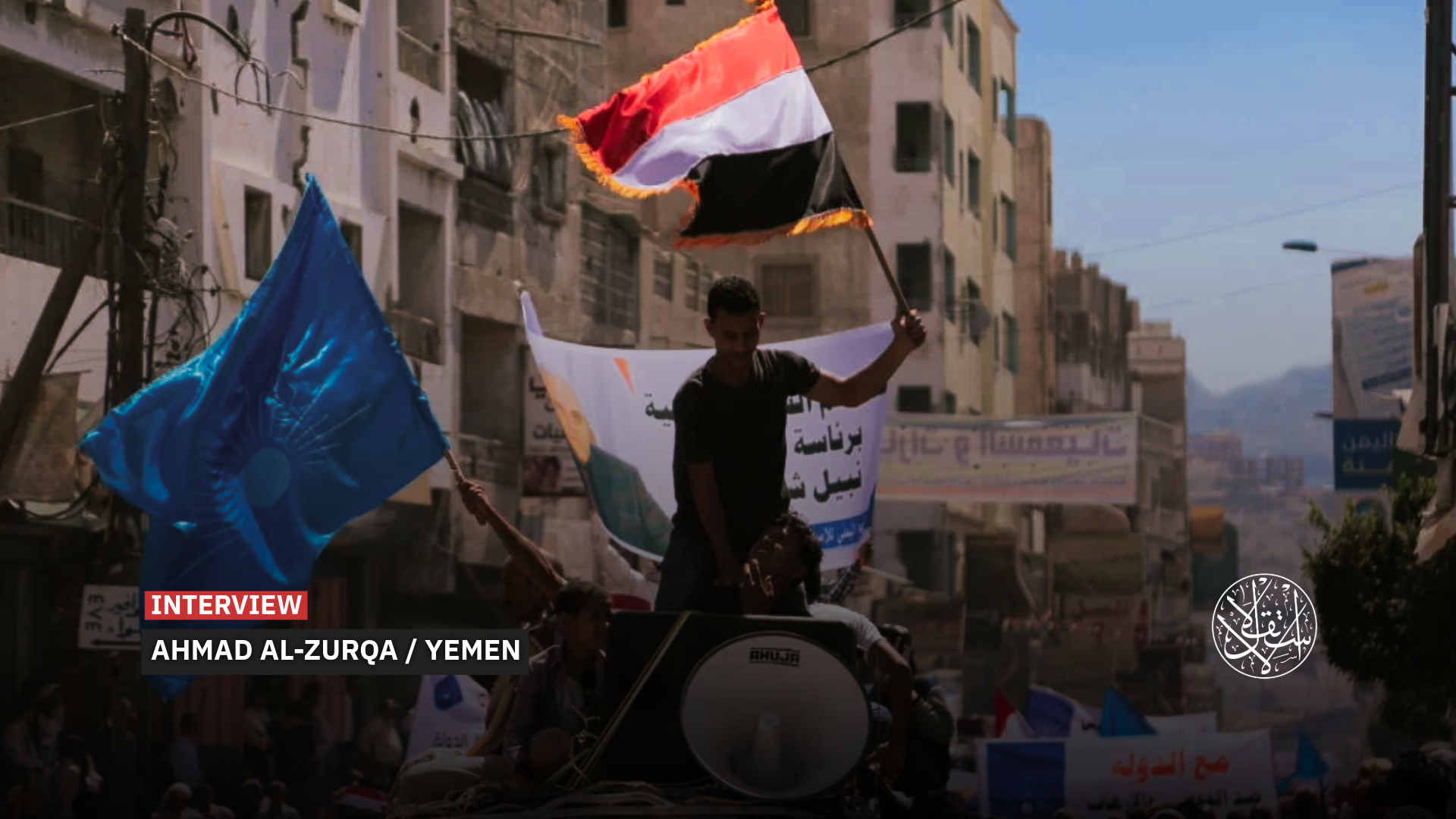
“The UAE has chosen to accelerate the implementation of its agenda on the ground in Yemen.”
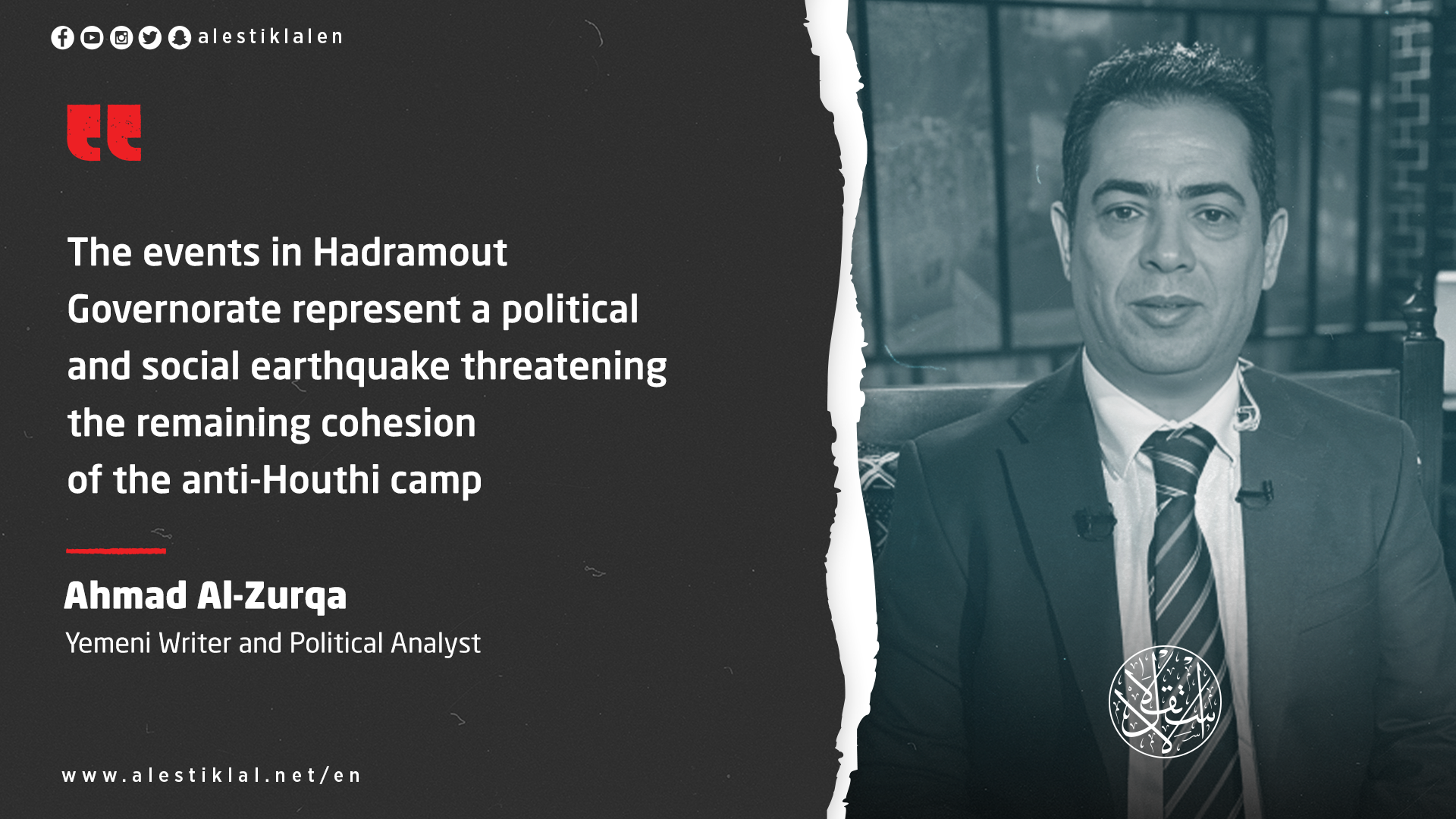
Yemeni writer and political analyst Ahmad al-Zurqa stated that the events in Hadramout Governorate transcend being a mere local incident, noting that they represent a political and social earthquake threatening the remaining cohesion of the anti-Houthi camp.
In an interview with Al-Estiklal, he emphasized that these developments have clearly exposed the fragility of the government, the Ministry of Defense, and the General Staff.
He pointed out that state institutions have often become merely symbolic and formal, while actual power is concentrated in the hands of armed groups.
He further noted that the embarrassment Saudi Arabia has faced in Hadramout is not a minor detail, as the Southern Transitional Council's expansion into the valley and desert has crossed sensitive security and political lines, and has openly raised the stakes.
He warned against the UAE using the Yemeni issue as a regional pressure tactic should disagreements arise with Riyadh on other matters.
He estimated that pushing Saudi Arabia into a military confrontation with the Southern Transitional Council in Hadramout or al-Mahra would mean opening a new front near its eastern borders, a highly dangerous scenario.
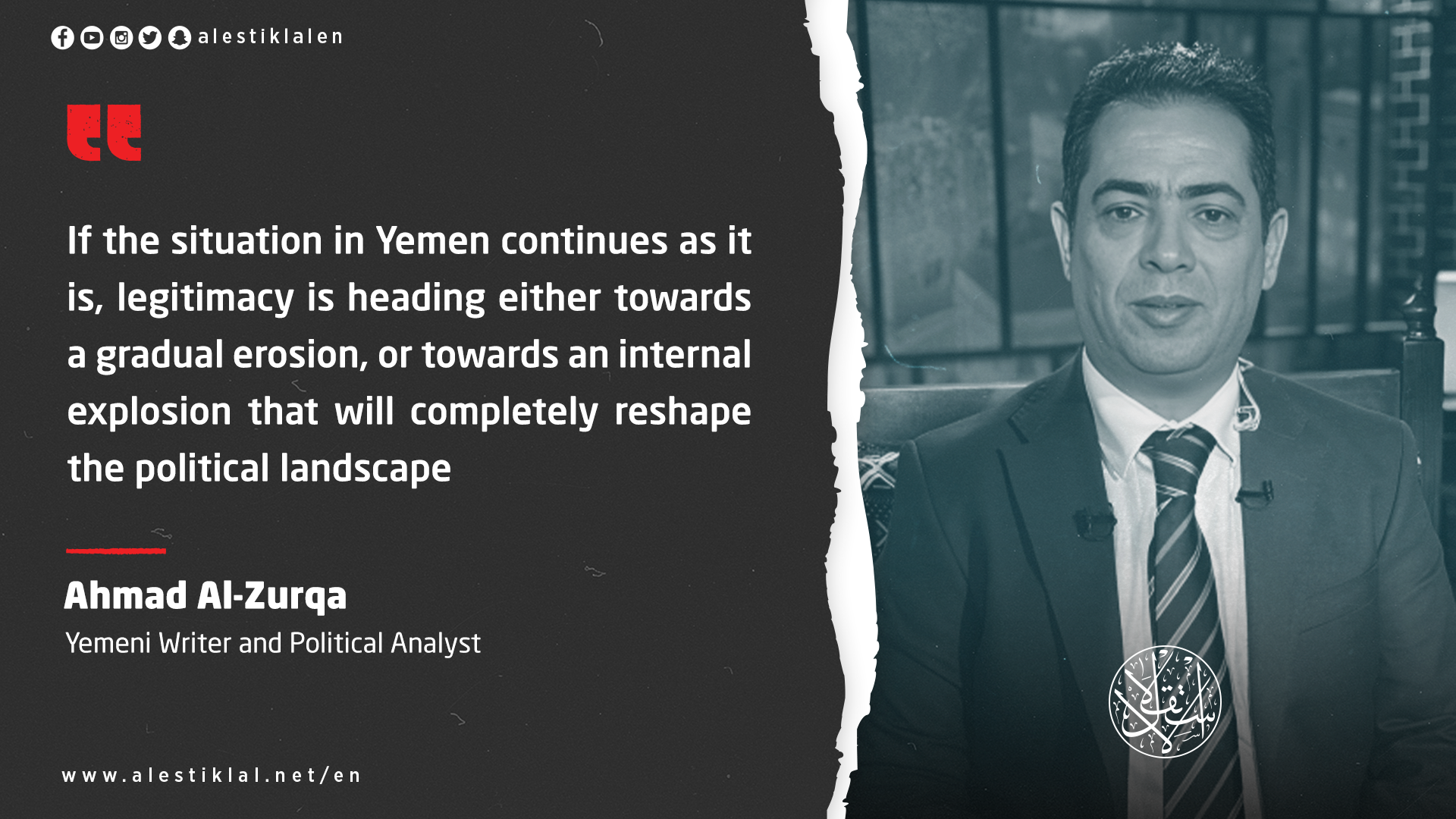
He emphasized that if the situation continues as it is, legitimacy is heading towards one of two bitter choices: either a gradual erosion until it becomes merely a formality devoid of the instruments of sovereignty, or an internal explosion that will completely reshape the political landscape.
Mr. Ahmad Al-Zurqa is one of the most prominent writers and political analysts in Yemen. He serves as the Director General of the Balqees TV channel and is known for his research on Islamic groups and political parties. He has contributed numerous articles and articles to Arab newspapers and websites.
Power Struggles
Do you believe that Saudi Arabia and the UAE are not in agreement regarding the new measures in Yemen, or is what is happening a division of roles aimed at fragmenting the country?
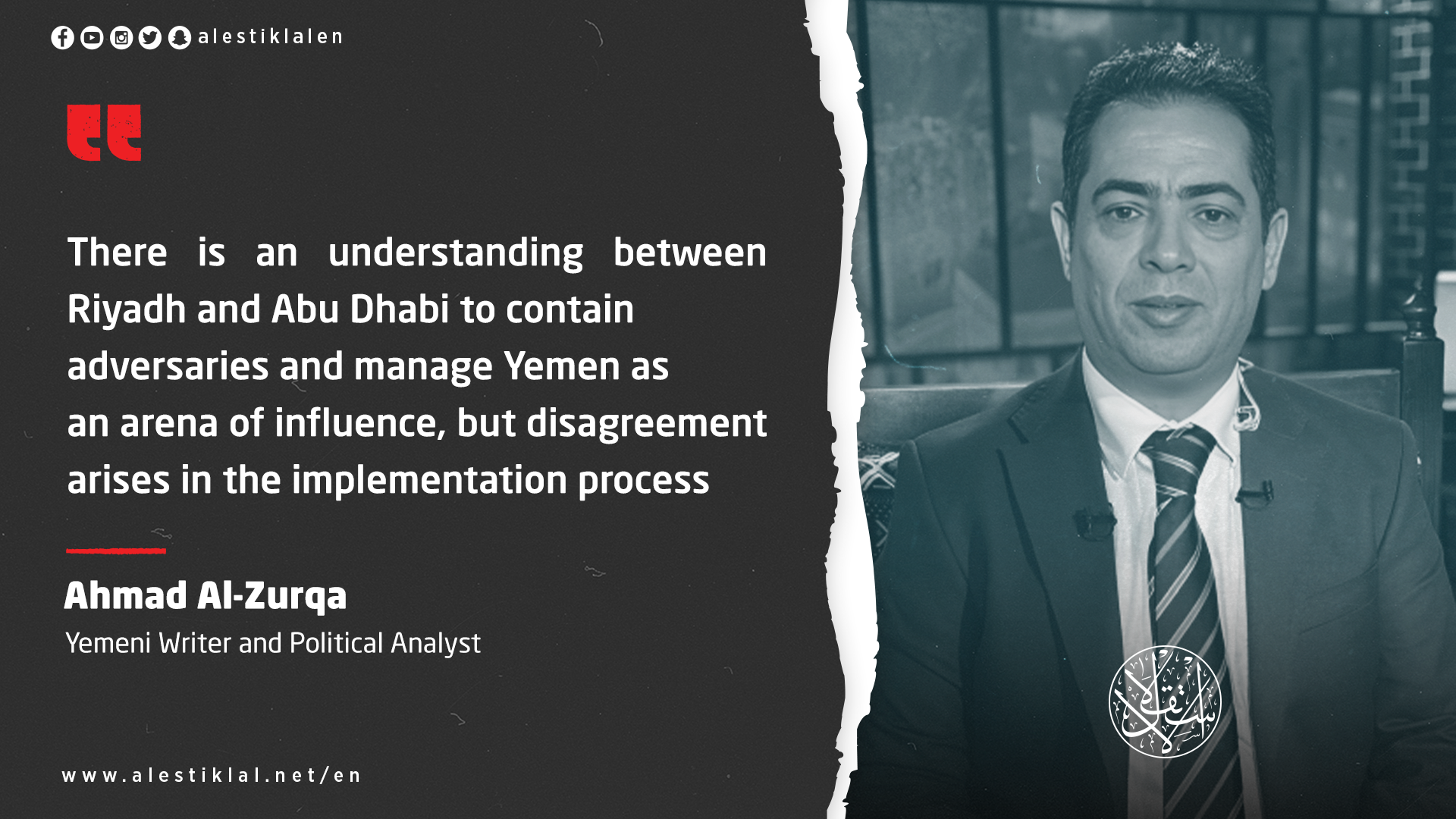
The situation is open to both interpretations. However, the more likely scenario is that there is an understanding on the major objectives, but this is countered by differences or disagreements regarding the mechanisms of implementation and the distribution of influence.
There is a general framework uniting Riyadh and Abu Dhabi based on containing adversaries, managing Yemen as an arena of influence, and preventing the establishment of a strong, independent Yemeni state.
But what is happening in Hadramout and Al-Mahra demonstrates that the UAE has chosen to accelerate the implementation of its agenda on the ground, particularly under the banner of combating the Muslim Brotherhood.
This slogan has practically become a cover for eliminating political opponents and building armed formations parallel to state institutions, rather than a genuine policy to combat extremism.
The embarrassment Saudi Arabia has faced in Hadramout is not a minor detail. The Southern Transitional Council's expansion into the valley and desert has crossed sensitive security and political lines, and has openly raised the stakes.
At this juncture, Riyadh seems to have discovered—albeit belatedly—that it has dismantled its traditional instruments within the legitimate government, while the UAE has expanded its investment in militias and political fronts within the Presidential Council and its surrounding circles.
As a result, the balance of power on the ground has shifted in favor of Abu Dhabi, while Saudi Arabia has borne the political and regional burden of the situation.
Has Saudi Arabia come to realize that a strong Yemen means the absence of militias and terrorist organizations?
In the absence of a clear strategy toward Yemen, Saudi policy has been characterized for years by a logic of crisis management and reactive measures, rather than one of forging a long-term political and security path.
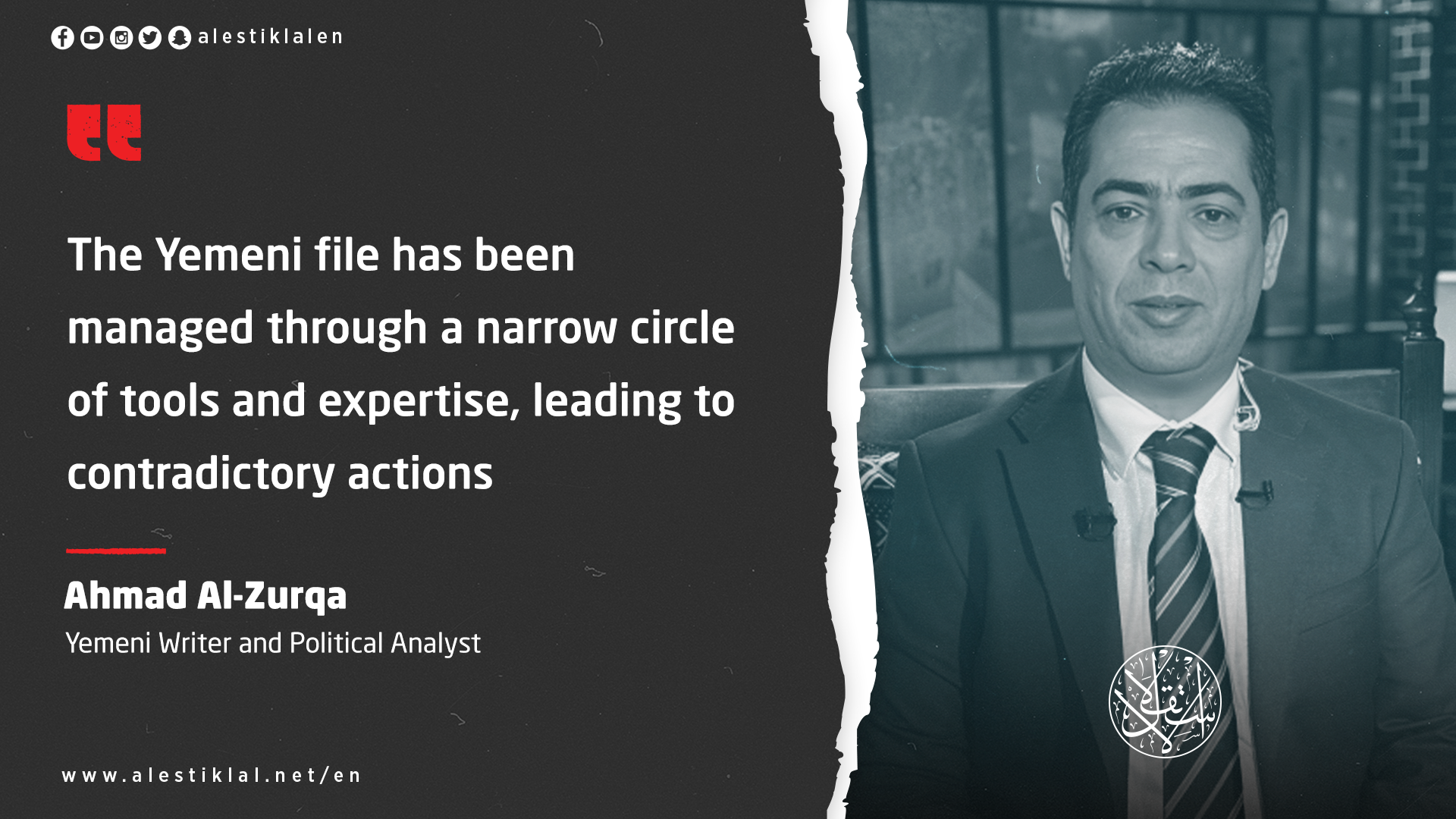
The Yemeni file has been managed through a narrow circle of tools and expertise, leading to contradictory actions: on the one hand, weakening the legitimate government's allies and paralyzing state institutions, and on the other hand, pursuing a bilateral settlement with the Houthis, bypassing the Yemeni state and the principle of restoring its authority.
The result is that Saudi Arabia has not produced a stable allied state, nor has it eliminated the threat of militias. Instead, it has contributed—intentionally or unintentionally—to expanding the arms economy and the influence of loyalties.
While Riyadh restricted its official allies, the UAE was building more disciplined and loyal formations, then providing them with political cover to transform them into instruments of control over cities, ports, and islands.
There have been reports of Saudi-Emirati communication aimed at restoring the status quo in Seiyun, Hadramout, and Al-Mahra. Will the Southern Transitional Council (STC) withdraw from these areas?
Withdrawal or retreat cannot be achieved through statements or superficial mediation. Unless Saudi Arabia exerts real and costly pressure on Abu Dhabi and its proxies, nothing fundamental will change on the ground.
The UAE may use the Yemeni file as a regional pressure tactic in any disagreement with Riyadh on other issues. Furthermore, pushing Saudi Arabia into a military confrontation with the STC in Hadramout or Al-Mahra would mean opening a new front near its eastern border—a highly dangerous scenario.
The STC currently possesses significant human, military, and financial resources, and is presented within the narrative of secession, while the reality points to an influence-peddling operation rather than a viable state-building project.
Therefore, a return to the status quo requires a clear Saudi decision: either a disciplined partnership with defined rules, or a halt to the gradual empowerment that is eroding legitimacy from within.
Political Earthquake
How do you interpret the repercussions of the STC's expansion in Hadramout on the overall Yemeni landscape?
What happened in Hadramout transcends being a local event; it is more like a political and social earthquake that threatens what remains of the cohesion of the anti-Houthi camp.
These developments have exposed the fragility of the government, the Ministry of Defense, and the General Staff, and confirmed that state institutions have often become merely symbolic, while actual power is concentrated in the hands of armed groups.
Is Yemen closer than ever to splitting into two states, a northern and a southern one?
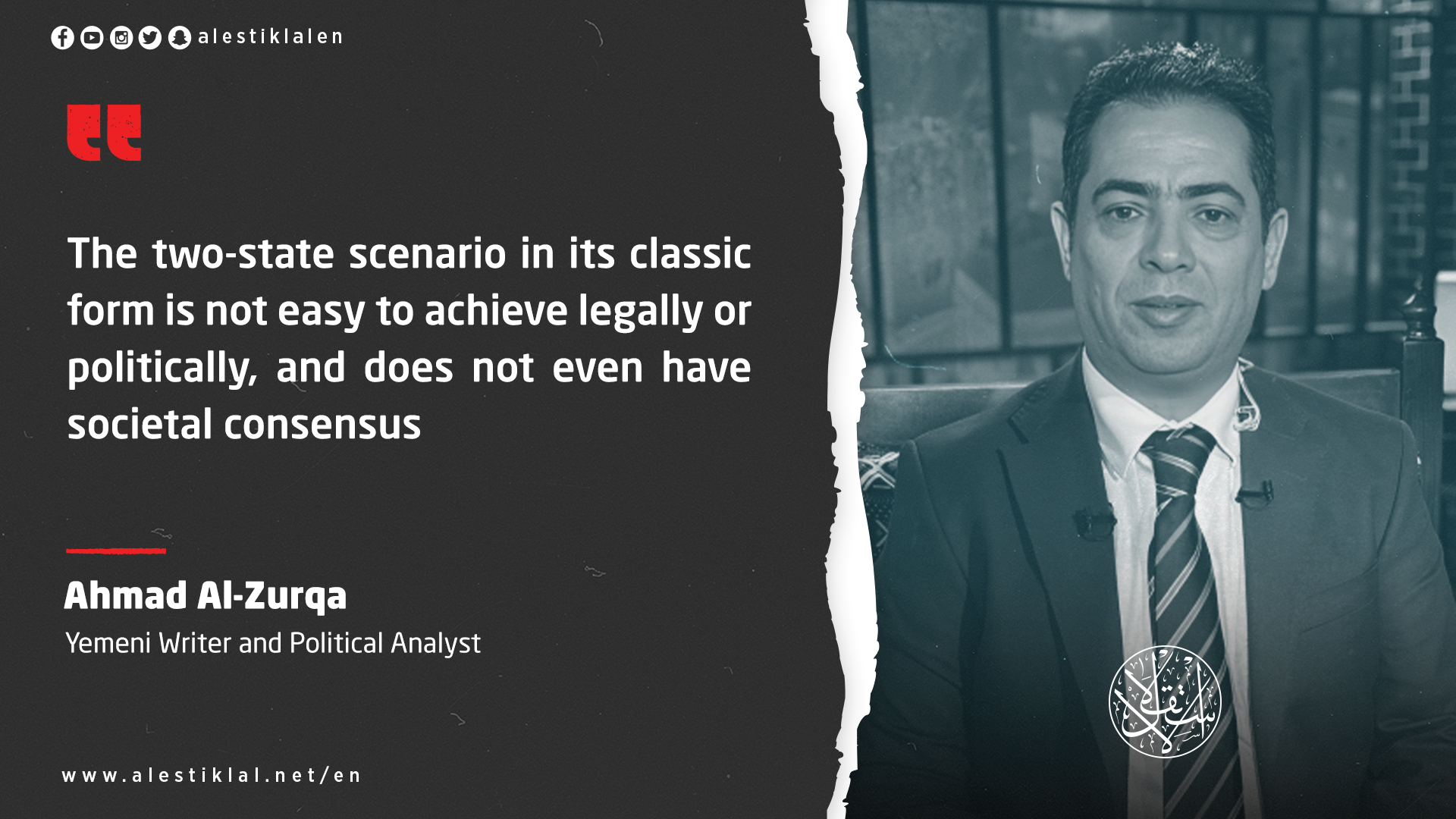
The two-state scenario, in its classic form, is not easily achievable legally or politically, and it lacks societal consensus, even within the south itself.
What we are approaching today is something far more dangerous: the de facto disintegration of Yemen into cantons of influence governed by weapons, foreign funding, and fragmented identities.
There are illusions among some separatist forces of restoring the pre-unity state, and illusions among the Houthis of restoring the pre-republican era, while there is widespread social and political resistance in the north, east, south, and west against secessionist projects.
In Hadramout and Al-Mahra specifically, popular and tribal sentiment tends to reject turning the governorates into arenas of external administration.
The realistic solution, if a comprehensive explosion is to be avoided, lies in a system of regions or a federation within a single state, with clear guarantees for power, wealth, and representation—not a two-state project that would produce a protracted border conflict.
Potential Repercussions
If this scenario materializes, will we be faced with a southern state under Emirati influence and a northern state under Iranian hegemony?
In Houthi-controlled areas, there is clear Iranian influence, while in areas under the control of the legitimate government, there is direct Saudi influence in specific sectors and regions, and direct Emirati influence in ports, islands, and certain formations, in addition to selective international interventions related to maritime security, energy, and counterterrorism.
The result is the absence of a national political center capable of imposing a unifying vision, and the Yemeni state remaining at a minimal functional level.
To what extent can the Houthi group exploit the divisions within the legitimate government's areas?
The Houthis are the primary beneficiaries of the legitimate government's fragmentation. Every conflict within this camp alleviates the military and political pressure on them, granting them time to reorganize their capabilities, strengthen security control, and ideologically mobilize.
Furthermore, the erosion of constitutional legitimacy and the multiplicity of decision-making centers have provided the Houthis with an opportunity to present themselves, in propaganda, as the most cohesive party.
Do you anticipate military or political moves by the Houthis in the coming period?
The possibility exists in the medium term. The Houthis consistently balance negotiation with calculated escalation, depending on the level of disarray among their adversaries.
Any further instability in Hadramout or Al-Mahra could reshape Saudi Arabia's priorities and potentially grant the Houthis greater room for maneuver.
What are the implications of these developments for the security of international waterways?
The world primarily deals with Yemen from the perspective of maritime security. The Bab al-Mandab Strait and the Arabian Sea are not merely economic details, but strategic chokepoints in global energy and trade.
Furthermore, Saudi Arabia's historical calculations regarding securing oil export routes through the Arabian Sea increase the sensitivity of the Al-Mahra region in particular.
Conversely, the unchecked control of ports and islands by local groups linked to external agendas could transform the Yemeni coast into an arena for regional and international competition, rather than a sovereign resource serving the Yemeni people.
Could Yemen become a permanent threat to regional and international security?
The absence of a functioning state, the proliferation of weapons, a war economy, and conflicting regional agendas could transform Yemen into a permanent source of threat, ranging from smuggling and maritime extortion to the expansion of extremist organizations and escalating local conflicts.
Even more dangerous is that this situation could become tempting for some parties as a tool for pressure and bargaining in broader regional issues.
The International Community
To what extent can the international community accept the collapse of legitimacy or the division of Yemen?
The international community tends to manage Yemen at a minimum: neither a complete collapse nor a radical solution.
Officially legitimizing the division is a highly sensitive issue, so the de facto fragmentation may be managed without legal recognition, focusing on issues such as maritime navigation, terrorism and energy.
Is there an international duality between the rhetoric supporting Yemeni unity and the practical actions taken?
Official rhetoric speaks of Yemeni unity, while practical actions deal with local proxies, reward armed control, and ignore the erosion of institutions.
This duality weakens the concept of the state and encourages warlords to expand their influence, ultimately leaving Yemenis to bear the brunt of the consequences.
How do you assess the role of regional states, particularly the Gulf states?
The regional role can be characterized on three levels:
The First relates to national security and borders, especially for Saudi Arabia, and focused on managing the threat rather than building the state.
The Second relates to maritime influence and the political economy of ports and islands, prominent in Emirati policy.
The Third relates to broader regional competition, where Yemen is managed as an arena within a larger struggle over waterways, energy, and international positioning.
The problem is that these roles were not designed to serve the stability of Yemen as a state, but rather to serve the interests of the countries involved, as they perceive them, which keeps Yemen fragile.
Radical Reform
Is the Presidential Council still capable of fulfilling its role?
The Presidential Council, in its current form, suffers from a structural flaw represented by the multiplicity of decision-making centers and the absence of a unified executive authority. It is more of a framework for bringing together competing factions than an actual command center.
With the expansion of armed groups, the value of the Presidential Council as an institution diminishes, and it becomes a political facade for decisions made outside the state.
What is the future of legitimacy if this trajectory continues?
If the situation continues as it is, legitimacy is heading towards one of two bitter choices: either gradual erosion until it becomes merely a formality without the instruments of sovereignty, or an internal explosion that reshapes the political landscape.
Radical reform requires unifying military command, ending the duplication of security agencies, reactivating institutions, drying up the war economy, and building a genuine national political contract.
What will become of the vast population living in dire humanitarian conditions?
This is the silent catastrophe. When the state is reduced to mere shells, the citizen becomes the weakest link: the collapse of services, the devaluation of the currency, the disintegration of education and healthcare, and the expansion of the informal economy.
Over time, society itself changes, jeopardizing any real chance of restoring the state, even if the war were to end militarily.
Are you afraid that Yemen will descend into a wider civil war?
Yes, and the danger doesn't come from the Houthis alone, but also from the conflicts within the legitimate government itself.
The proliferation of weapons and the absence of a national authority capable of enforcing the law make any friction liable to escalate into a protracted series of confrontations.
In conclusion, I address a message to the Yemeni political forces: “Stop governing Yemen with a spoils-of-war mentality. The state is not a job or a quota. Without a clear national project based on a unified state, law, and army, you are not issuing political statements; you are writing the death certificate of the future.”
I also address a message to the countries of the region: “Your interests will not be protected in the long run by a weak Yemen and multiple militias. A strong Yemeni state is not a threat to anyone; rather, it is a guarantee for borders, waterways, and the economy.”
To the international community: “You cannot speak of maritime security while turning a blind eye to the dismantling of the very state that is supposed to protect it. Double standards in Yemen will not bring peace.”