Exclusive: Egyptian Human Rights Activist: Amendments to the criminal Procedure Law Reinforce Repression, Not Justice Reform

Mahmoud Gaber, director of the human rights organization Justice for Human Rights (JHR), said, "head of the regime Abdel Fattah el-Sisi’s objection to only eight articles of the proposed criminal procedure law reflects an extremely partial view, one that does not come close to addressing the core crisis embedded in the law’s very philosophy."
In an interview with Al-Estiklal, Gaber explained that "the real danger does not lie solely in certain articles concerning pre-trial detention or questioning without a lawyer present, but in the overall legislative framework that grants the executive branch supremacy and expands the powers of investigative authorities at the expense of fair trial guarantees."
The draft law was submitted to parliament on September 28, 2025, while el-Sisi’s objections focused on key provisions relating to the sanctity of private homes, the regulation of pre-trial detention, judicial notifications, and the interrogation of suspects in cases of necessity. He argued that the bill did not grant the public prosecution sufficient powers compared with those already accorded to judicial police officers, meaning essentially the security apparatus.
He also rejected the clause that limits the detention of suspects in certain cases without a reasoned judicial order or a maximum detention period, which, according to experts, is an attempt to keep the door open for indefinite pre-trial detention under the guise of security needs.
"The so-called formal amendments they talk about will not address the fundamental loopholes. We are faced with provisions that restrict the right to defense and public hearings," Gaber added.
He continued, "They also implicitly provide immunity for torture practices, and expand the justifications for pre-trial detention using vague terms such as 'serious disruption of public order.'"
The Justice for Human Rights director emphasized that "any genuine reform cannot be achieved through top-down decisions or partial proposals. It must be based on a societal dialogue involving civil society organizations, bar associations, and legal experts to draft balanced provisions that restore the presumption of innocence and ensure equality between prosecution and defense."
“Passing the draft law in its current form will not modernize the justice system, but will merely cement the repressive policies that have sent thousands of detainees to Egyptian prisons arbitrarily over the years,” Mahmoud said.
Mahmoud Gaber, an Egyptian human rights lawyer born in 1975, graduated from Alexandria University’s Faculty of Law, has been active in the Egyptian human rights field, and currently serves as director of Justice for Human Rights and its official spokesperson.
The organization describes itself as an independent, non-profit human rights body focusing on Egyptian affairs, committed to documenting and reporting on the state of human rights in Egypt.
Reasons for Revisiting the Law
Why has the presidency of the Egyptian regime returned the draft criminal procedure law to parliament at this moment?
From the moment the draft was made public, it was riddled with constitutional and legal concerns over the wording of several of its articles, naturally sparking both domestic and international human rights pressures.
As such, the decision to return it to parliament cannot be separated from the regime’s attempt to contain these criticisms at home and abroad before pushing it through definitively.
While the constitution does grant the president the right to veto laws within thirty days of receipt, and there may indeed have been genuine constitutional concerns, the political motives are impossible to ignore, particularly amid escalating human rights tensions and mounting pressure from Europe and the United States.
In fact, it seems the political dimension outweighs any legal considerations, especially given a regime that has never truly adhered to the rule of law or respected the constitution in the first place.
Do we see this move as positive, and could it have any lasting impact on Egypt’s deteriorating human rights record?
If approached seriously, there is no doubt that it could mark the start of meaningful improvements, but if it amounts to nothing more than cosmetic tweaks, it will have no tangible effect on the ground.
Given the current human rights context, political calculation is likely to prevail, with the law being passed in a cautious form while repressive practices remain untouched.
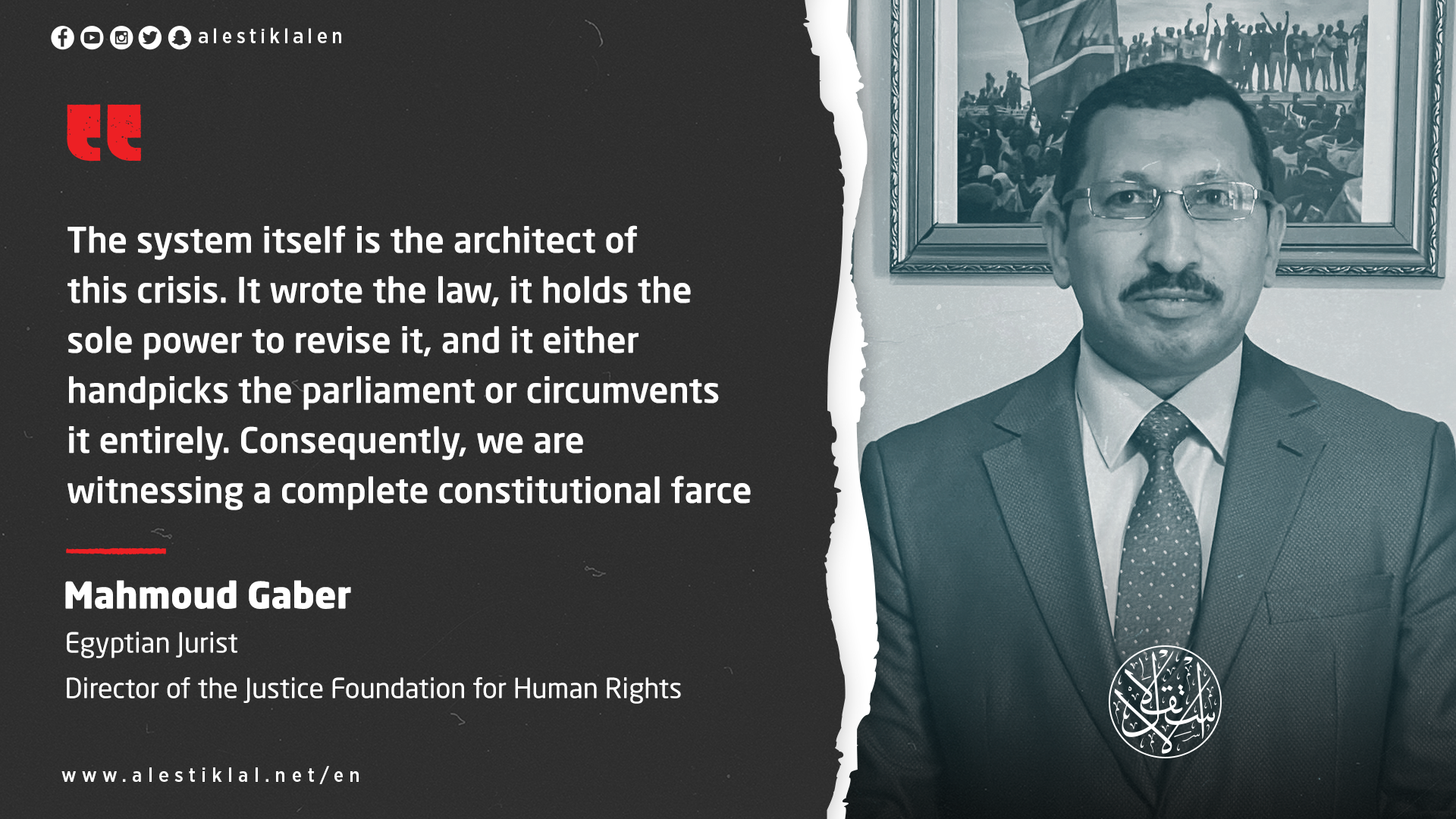
What is most important, however, is to recognize that the regime itself is at the heart of the crisis; it drafts the law, amends it, enacts it, or returns it to parliament, leaving the country trapped in a state of systemic dysfunction.
The principle of separation of powers, meant to guarantee genuine justice, is deeply flawed; the executive so thoroughly dominates the legislature that these proceedings become little more than a theatre, entirely disconnected from any real reform of the justice system or the human rights situation.
Landmines in the Draft
Which provisions in the criminal procedure bill do you see as the most dangerous for citizens’ rights, and why?
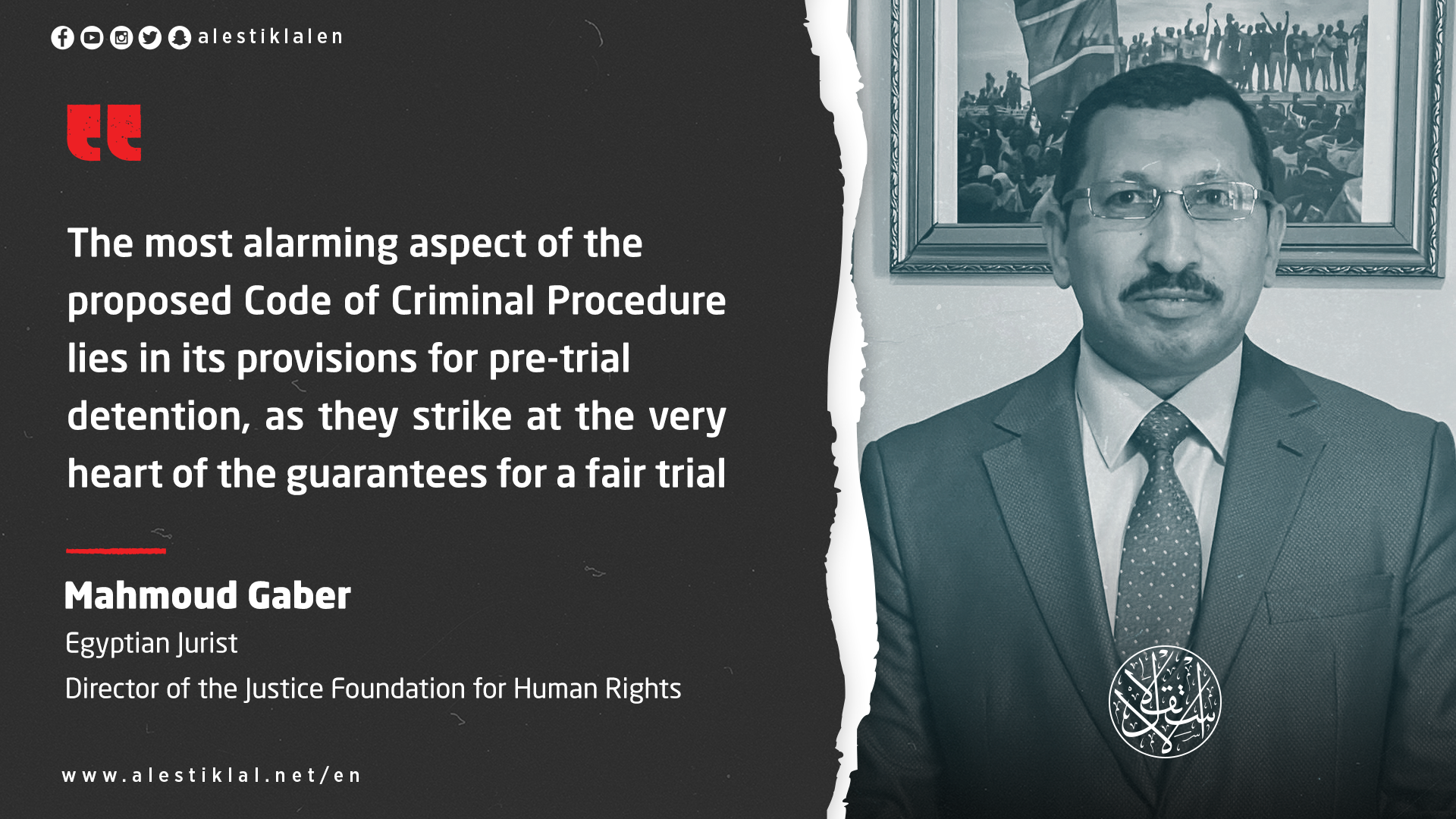
The most dangerous aspects of the draft criminal procedure law are the provisions related to pretrial detention, because they strike at the very core of fair trial guarantees.
Any clause that allows prolonged detention, asset seizures, surveillance, travel bans, or remote trials without strict judicial oversight effectively becomes a tool for violating citizens’ fundamental rights.
We are talking about more than 540 articles that carry real hazards, ranging from expanded restrictions on freedoms and increased repression of detainees to measures that undermine the very nature of ordinary justice.
This includes denying defendants the right to appear before a court and relying instead on virtual trials conducted online, with judges sitting behind screens while defendants and their lawyers remain behind prison walls.
Such provisions constitute an explicit erosion of the idea of justice, striking at the principles of public hearings and the right to defense.
Perhaps most alarmingly, the law grants military prosecutors powers equal to those of civilian prosecutors, effectively militarizing the judiciary and expanding the army’s influence over the judicial system.
In addition, the bill gives the public prosecution and police free rein to raid and search homes without judicial permission, directly contradicting basic constitutional safeguards.
By granting such sweeping powers to the prosecution, judicial oversight of investigations becomes largely symbolic and weak, upsetting the balance between the branches of government and turning the prosecution into an entity more loyal to the executive than to independent judicial principles.
Ultimately, the draft enshrines a system that codifies repression and extinguishes any hope of fair trials in Egypt.
Judicial Policing
What is your view on the provisions expanding judicial policing and granting new officers and actors powers that could be exploited arbitrarily?
If the regime is serious about genuine reform, the first step must be to clearly define which bodies are authorized to exercise judicial policing powers, and to tie those powers to direct and effective judicial oversight, preventing them from being granted to officers or agencies operating outside the authority of the judiciary.
The absence of such controls leaves the door wide open to unchecked abuses and violations.
The second priority is to activate the oversight of the public prosecutor and his deputies over prisons and detention facilities, a practice almost entirely absent in Egypt, despite being one of the most basic safeguards in any judicial system that respects itself.
The law should require the prosecution to carry out regular, unannounced inspections, and oblige prison administrations to submit transparent reports on detainee conditions.
Technical monitoring tools widely used around the world should also be introduced, such as installing surveillance cameras in detention areas and recording interrogations in full, both audio and video, to eliminate any opportunity for coercion, torture, or pressure on defendants beyond the reach of judicial scrutiny.
These mechanisms are standard in many countries and require no major legislative changes, only political will.
In addition, the National Council for Human Rights must be granted genuine, not symbolic, powers to conduct on-the-ground inspections of detention centers and prisons.
More importantly, space must be opened for independent civil society groups and national and international human rights organizations to fulfil their role as true monitors and guarantors.
These institutions are not enemies of the state, but partners in ensuring justice and transparency.
Finally, no discussion of judicial reform or a balanced legal system can be credible without enforcing accountability and ending impunity.
Unless those responsible for violations are held to account, every amendment will remain ink on paper, and the abuses will continue without end.
Media Celebration
How do you interpret the media and rights-focused celebration (closely aligned with the state) of the criminal procedure bill at its inception?
This brings us back to the fundamental question: was the decision to return the criminal procedure law to parliament driven by genuine legal concerns, or purely political ones? In my assessment, the political motive clearly dominates.
The media and parliamentary celebration that accompanied the move was little more than an attempt to project the image of legal reform at a time when the state faces mounting international and human rights pressures.
The reality, however, is that nothing substantial is likely to change on the ground. Consider, for example, the statements made by the Speaker of Parliament, Hanafy el Gebaly, in April 2025, following the law’s initial approval.
He declared that the parliament had “enacted modern legislation befitting Egypt’s stature and the ambitions of its people,” sparking a wave of media fanfare.
Then, five months later, when head of the regime el-Sisi returned the law to parliament in September, the same man stated that the president’s decision “reflects a commitment to ensure legislation is built on solid foundations of clarity and rigor, without allowing the demands of swift justice to override guarantees of freedom,” once again accompanied by a new wave of public celebration.
How can the contradictions of parliament and its alignment with Egypt’s authoritarian current be explained?
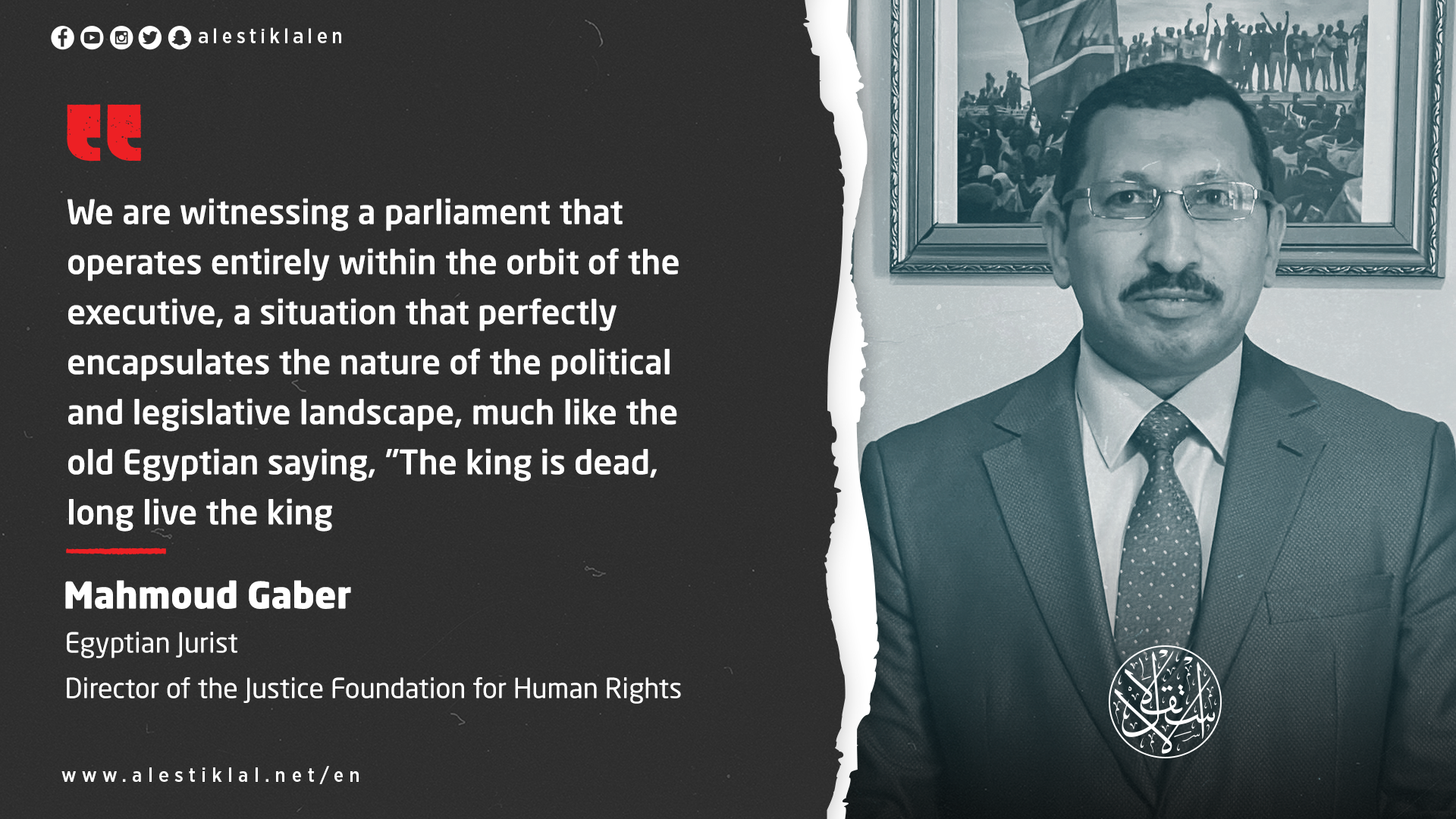
This stark contradiction encapsulates the nature of Egypt’s political and legislative landscape; we are faced with a parliament orbiting the power center, much as one might say, “the king lives, the king dies.”
In other words, positions are not based on independent legal assessment or genuine oversight, but on the desires of the head of the executive.
As a result, talk of serious legal reform remains an illusion, so long as the regime is the one that drafts the law, returns it, and celebrates it, while independent institutions are entirely absent from any meaningful role.
Where is the Solution?
In your view, will parliament be content with cosmetic amendments, or will it dare to implement substantive changes that respect the constitution and human rights?
The most likely outcome is that we will see only cosmetic amendments, unless substantial popular pressure or strong interventions from independent international, judicial, or human rights bodies force genuine changes.
The expected scenario is that the president’s objections will be referred back to the parliamentary general committee, which includes the heads of specialized committees and party representatives, to review the contested articles and produce a rapid report for presentation to the full assembly.
Yet, the core of the crisis lies in how the law itself is approached. Its approval after presidential objections requires the consent of two-thirds of lawmakers, and after the formation of a special committee to revisit and redraft certain provisions, the bill will be presented again as if following a normal legislative process.
In reality, we are confronted with what might be called a “mini-constitution,” a practical translation of constitutional guarantees of rights and freedoms into vaguely worded, elastic provisions that open the door to widespread violations.
Take, for instance, the clauses allowing the interrogation of a suspect in the absence of a lawyer under the pretext of urgency or necessity.
These are not safeguards of justice, but legal loopholes that effectively legitimize the breach of fundamental defense rights.
I therefore see no real political will for reform, only an attempt to present the law in a superficially acceptable form domestically and internationally, while its substance remains designed to curtail freedoms and expand state powers at the expense of individual rights.
Finally, how can any new amendment to the law be judged as a genuine reform?
First, it must be emphasized that the Criminal Procedure Code is among the most critical and consequential laws in any state, serving as the true safeguard for fair trials.
Undermining it, or drafting it defectively, effectively dismantles the entire judicial system, since the law governs every aspect of defense, detention, investigation, and trial.
Any serious reform must therefore begin with respect for citizens’ constitutional rights, guaranteeing fair and transparent trials, and actively involving independent civil society organizations, bar associations, and legal experts in shaping the text.
The law must align with international human rights standards, rather than serving as a legal veneer for repressive practices.
Yet, the reality is starkly different. Tens of thousands of detainees languish in Egyptian prisons for years without fair trials or proper judicial procedures, held as hostages to decades of political vengeance.
Every month, Justice Egypt receives letters from inside prisons such as Badr 3, detailing appalling conditions: denial of healthcare, prolonged solitary confinement, and both psychological and physical torture, with many prisoners living under constant threat of death.
These realities alone starkly demonstrate that the regime has no genuine interest in resolving the human rights crisis, whether through amendments to the Criminal Procedure Code or otherwise, because those who drafted the law are the very ones enforcing these policies, and those with the power to amend or resend it to parliament are the same actors perpetuating the system of repression.
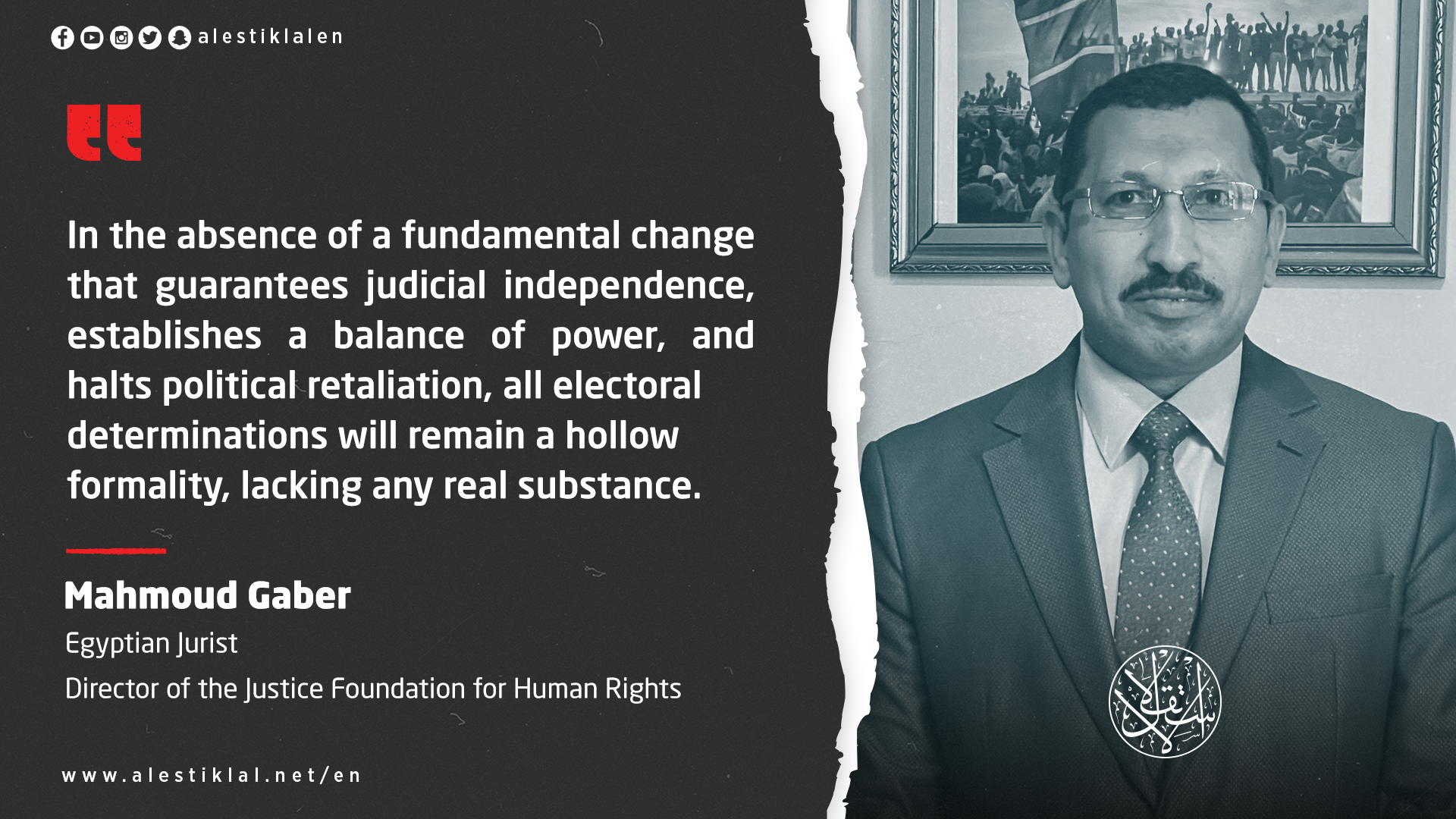
Thus, unless there is a radical shift guaranteeing judicial independence, rebalancing powers, and halting political vengeance, any amendments will remain mere formality without substance.